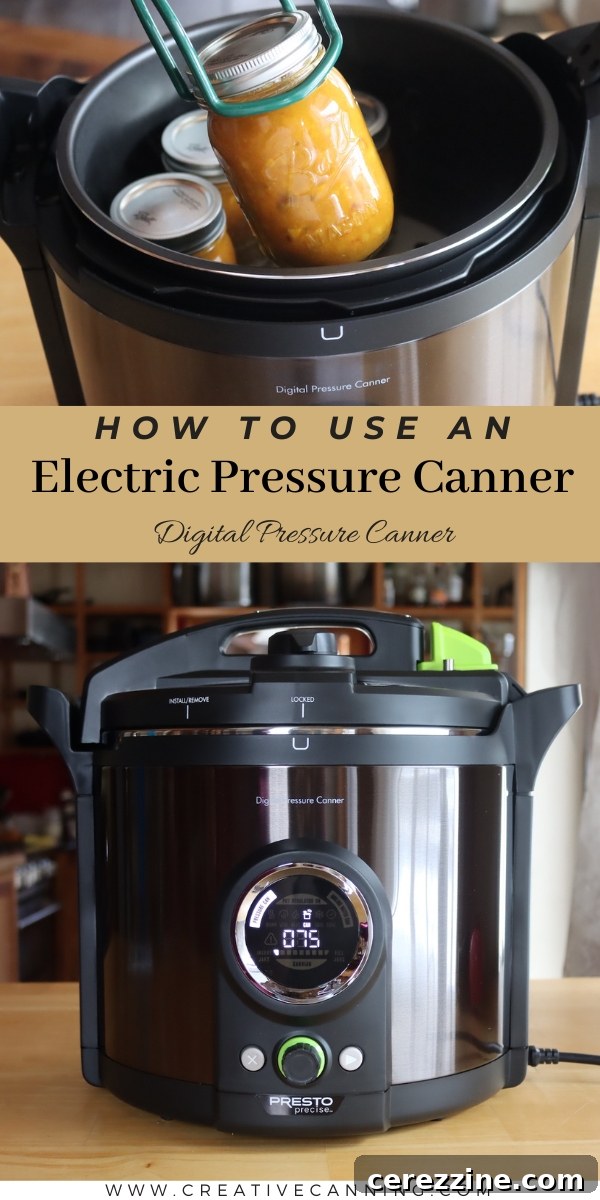
In the evolving world of home food preservation, a truly revolutionary innovation emerged in 2020: the electric pressure canner. Designed to transform the often intimidating process of pressure canning into a straightforward, automated task, these appliances have quickly become a game-changer for both novice and experienced canners alike. With an electric pressure canner, much of the complexity is handled by the machine itself, leaving you with the simple task of preparing your food, loading the jars, and patiently awaiting the perfectly preserved results.
For many, the thought of pressure canning conjures images of bubbling stovetop pots, hissing weights, and the underlying anxiety of maintaining precise pressure. I distinctly recall my own apprehension when I first fired up my traditional stovetop pressure canner over a decade ago. The entire process felt like a delicate dance on a knife’s edge, my mind constantly racing with worries about potential mishaps or, worst of all, forgetting a crucial step.
Over the years, as I’ve processed thousands of jars of homegrown produce and homemade meals for my family – easily exceeding 1,000 jars annually – the routine has become second nature. Yet, that initial learning curve was steep, peppered with moments of forgetfulness and minor fiascos. My husband still vividly recounts the time we initiated a canning batch only to discover the pressure regulator weight was still inside the canner! A frantic search ensued, followed by the tedious process of cooling down, unloading, and restarting everything from scratch. These experiences, while now humorous in retrospect, highlight the inherent complexities and potential for human error in traditional pressure canning.
The culinary world experienced a similar paradigm shift with the introduction of the Instant Pot in 2010. Its “set it and forget it” approach to pressure cooking captivated millions, making once-daunting recipes accessible at the touch of a button. However, despite its pressure-cooking prowess, the Instant Pot is fundamentally different from a pressure canner. Many aspiring home canners have mistakenly assumed their Instant Pot could safely preserve food, only to learn a critical lesson: canning in an Instant Pot is not a safe practice.
The core issue lies in the Instant Pot’s inability to maintain the precise and consistent temperatures essential for safe pressure canning. Unlike pressure cooking, which simply requires a general pressure range to cook food quickly, pressure canning demands strict adherence to specific temperature and pressure levels to destroy harmful bacteria, particularly Clostridium botulinum. Furthermore, Instant Pots do not perform the vital initial venting process, which is necessary to expel air from the canning chamber and ensure uniform heat distribution for effective sterilization. These limitations mean that, regrettably, you cannot safely pressure can food in an Instant Pot or similar multi-cookers.
Fortunately, the frustration of these limitations gave way to excitement with the arrival of dedicated electric pressure canners. The release of the automatic Presto Precise Digital Pressure Canner was a monumental moment for the home canning community. This innovative appliance combines the intuitive, button-press ease of an Instant Pot with the critical ability to accurately maintain and adjust ideal canning pressures. It’s truly the best of both worlds.
What sets this appliance apart is its intelligent design, which guides users through every stage of the canning process. This integrated prompting system significantly minimizes the chance of forgotten steps, a common pitfall for beginners and even experienced canners. Once initiated, the Presto Digital Pressure Canner independently manages pressure levels, eliminating the need for constant monitoring and manual adjustments. As a passionate home canner with over a decade of experience and a collection of three traditional pressure canners, I can confidently say that this electric model has completely won me over. I envision this technology not just as an improvement, but as a revolution that will introduce the timeless art of food preservation to an entirely new generation of enthusiasts, making it more accessible and less daunting than ever before.
Pros and Cons of Electric Pressure Canners: A Balanced Perspective
While I encourage you to delve into my comprehensive review of the Presto Digital Pressure Canner for an in-depth analysis, here’s a concise overview of the primary advantages and disadvantages associated with these modern canning marvels:
Advantages of Electric Pressure Canners
- Frees Up Stovetop Space: Unlike traditional canners that monopolize a burner, electric models operate independently, allowing your cooktop to remain available for other culinary tasks. This is particularly beneficial in smaller kitchens or during busy cooking sessions.
- Automated Operation: The canner guides you through each step and automatically manages the processing, virtually eliminating the risk of forgetting a critical stage or mismanaging pressure. It’s truly a “set it and forget it” experience, once loaded.
- Accurate and Automatic Pressure Maintenance: This is arguably the most significant benefit. The built-in sensors and intelligent controls ensure that the precise pressure required for safe canning is consistently maintained throughout the entire processing time, without any manual adjustments.
- No Altitude Adjustments Necessary: A major relief for canners living at higher elevations! Electric pressure canners automatically compensate for altitude, ensuring your food is always processed safely and effectively, regardless of your geographical location. This simplifies recipe adherence immensely.
- Whisper-Quiet Operation: Say goodbye to the rhythmic jiggling and hissing of stovetop canner weights. Electric models operate silently, creating a much more peaceful kitchen environment during long canning sessions.
- Enhanced Safety Features: Equipped with multiple fail-safes, including automatic shut-offs and physical locking mechanisms, these canners significantly reduce the risk of accidents, providing peace of mind to users.
- Superior Insulation: The well-insulated design means that external heat dissipation is minimal. Your kitchen stays cooler, even during extended canning processes, making it a more comfortable experience, especially in warmer climates.
- User-Friendly Interface: Designed with simplicity in mind, electric pressure canners are as easy to operate as popular electric pressure cookers, making them highly approachable for beginners.
- Reduces Intimidation Factor: For many, the perceived danger and complexity of traditional pressure canning are major deterrents. Electric models, with their automated safety features and guided process, remove much of this fear, making home preservation more accessible.
Disadvantages of Electric Pressure Canners
- Limited Capacity: Most electric pressure canners currently available on the market offer a smaller capacity compared to large stovetop models, typically accommodating 5 quarts or 8 pints at a time. This might necessitate multiple batches for larger harvests.
- Audible Alerts at Each Step: While helpful for guidance, the consistent beeping at every stage of the process can be perceived as slightly annoying by some users, especially if they are already familiar with the steps.
- Extended Cool-Down Period: Due to their excellent insulation, electric canners retain heat very effectively, leading to longer natural depressurization and cooling times. While this is beneficial for food safety, it means you’ll need to wait longer before safely opening the canner and removing your jars.
Exploring the Landscape of Electric Pressure Canners
When I initially embarked on my research to compare various electric pressure canners, I anticipated a diverse range of models and functionalities. However, my exhaustive investigation revealed a surprisingly limited selection of appliances that genuinely meet the rigorous USDA guidelines for safe pressure canning. As of my detailed assessment, only two prominent models currently stand out in this critical category. To provide the most accurate insights, I acquired both the Nesco/Carey Digital Pressure Cooker and Canner and the acclaimed Presto Precise Digital Pressure Canner, subjecting them to extensive testing in my own kitchen.
The Presto model proved to be an absolute pleasure to use. I was able to successfully initiate a home pressure canning batch within minutes of unboxing it. Its intuitive design and automatic features made the entire process seamless and incredibly user-friendly, cementing my strong endorsement of this appliance.
Conversely, my experience with the Carey/Nesco canner was considerably more challenging and less automatic. Despite my extensive canning expertise, I frequently encountered issues, most notably inadvertently pressing the wrong button and starting the canning timer before the unit had even reached the proper pressure. A critical design flaw in this model is the inability to halt the process once initiated, forcing a complete cycle and necessitating a frustrating and time-consuming re-processing of the jars. Given the paramount importance of food safety in canning, the potential for human error with the Carey/Nesco model makes it difficult to recommend at this time. To ensure I provide only the most reliable and foolproof guidance, this article will primarily focus on the Presto canner, whose straightforward operation truly stands out.
I remain committed to thoroughly evaluating the Carey/Nesco model, and once I’ve mastered its specific quirks and can confidently mitigate potential processing errors, I will issue a comprehensive review and update these instructions accordingly. Until then, my strong advice is to exercise caution with the Carey/Nesco due to the higher risk of improper processing.
It’s also crucial to distinguish between genuine electric pressure canners and other “electric canners” on the market, which are often only approved for water bath canning. This distinction is vital for safety.
Examples of these include the Instant Pot Max and even the Nesco Digital Pressure Cooker and Canner (which, despite its name, has pressure canning capabilities that are often misunderstood or mis-marketed). While these appliances function as excellent pressure cookers, their “canning” settings are typically suitable only for water bath canning, not the high-pressure environment required for low-acid foods. Manufacturers sometimes obscure this crucial information in the fine print of their documentation, leading to widespread confusion and disappointment among consumers. My personal experience with such misleading marketing left me genuinely frustrated, but it has reinforced the importance of clear, accurate information when discussing true electric pressure canners.
Another specialized appliance, the All American electric autoclave, visually resembles their robust stovetop pressure canners. However, it’s designed specifically for industrial sterilization, not home food canning. Its internal configuration is not optimized for canning jars, and it operates at a fixed pressure of 17 psi, which is significantly higher than the levels typically required for safe food preservation. Furthermore, with a price tag nearing $1200, it’s clearly not an economical alternative for the home canner.
Similarly, the Ball electric canner is another model that frequently causes confusion. This appliance is essentially a modernized electric kettle or an expensive heating pot with a basic heating element. It is exclusively designed for water bath canning, making it unsuitable for any pressure canning applications. Understanding these distinctions is paramount for anyone venturing into the world of home food preservation.
Mastering Your Electric Pressure Canner: A Step-by-Step Guide
One of the most appealing aspects of electric pressure canners, particularly the Presto model, is their remarkable ease of use. The intuitive interface and integrated prompting system guide you effortlessly through each stage of the canning process, making it accessible even for absolute beginners. If you’re a visual learner, the concise 6-minute video provided by Presto offers an excellent overview, which I’ve included below. For those who prefer written instructions, I’ll walk you through every step in detail, ensuring you feel confident and prepared for your first canning adventure.
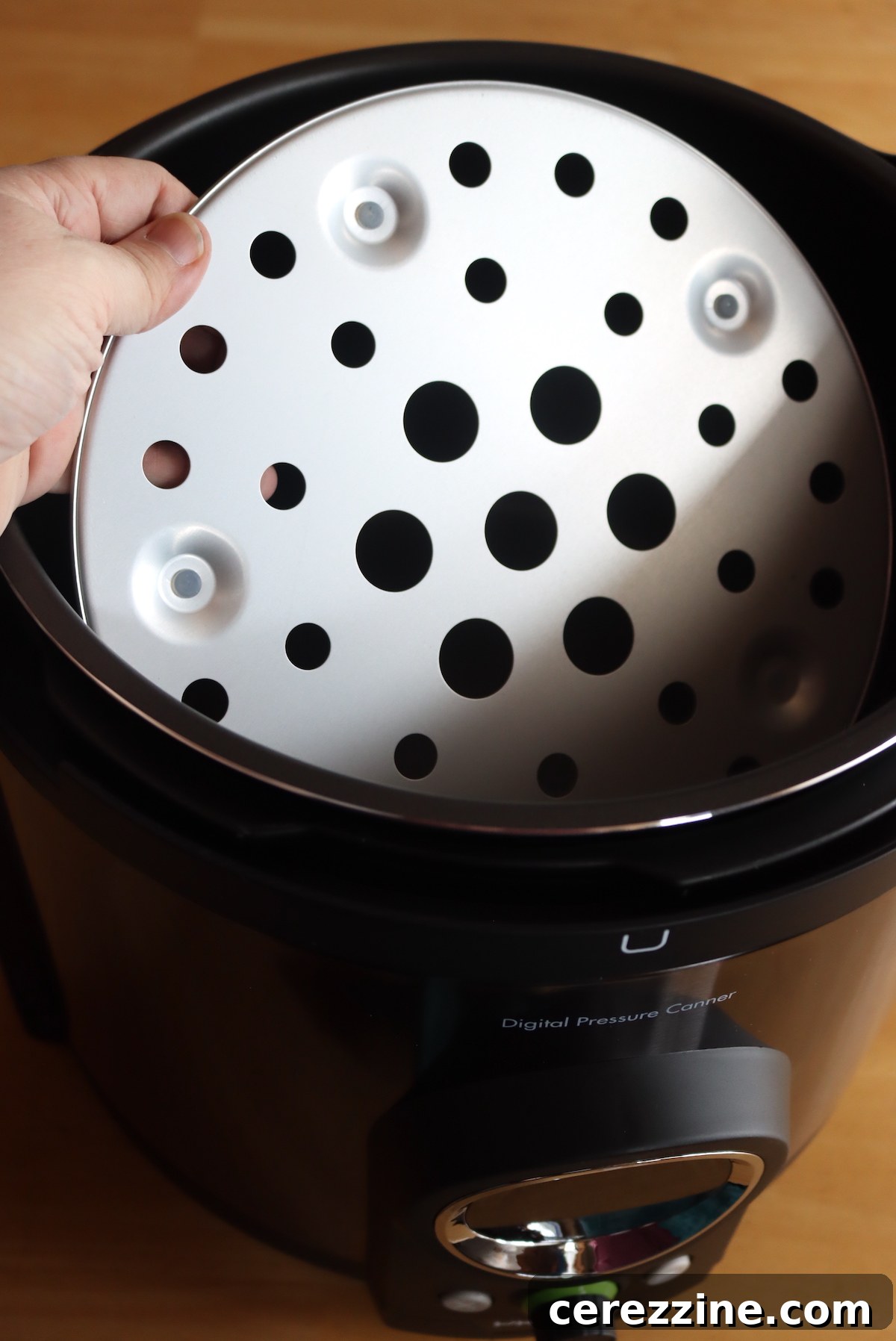
To begin, select a sturdy, level surface near a grounded electrical outlet for your canner. Before plugging it in, perform a quick visual inspection to ensure all components are properly seated and no parts are damaged or missing. Once satisfied, plug in the appliance. Insert the inner pot and then place the canning trivet at the bottom of the pot. The trivet is crucial; it prevents your jars from sitting directly on the heating element and allows water circulation.
Next, carefully add 3 quarts of water to the canner’s inner pot. This water is vital; it generates the steam needed to create the pressurized environment for safe processing. You’ll notice a convenient fill line marked precisely at the 3-quart level inside the canner, eliminating any guesswork.
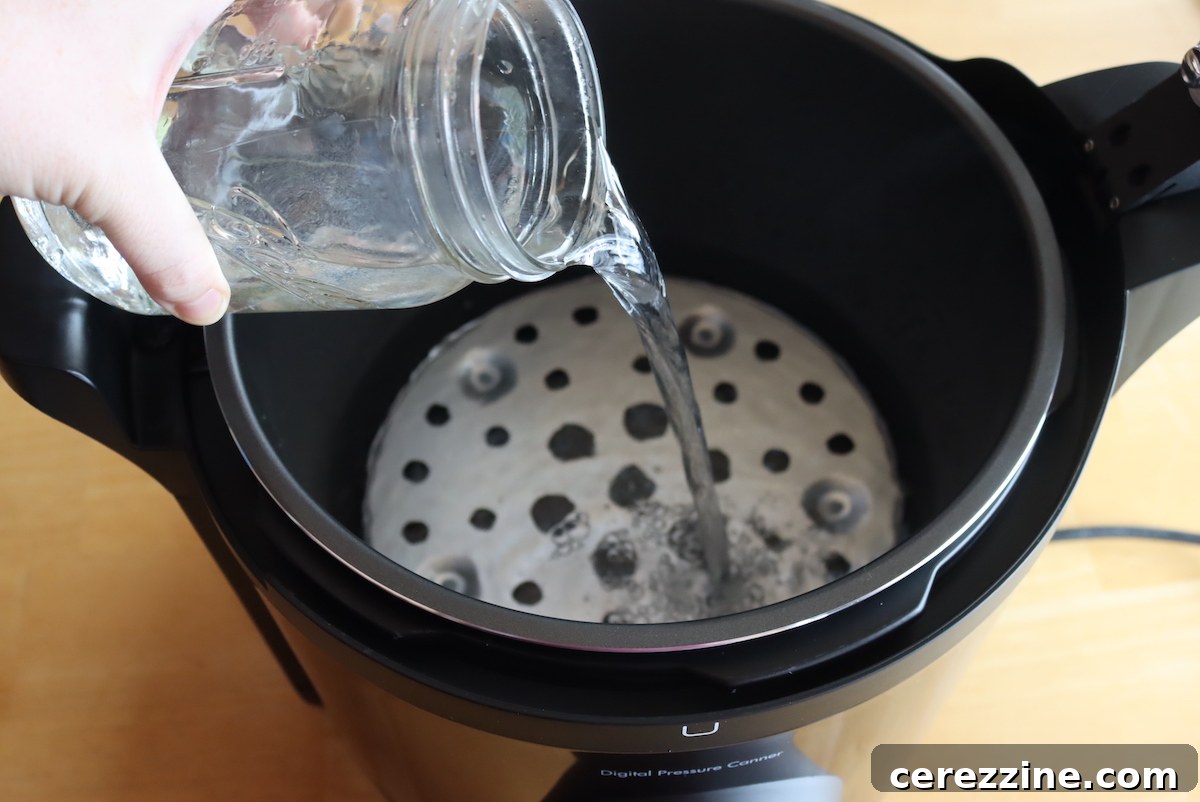
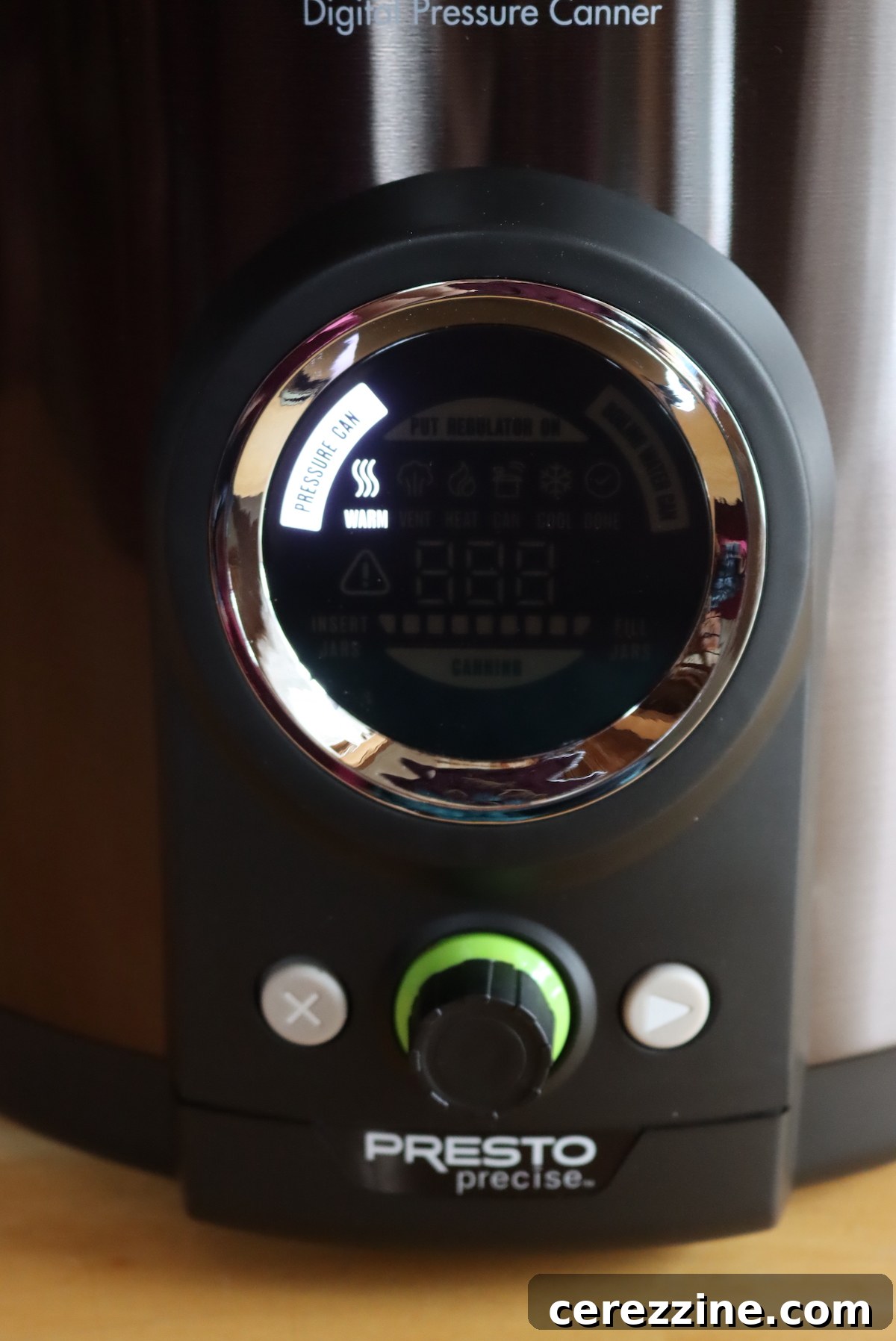
With the water added, power on your canner and navigate the menu to select “pressure canning.” The display will then prompt you to set the total canning time. This duration is entirely dependent on the specific recipe you are using, typically ranging from 10 to 180 minutes. Always consult a tested, reliable pressure canning recipe for accurate processing times, as these are critical for food safety.
After setting the processing time, the canner will instruct you to place your empty jars inside to pre-warm them. This step serves a dual purpose: it warms your jars to prevent thermal shock when hot food is added, and it also pre-heats the canner itself, ensuring optimal operating conditions. Do not skip this important pre-warming phase. If you typically pre-warm and sterilize your jars in a dishwasher, that’s perfectly acceptable; simply allow the canner to pre-warm without the jars inside, as the canner’s primary goal here is to get itself up to temperature.
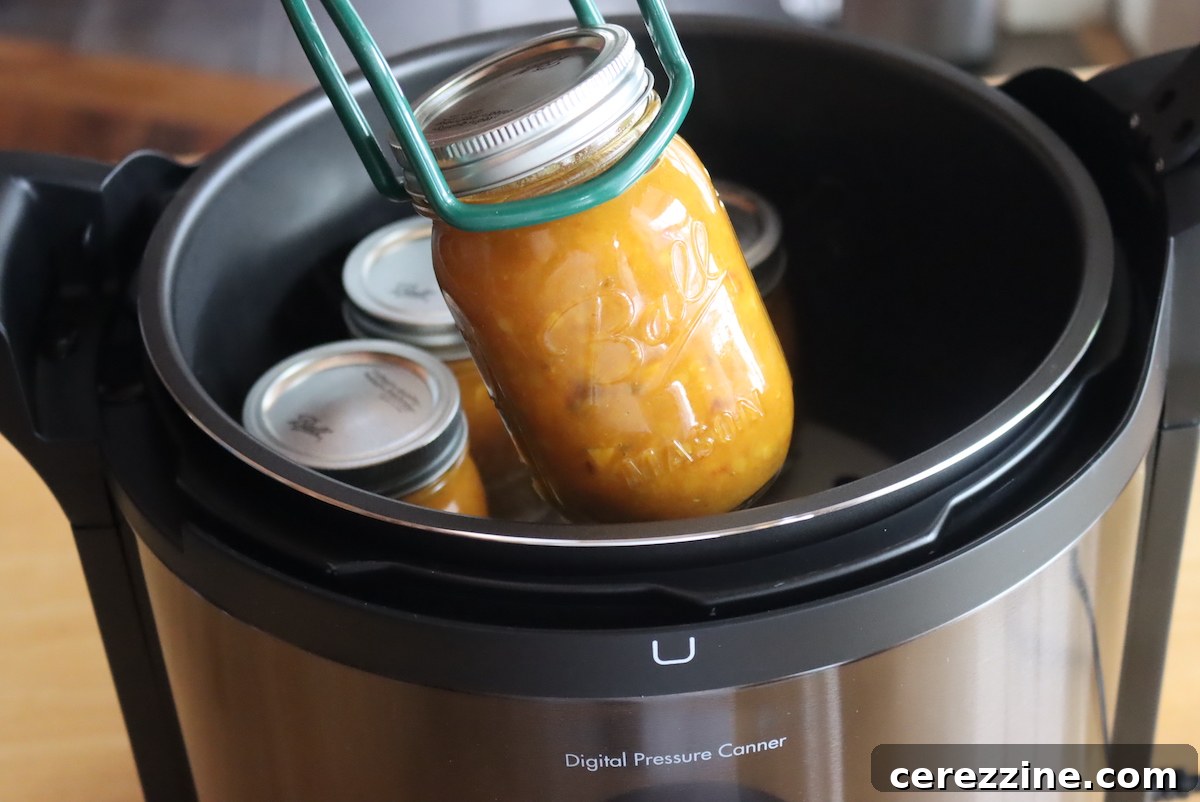
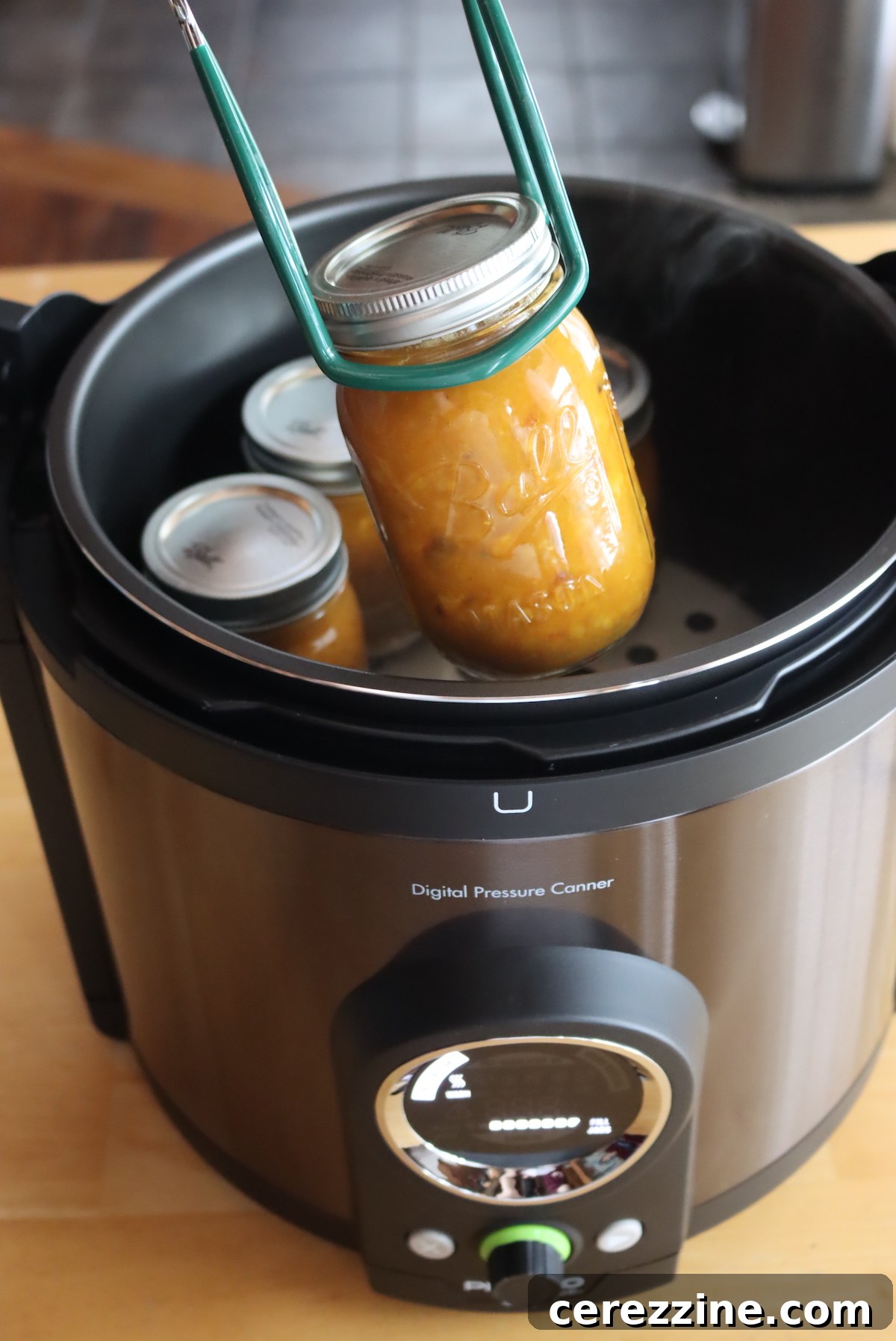
Once the pre-warming cycle is complete, the canner will prompt you to fill your jars with your prepared food. At this stage, meticulously follow your chosen recipe, ensuring you fill the jars with hot food, leave the precise headspace indicated, and then secure them with two-part canning lids tightened “finger-tight.” With your filled jars ready, carefully load them into the electric pressure canner when the display instructs you to do so.
After loading the jars, place the canner lid securely onto the base. At this point, you will latch it closed using the locking mechanism, but crucially, do not yet place the pressure regulator on the steam vent. This initial sealing allows the canner to begin heating its contents to a boil, preparing for the essential venting process that follows.
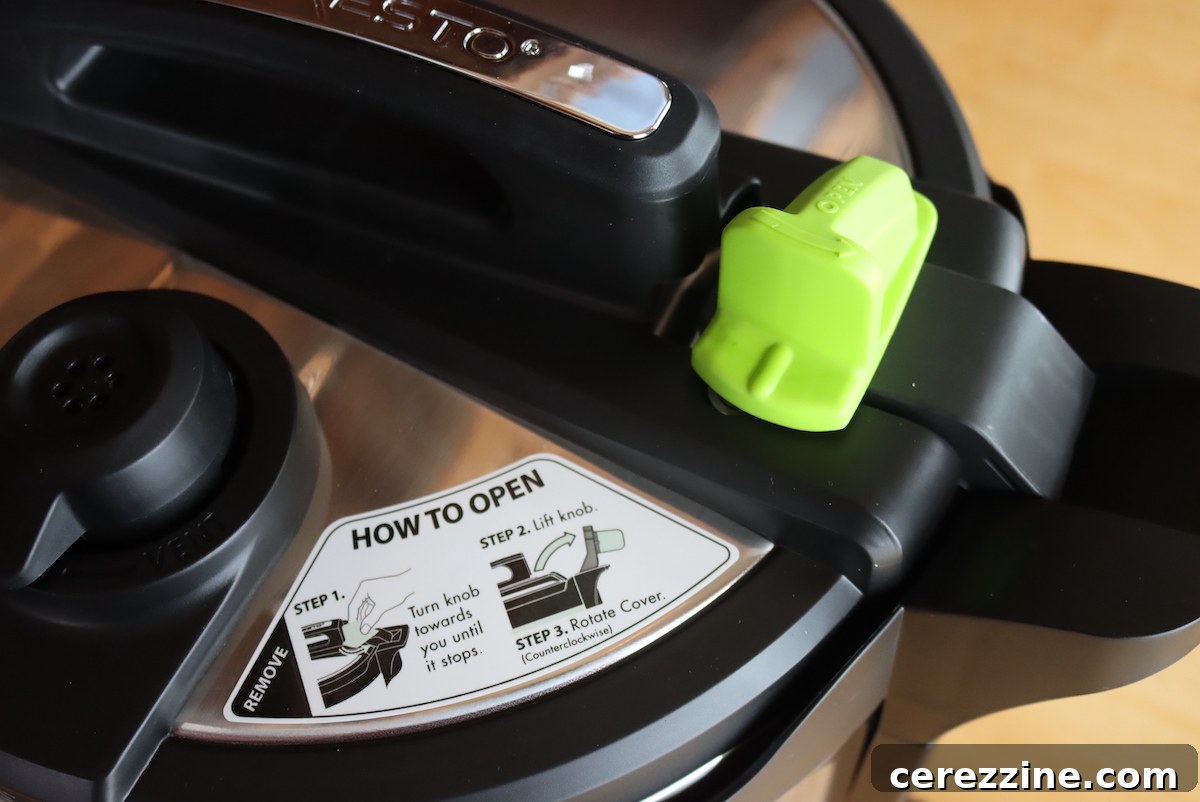
Once the lid is latched, press the “advance” button on the control panel. The canner will now commence heating the water to boiling point, allowing steam to build and prepare for venting. This phase typically takes anywhere from 5 to 15 minutes, depending on the initial temperature of your jars and food.
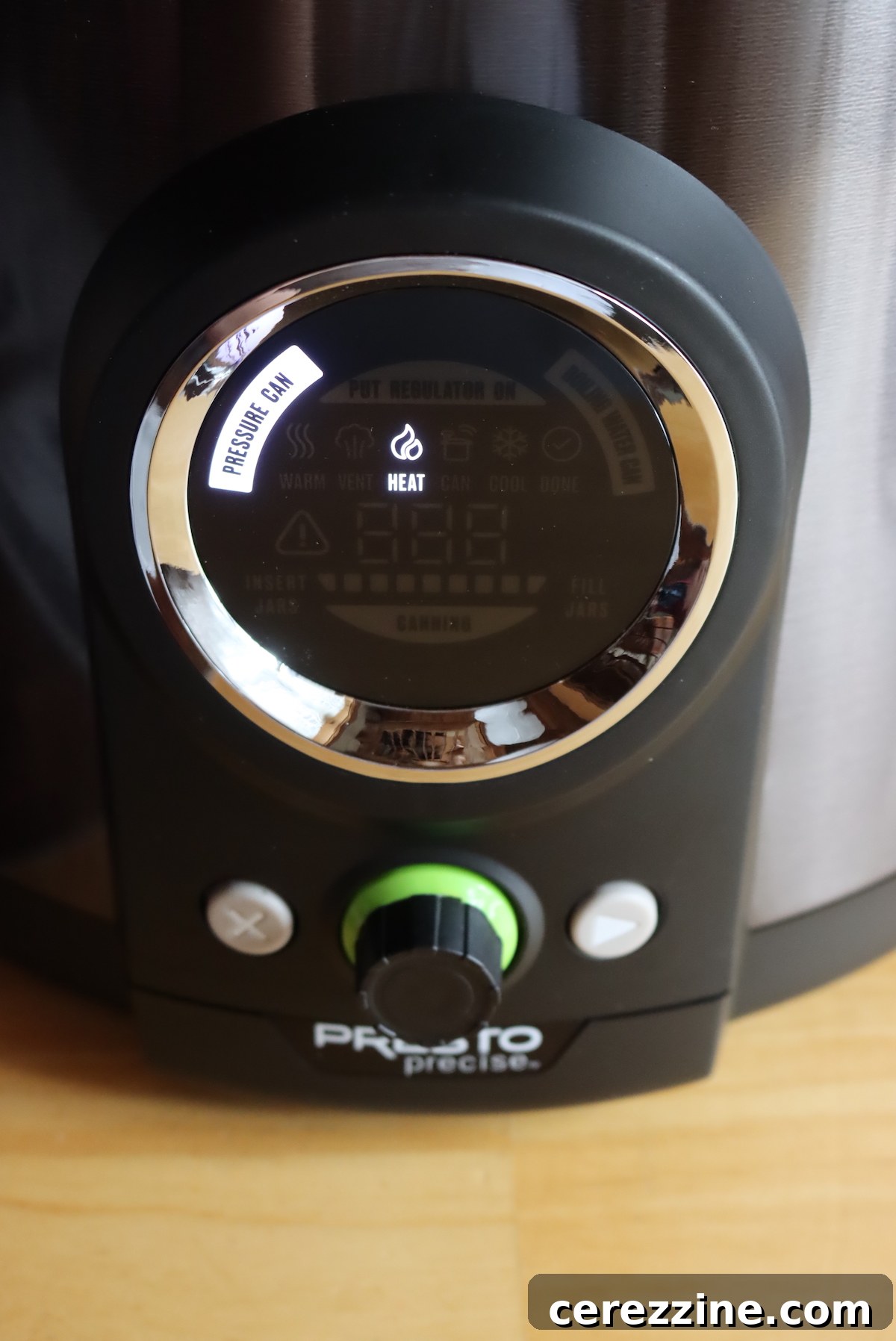
Upon reaching a vigorous boil, the canner’s display will shift to “venting” and initiate a 10-minute countdown. During this critical period, a steady stream of steam will be released from the vent. This process effectively purges all residual air from the canning chamber, ensuring that the environment inside is composed entirely of pure steam. This complete removal of air is absolutely vital for achieving uniform heat penetration and guaranteeing the safety of your preserved food.
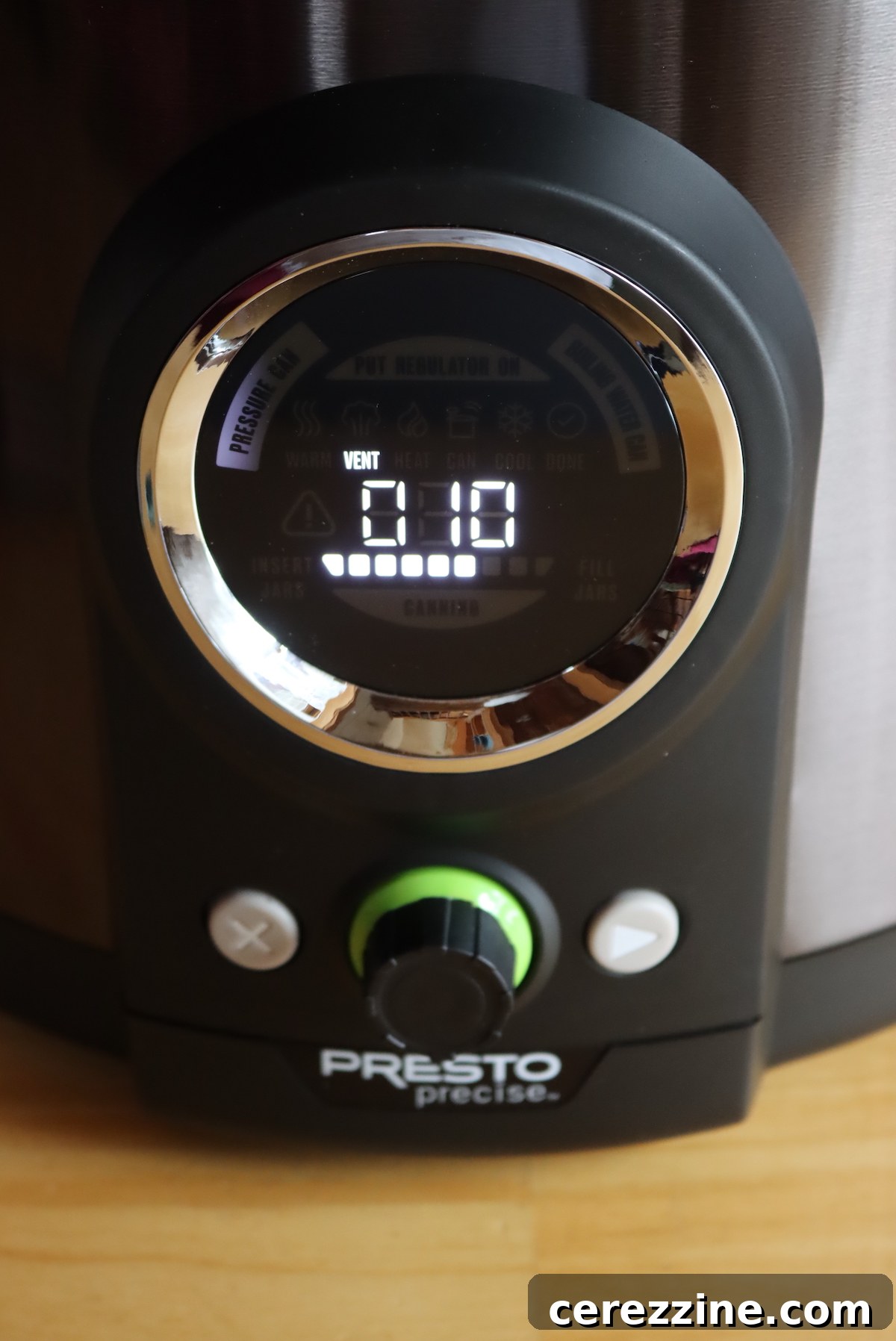
Once the 10-minute venting cycle concludes, the canner will prompt you to place the pressure regulator onto the steam vent and rotate it to the “canning” position. It’s important to remember that pressure has not yet begun to build during the venting phase; this step is where the magic of pressure canning truly begins.
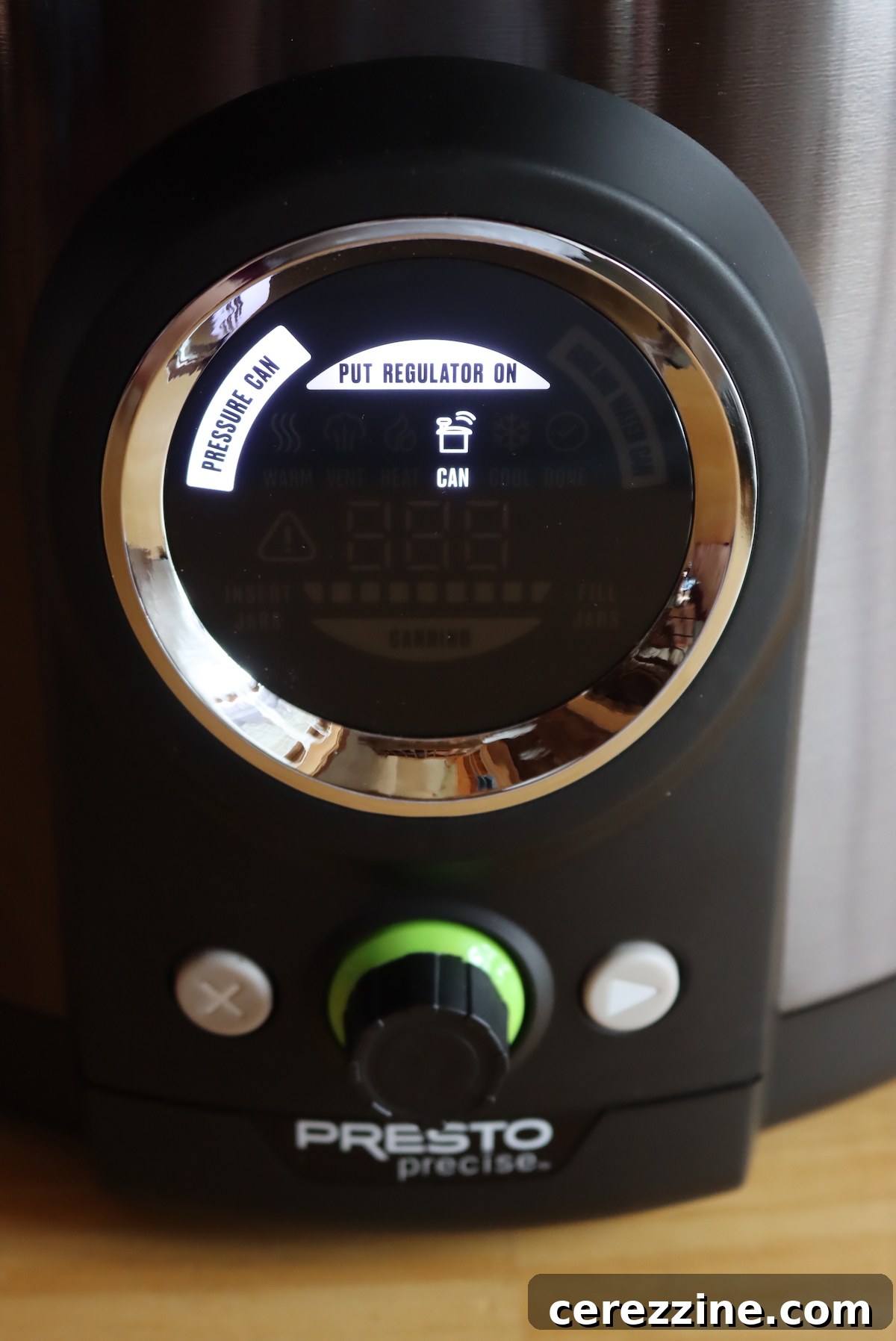
Carefully take the pressure regulator and align it with the steam valve on the canner lid. It should snap firmly and neatly into place, creating a sealed system.
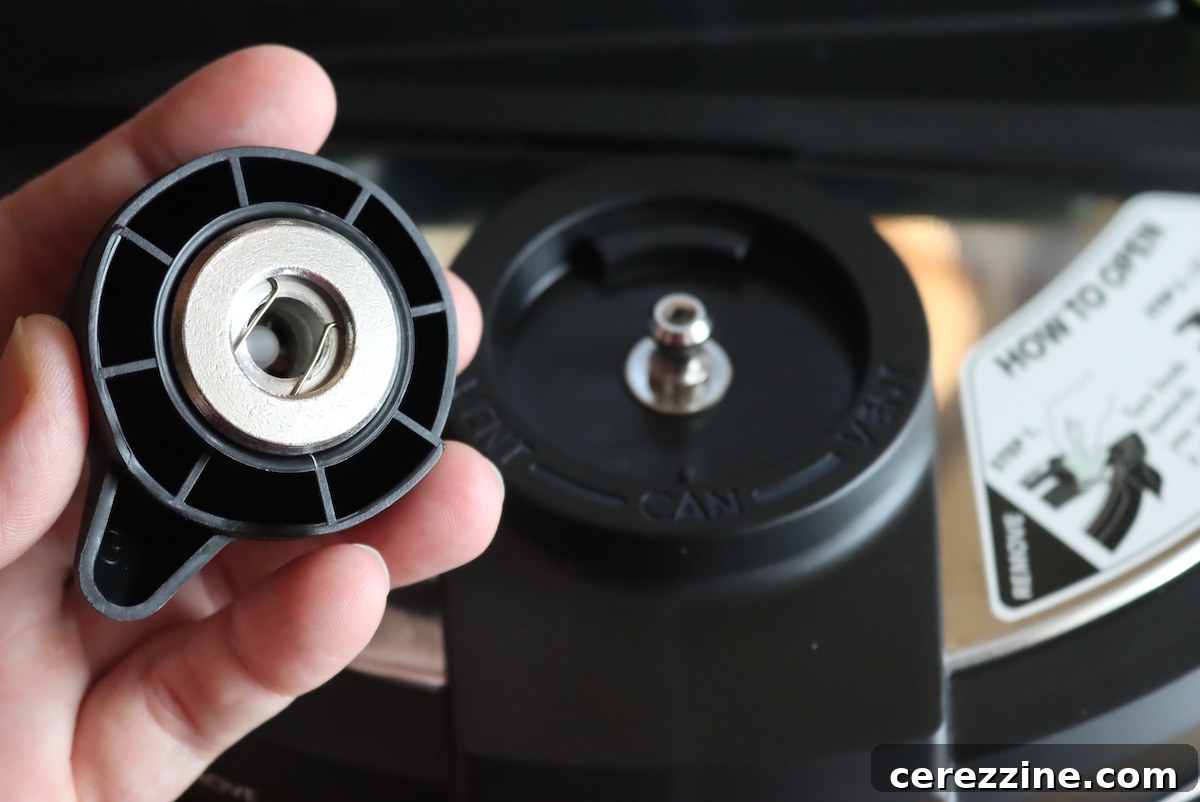
Verify that the regulator is properly oriented to the “canning” setting, rather than the “venting” position. The indicator on the regulator should be clearly pointing towards the front, signifying it’s locked into the correct position for pressure building.
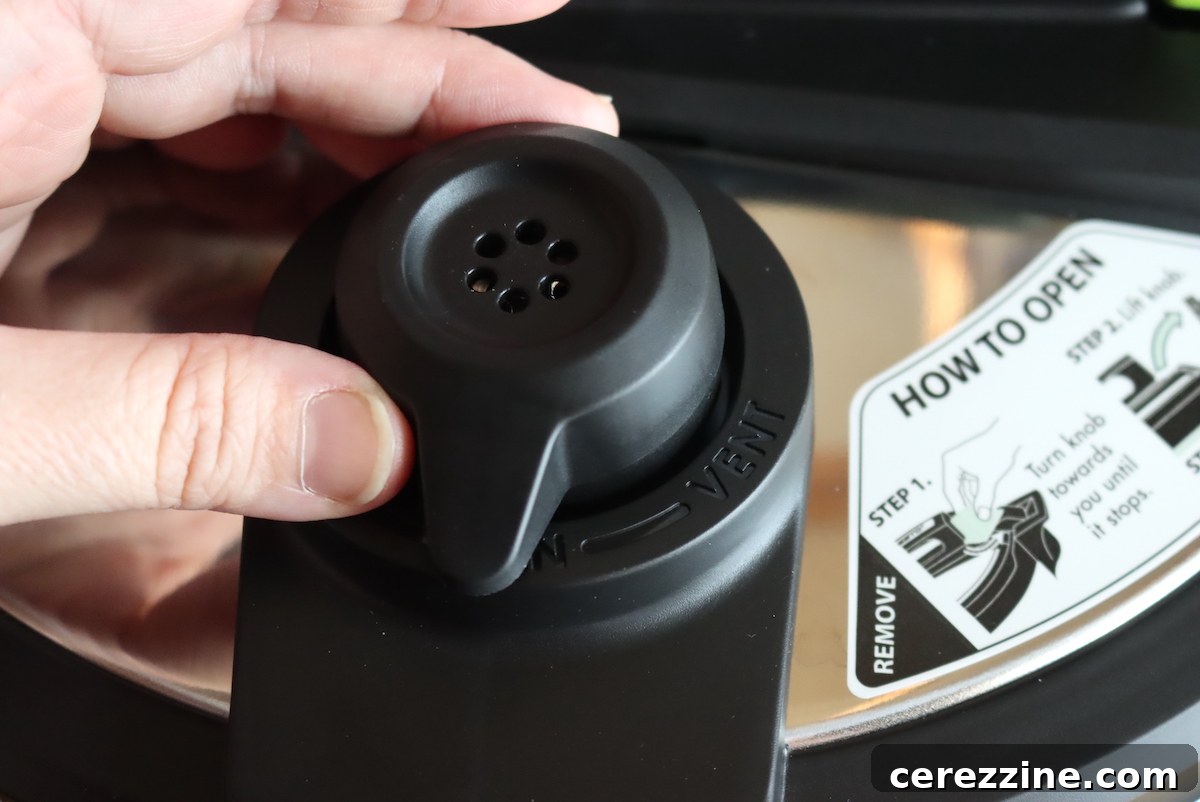
With the pressure valve now securely in place and correctly aligned, press the “advance” button once more. The canner will now initiate the crucial phase of building internal pressure. As the pressure steadily increases within the chamber, an additional layer of safety engages: a physical metal lock will pop up adjacent to the main latch. This ingenious safety mechanism mechanically prevents the lid from being opened while the canner is pressurized, offering significant peace of mind and preventing accidental injury.
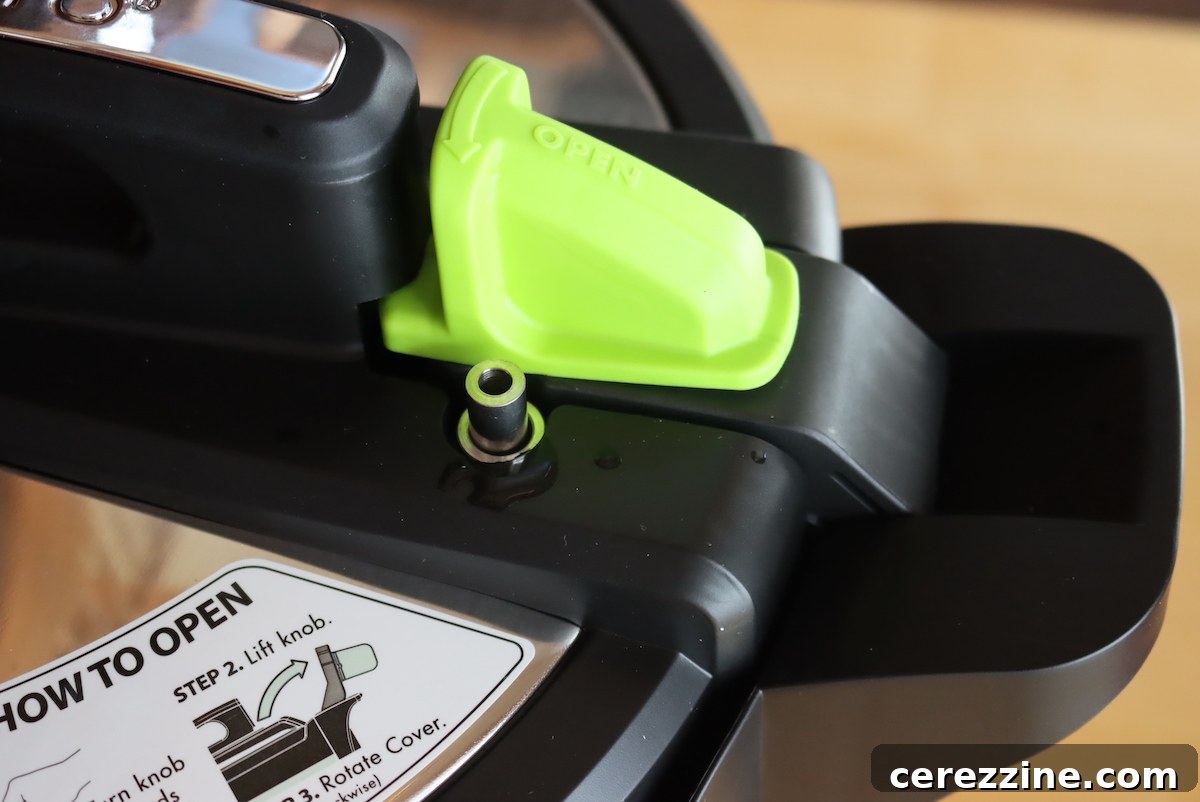
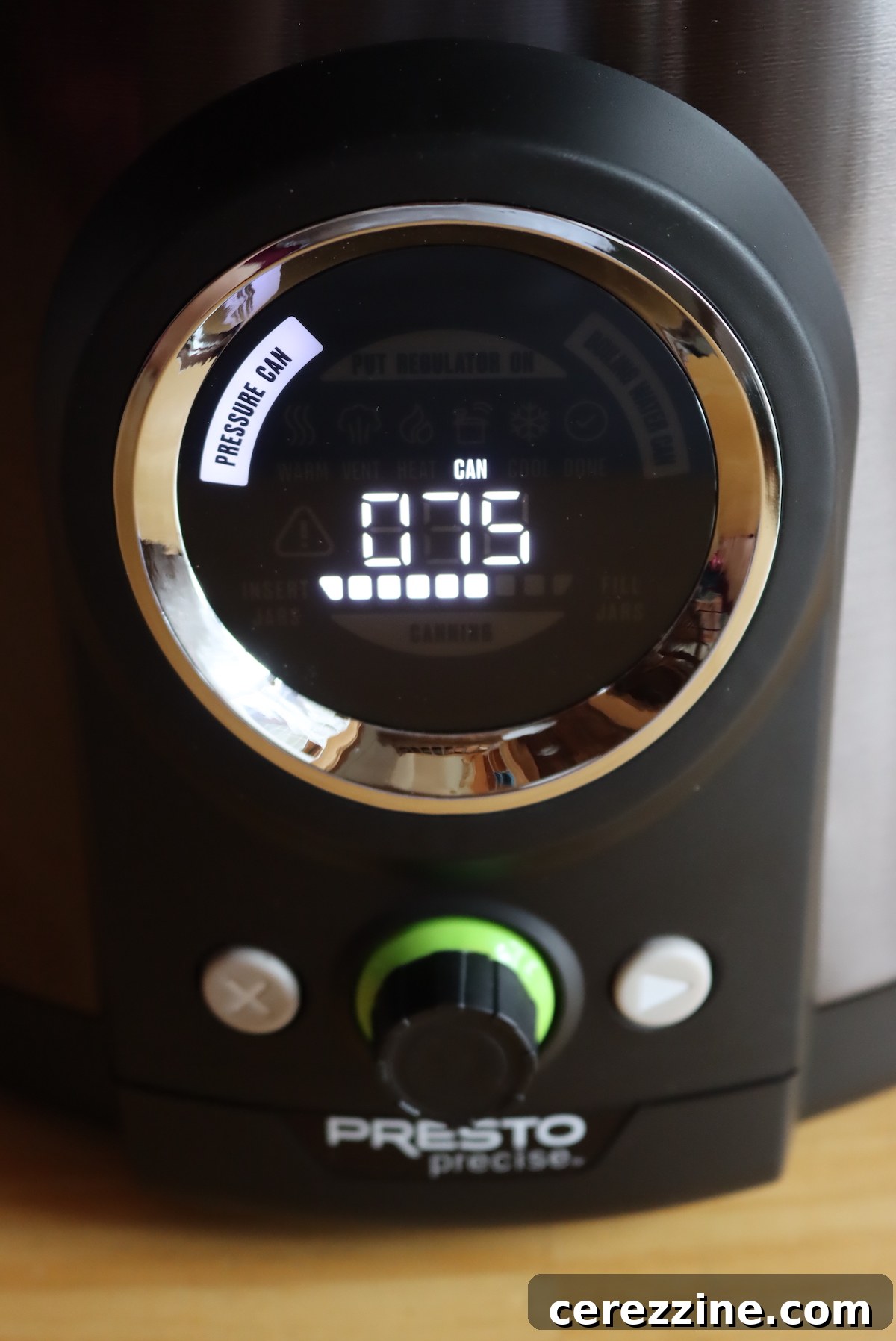
It’s important to note that while the canner is actively building pressure, the actual processing time for your food has not yet commenced. The internal processing timer will only activate once the canner has reached and stabilized at the precise, safe pressure required for your specific canning recipe. Once the ideal pressure is achieved, the screen will prominently display a countdown timer, clearly indicating the remaining processing time. This duration, as always, is determined by your chosen canning recipe.
A remarkable feature of the electric pressure canner is its automatic altitude adjustment. This means you can be entirely confident that your food is being processed at the correct, safe pressure, regardless of your geographic elevation. Your only responsibility is to accurately set the total processing time specified in your recipe.
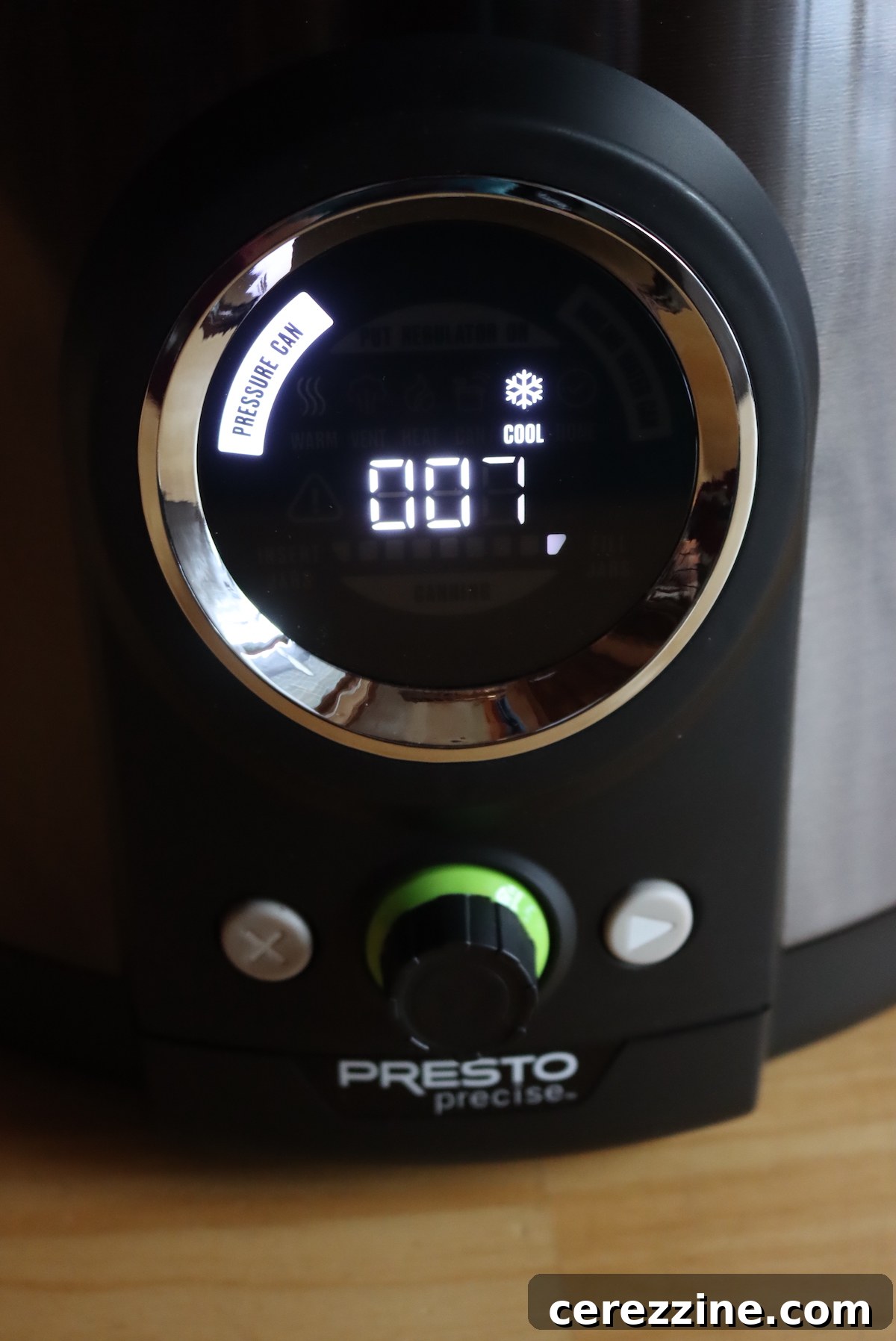
Upon the successful completion of the processing time, the canner’s display will transition to a “cooling” screen. During this phase, the internal pressure will gradually and naturally decrease back to zero. This depressurization process can take a significant amount of time, typically ranging from 45 to 90 minutes, primarily due to the canner’s excellent insulation. As the cooling process nears its end, usually with about 10 minutes remaining, a countdown timer will appear on the display, keeping you informed.
Once the chamber has fully depressurized and cooled sufficiently, the safety lock will disengage, and the screen will display “done.” It is critical to understand that “done” signifies the release of pressure, not that the contents are cool. The jars and their contents will still be boiling hot inside the canner. Always use a proper canning jar lifter to carefully remove the jars to avoid burns.
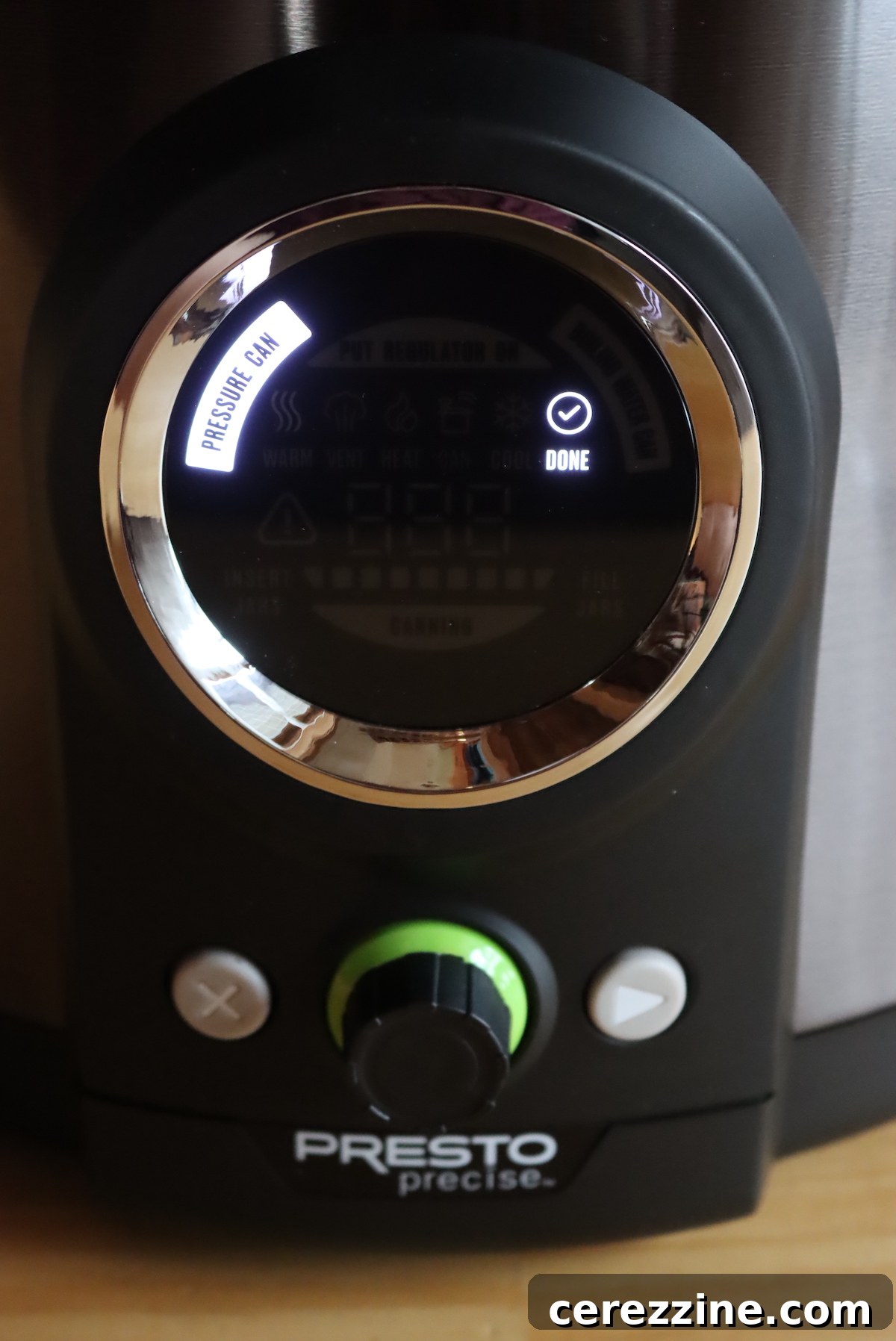
You have the flexibility to remove the jars immediately after the “done” indicator, or you can allow them to remain in the canner for a longer period if desired. Regardless of when you remove them, place the hot jars on a towel or cooling rack, ensuring they are not touching each other, and allow them to cool completely and undisturbed for 12 to 24 hours. This slow cooling process is essential for achieving a strong, reliable seal.
Once cooled, the final critical step is to check the seals on each jar. This is identical to checking seals after stovetop canning. A properly sealed jar will have a lid that is concave and does not flex when pressed. Even with the precision of an electric canner, sealing issues can still occur due to factors unrelated to the canner itself, such as food particles on the rim, faulty lids, or improper headspace. Always remove the canning rings before storage, as leaving them on can mask a false seal. Store any unsealed jars in the refrigerator for immediate consumption.
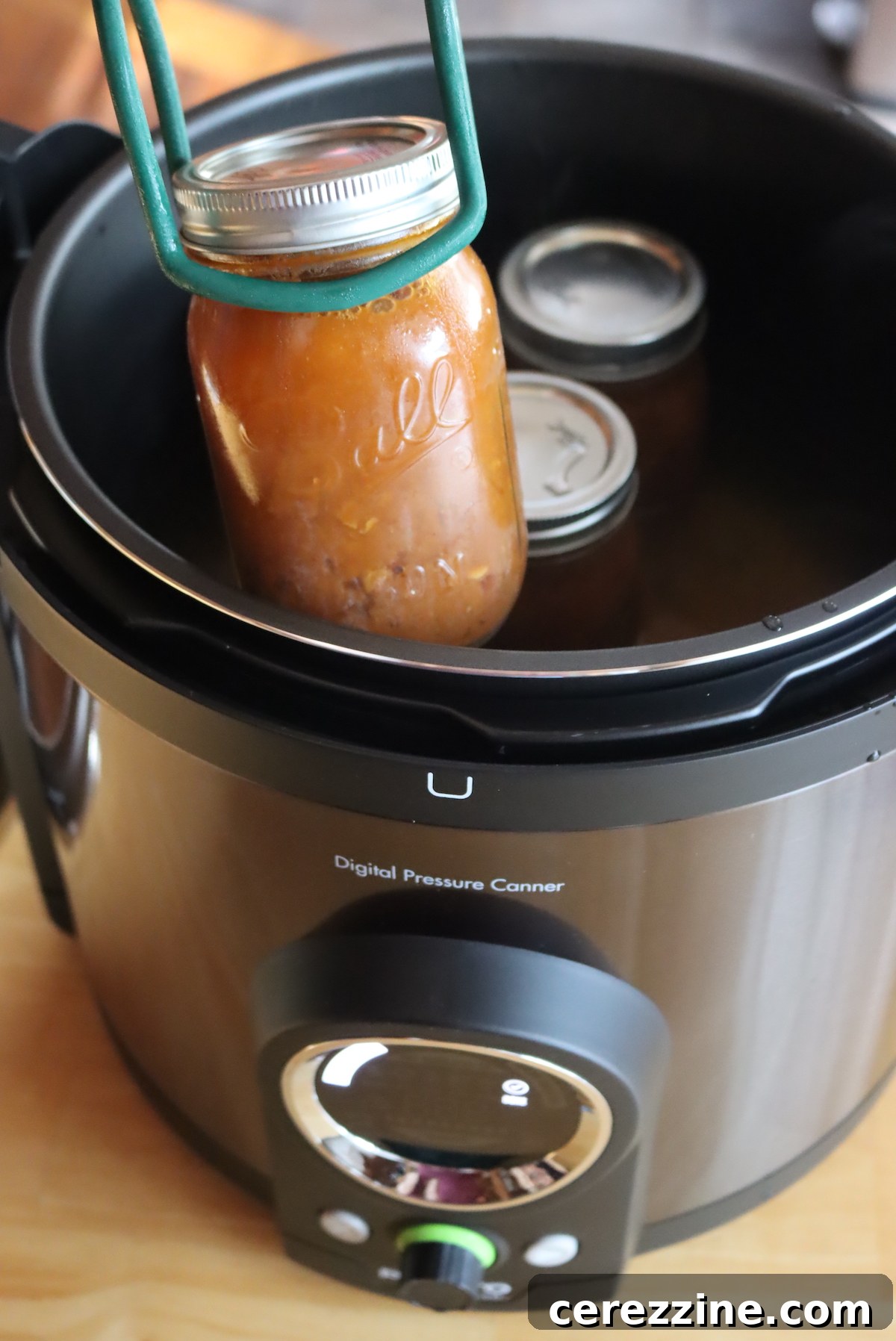
Congratulations! You’ve successfully completed your first batch with an electric pressure canner. As you can see, while the technology is advanced, the user experience is incredibly straightforward. The primary advantages lie in the guided process, ensuring you don’t miss any critical steps, and the automatic pressure maintenance, which significantly boosts confidence in the safety of your home-preserved goods.
Effortless Water Bath Canning with an Electric Pressure Canner
Beyond its primary function as a precision pressure canner, the electric pressure canner also offers exceptional versatility by accommodating water bath canning. The process for water bath canning in these units is remarkably similar to pressure canning, retaining the same ease and automation. The key difference is simply the setting you select at the beginning of your session. Instead of choosing “pressure canning,” you’ll opt for the “water bath canning” setting and then seamlessly follow the on-screen prompts.
In water bath mode, the critical distinction is that you will never attach the pressure regulator. This ensures the chamber operates at atmospheric pressure, relying solely on boiling water to process your high-acid foods. You will still follow the steps of pre-warming jars, loading your prepared food, securely placing the lid, and allowing the unit to process the jars within the boiling water environment. The electric canner expertly maintains a rolling boil for the duration specified by your recipe, providing a hands-off and worry-free water bath canning experience. For a visual demonstration, the video below comprehensively walks you through every step of this simplified process:
Frequently Asked Questions About Electric Pressure Canners
While I’ve aimed to cover all essential aspects of electric pressure canners, here are detailed answers to some of the most common questions that often arise:
Are Electric Pressure Canners a Worthwhile Investment?
Absolutely! From my perspective as an ardent home canner with over a decade of experience across various pressure canner types, electric pressure canners are an exceptional advancement in food preservation. The Presto Electric Pressure Canner, in particular, has earned my enthusiastic recommendation. Its ease of use, automated precision, and comprehensive safety features make it an invaluable tool that significantly simplifies the canning process, boosting confidence for beginners and streamlining operations for seasoned preservers.
Is There a USDA-Approved Electric Pressure Canner?
It’s important to clarify the role of the USDA in canning. The United States Department of Agriculture (USDA) does not directly test or “approve” specific brands or models of pressure canners for home use. Instead, the USDA publishes and regularly updates rigorous guidelines and recommendations regarding the temperatures, pressures, and processing times required to safely preserve various types of food. These guidelines are based on extensive scientific research to ensure the destruction of harmful microorganisms, especially Clostridium botulinum. Manufacturers then design their equipment to meet or exceed these critical safety parameters. According to the official Presto Canning Website, the Presto Precise Digital Pressure Canner has been engineered to fully comply with and meet these stringent USDA guidelines, providing users with assurance of its safety and efficacy.
When Did Electric Pressure Canners First Emerge?
The first truly dedicated electric pressure canner, designed specifically for safe home food preservation according to USDA guidelines, was introduced to the market in June 2020. This timing, unfortunately, coincided with a period of significant global disruption and public focus on other pressing issues. As a result, many home canners, even several years later, remain unaware of the existence and transformative potential of these innovative appliances, missing out on a much simpler way to preserve food.
Electric Pressure Canner vs. Electric Pressure Cooker: Understanding the Crucial Distinction
The fundamental difference between an electric pressure canner and an electric pressure cooker lies in their core function and precision requirements. An electric pressure canner is specifically engineered to maintain highly precise and consistent temperatures and pressures throughout the entire processing cycle. This unwavering accuracy is absolutely vital for adhering to USDA food safety guidelines, ensuring that potentially dangerous bacteria are neutralized in low-acid foods.
In contrast, an electric pressure cooker, such as an Instant Pot, is designed for cooking food quickly under pressure. While effective for cooking, these appliances do not need to maintain the same level of stringent precision. They typically operate within a broader pressure range, which can fluctuate by 3 to 5 psi or more during operation. This variability means that pressure cookers can frequently drop below the minimum safe pressure required for proper food canning. While such fluctuations are inconsequential when simply cooking a meal, they can have catastrophic food safety implications when attempting to pressure can. Furthermore, a key safety feature of electric pressure canners is their automatic adjustment for altitude, which pressure cookers lack. This altitude compensation is essential for ensuring safe processing at various elevations, a critical capability that differentiates a true pressure canner.
Does an Electric Pressure Canner Include a Warranty?
Yes, the Presto Precise Digital Pressure Canner typically comes with a manufacturer’s warranty, which provides coverage against defects in materials and workmanship. For the Presto model, a 1-year warranty is standard, offering a period of assurance for your investment.
What is the Expected Lifespan of Digital Pressure Canners?
Since electric pressure canners are a relatively new product category, there isn’t extensive long-term data available to definitively state their exact lifespan. However, we can draw some comparisons from similar electric kitchen appliances. For instance, popular electric pressure cookers like Instant Pots are generally rated for an average lifespan of 3 to 5 years of regular use. My own Instant Pot, despite being a heavy user, is still functioning well at 7 years old, suggesting that well-maintained units can exceed these estimates. It’s reasonable to anticipate a similar lifespan for a digital pressure canner, though this is still an educated guess given their recent market introduction.
It’s crucial to manage expectations: if your goal is an appliance that can be passed down through generations, a traditional All-American Brand Pressure Canner (a non-electric model) would be a more suitable choice. No electronic appliance, especially one with integrated computer components, is designed for a lifetime of use in the same way heirloom quality stovetop models are.
What is the Best Electric Pressure Canner to Purchase?
As of April 2023, the market for USDA-guideline-compliant electric pressure canners remains quite specialized, with only two primary contenders. These are:
- The Nesco/Carey Digital Pressure Cooker and Canner
- The Presto Precise Digital Pressure Canner
I have personally evaluated both models, and based on extensive hands-on experience, I unequivocally recommend the Presto Precise Digital Pressure Canner. Its superior ease of use and foolproof operation make it the standout choice. Even as an experienced canner, I encountered multiple instances of human error with the Carey/Nesco model, which resulted in potentially under-processed food – a significant food safety concern. While I would ideally love to recommend a more economical alternative, for reliable and safe electric pressure canning, the Presto Precise Digital Pressure Canner is, by a considerable margin, the best option available today.
If budget is a primary concern and the Presto model is beyond your reach, I would advise opting for a traditional stovetop pressure canner instead. In my experience, quality stovetop canners offer a more economical entry point and prove to be more dependable for safe canning than the less intuitive Nesco/Carey electric version.
Further Your Canning Knowledge: Guides and Reviews
Eager to dive deeper into the fascinating world of home canning? Explore these comprehensive guides and reviews to expand your expertise and ensure safe, successful food preservation:
- Beginner’s Guide to Pressure Canning: Your Essential First Steps
- Unpacking the Truth: Can You Can in an Instant Pot?
- In-Depth Analysis: Presto Precise Digital Pressure Canner Review
- Beyond the Basics: What is Canning Salt? (And Suitable Substitutions)
Inspiring Pressure Canning Recipes to Try
Ready to put your electric pressure canner to work? Fill your jars with confidence using these delectable and safe pressure canning recipes, perfect for preserving a variety of wholesome foods:
- Hearty Home-Canned Beef: A Pantry Staple
- Preserving the Harvest: Canning Potatoes
- Sweet & Savory: Canning Pumpkin Puree
- Golden Goodness: Canning Sweet Potatoes
- Summer’s Bounty: Canning Fresh Corn