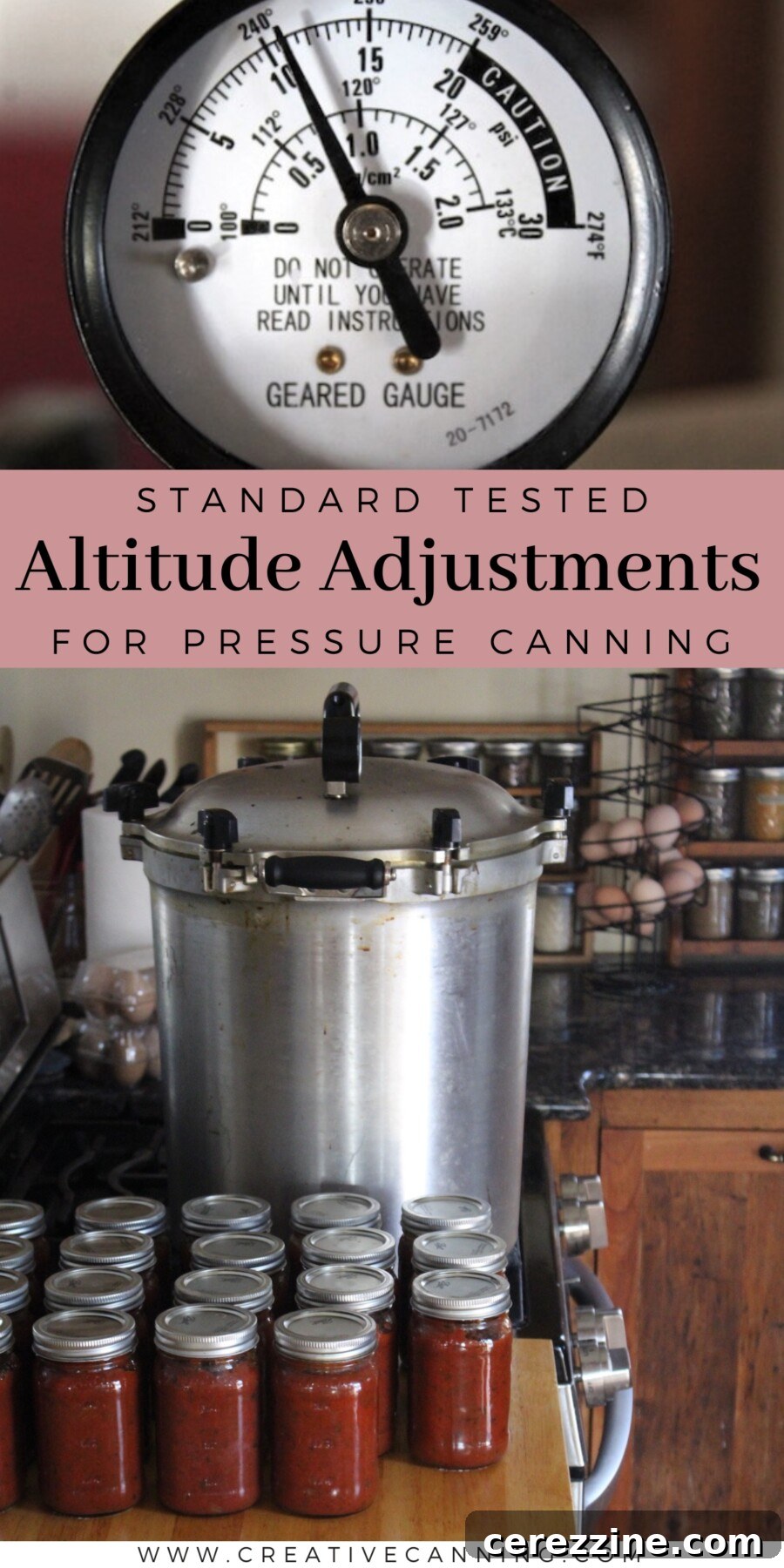
Altitude adjustments for pressure canning might initially seem like a complex topic, but they are fundamentally straightforward once you understand the underlying principles and consult the relevant charts. The key lies in recognizing that these adjustments involve altering the pressure, not the processing time. Grasping this distinction can make the entire concept significantly less daunting for any home canner.
For those passionate about home food preservation through pressure canning, discussions around altitude adjustments are inevitable and frequently revisited. While the notion can sound intimidating, the good news is that the practical application is quite simple. The core principle for pressure canning is clear: you do not change the processing time; instead, you adjust the pressure.
This seemingly minor adjustment carries immense importance for food safety. Pressure canning processes are meticulously designed to ensure specific internal temperatures are reached and maintained throughout the entire tested processing duration. At higher elevations, the atmospheric pressure is lower, which directly causes water to boil at a reduced temperature. If you neglect to adjust your canner’s pressure for your altitude, the internal temperature required for safe processing may not be achieved, even if you diligently follow every other step of the recipe. This can leave your canned goods vulnerable to spoilage and harmful bacteria.
Understanding Altitude Adjustments for Pressure Canning
Altitude adjustments for pressure canning are essential modifications made to the required canning pressure when preserving food at elevations above sea level. As your elevation increases, the surrounding atmospheric pressure decreases. This reduction in external pressure alters the internal temperature your pressure canner can achieve at a given Pounds per Square Inch (PSI) reading. To compensate for this natural phenomenon and ensure the safety of low-acid foods, tested canning recipes mandate higher pressure settings at increased elevations. This ensures the critical temperature necessary to destroy harmful microorganisms, such as Clostridium botulinum spores, is consistently met inside the jars.
For home canners, the elevation at which adjustments become necessary varies depending on the type of canner you are using. Generally, the critical cutoff for weighted-gauge canners is above 1,000 feet, while for most dial-gauge pressure canning tables that begin at 11 PSI, the adjustment typically starts above 2,000 feet. This distinction is crucial, as the specific adjustment directly correlates with the mechanism of your canner.
Standard Altitude Adjustments for Pressure Canning: The Essential Chart
Here is the foundational pressure canning altitude chart, widely adopted for numerous USDA-style home canning recipes. This chart applies specifically to low-acid foods, which include a wide variety of items such as vegetables, meats, poultry, fish, beans, and homemade soups. Always refer to this chart to ensure the safety and quality of your preserved foods.
Weighted-Gauge Pressure Canner Guidelines:
- 0 to 1,000 feet: Maintain 10 pounds pressure
- Above 1,000 feet: Maintain 15 pounds pressure
Dial-Gauge Pressure Canner Guidelines:
- 0 to 2,000 feet: Maintain 11 pounds pressure
- 2,001 to 4,000 feet: Maintain 12 pounds pressure
- 4,001 to 6,000 feet: Maintain 13 pounds pressure
- 6,001 to 8,000 feet: Maintain 14 pounds pressure
- 8,001 to 10,000 feet: Maintain 15 pounds pressure
This chart represents the primary adjustment guide for most home canners. However, it is always paramount to double-check your specific, tested recipe for any unique instructions or variations. Remember, the processing time remains constant across all altitudes. The correct PSI (Pounds per Square Inch) required for safe processing depends solely on your geographical elevation and the type of pressure canner you are operating.
Why Pressure Adjusts, Not Processing Time, in Pressure Canning
This particular aspect often causes confusion, especially because altitude adjustments for water bath canning typically involve extending the processing time. Pressure canning operates on a fundamentally different principle due to its ability to achieve temperatures well above the boiling point of water. Understanding this distinction is vital for safe and effective food preservation.
For pressure canning, every tested process is meticulously engineered to reach and sustain a specific, high internal temperature inside the canner. This temperature is critical for destroying heat-resistant bacteria and their spores, such as those responsible for botulism. The method for compensating for higher altitudes in pressure canning is by increasing the pressure within the canner. This elevated pressure, in turn, raises the boiling point of water and ensures that the canner achieves and maintains the necessary processing temperature. The processing time remains consistent because the recipe has already been rigorously tested and validated for that specific duration at the proper, high temperature.
In simpler terms, pressure canning recipes are not underprocessed because they need more minutes. They become unsafe if the canner fails to reach the correct processing conditions in the first place. Increasing the PSI directly addresses this issue by elevating the internal temperature to the safe threshold. Therefore, it is crucial to never arbitrarily combine the logic of water bath canning with that of pressure canning. For pressure canning, always strictly adhere to the tested processing time and precisely adjust the pressure according to your elevation to guarantee the safety of your home-canned foods.
Dial Gauge vs. Weighted Gauge: Explaining Different Adjustment Methods
Many home canners ponder why the adjustment charts for dial-gauge and weighted-gauge canners differ so significantly—one presenting a gradual progression (11, 12, 13, 14, 15 pounds) while the other simply jumps from 10 to 15 pounds. The answer lies in the fundamental design and operational mechanism of each canner type.
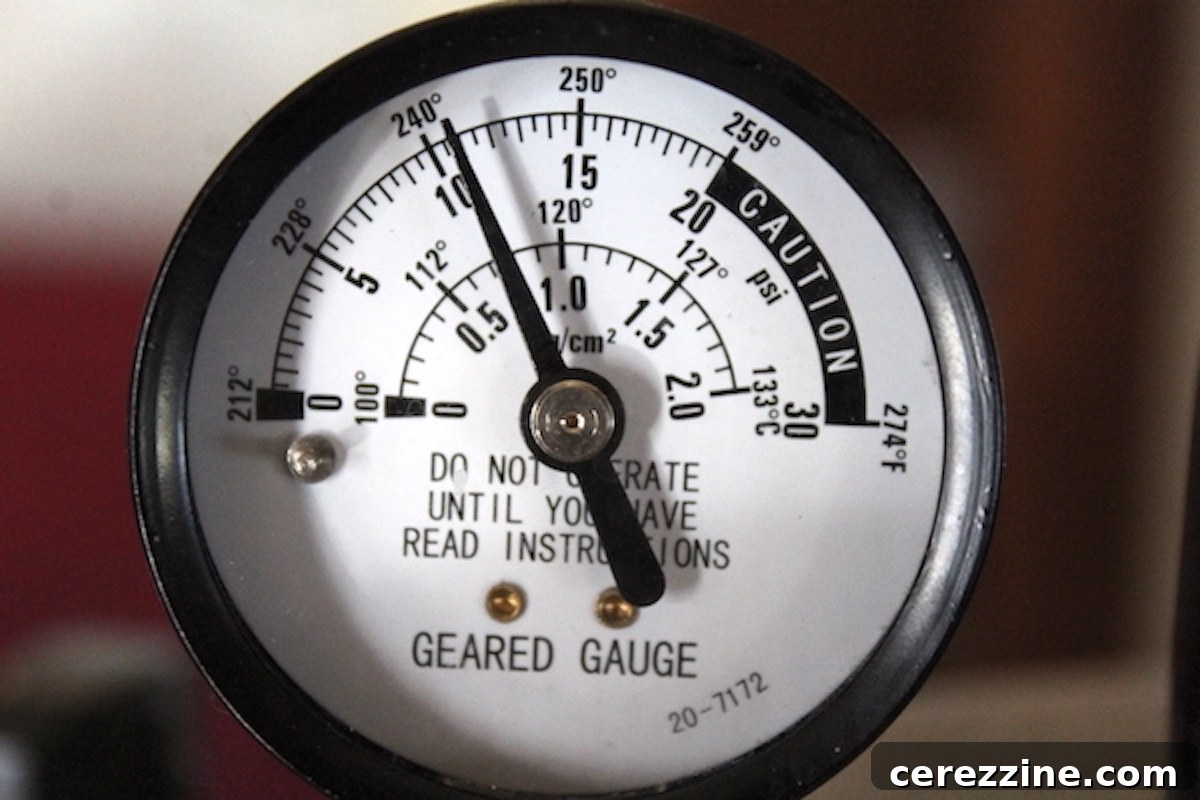
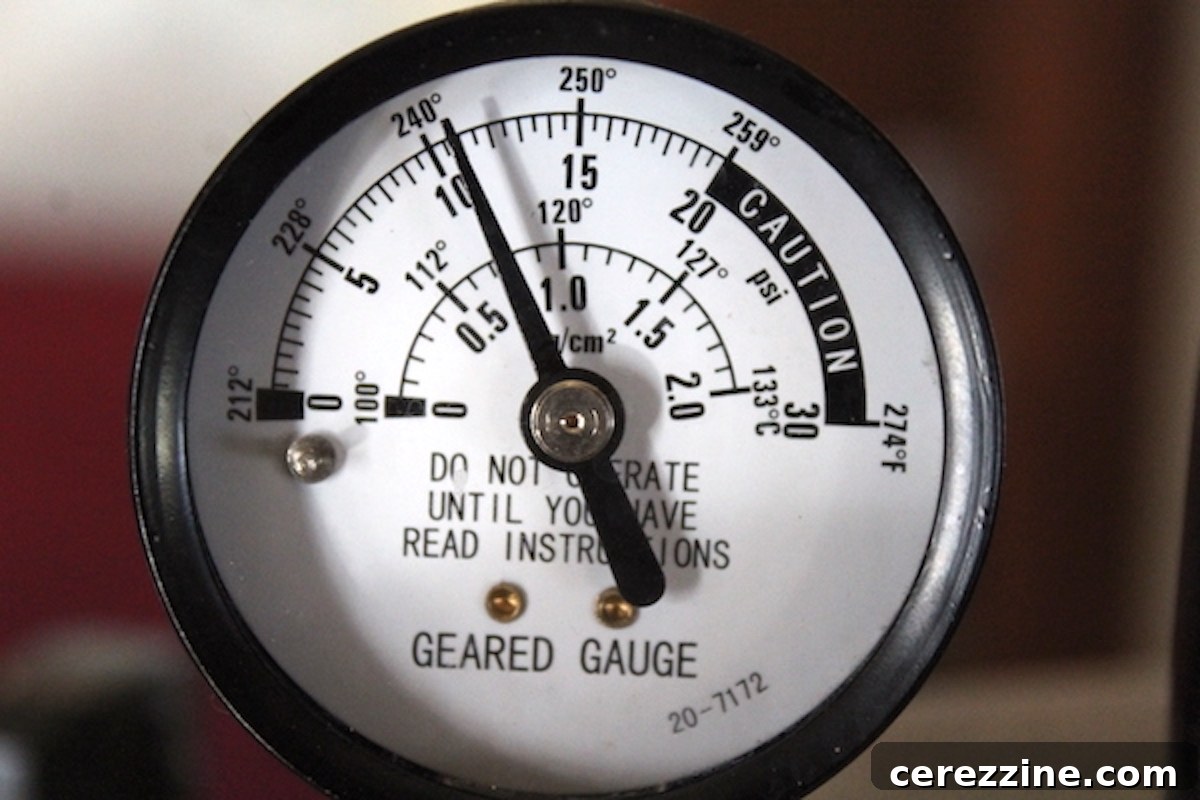
A dial-gauge canner is equipped with a visual gauge that allows you to continuously monitor and adjust the internal pressure in smaller, more precise increments. This precision enables specific recommendations for incremental pressure increases as altitude rises. The needle on the dial allows canners to fine-tune the pressure, ensuring that the exact required PSI for a given elevation is met. This meticulous control is why dial-gauge charts can specify an increase of just one pound per square inch for specific altitude bands.
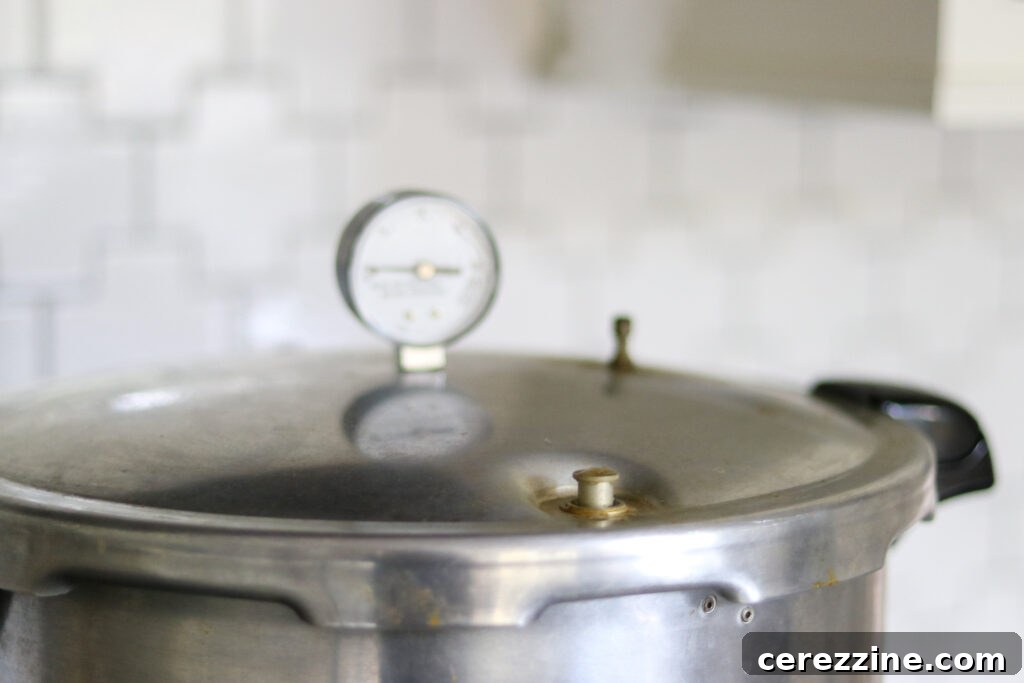
Conversely, a weighted-gauge canner operates on a less flexible system. Home models typically employ weights that are designed to operate at fixed pressure settings, commonly 5, 10, or 15 pounds of pressure. These weights are placed over the vent pipe, and when the canner reaches the specified pressure, the weight begins to jiggle or rock, indicating that the target pressure has been achieved. Since there aren’t practical, standard weighted options for 11, 12, 13, or 14 pounds of pressure, the safest and only viable recommendation for any altitude above 1,000 feet when using a weighted-gauge canner is to ascend to the next available higher setting, which is 15 pounds pressure. While this might sometimes result in slightly higher pressure than strictly necessary, it ensures food safety above the 1,000-foot mark.
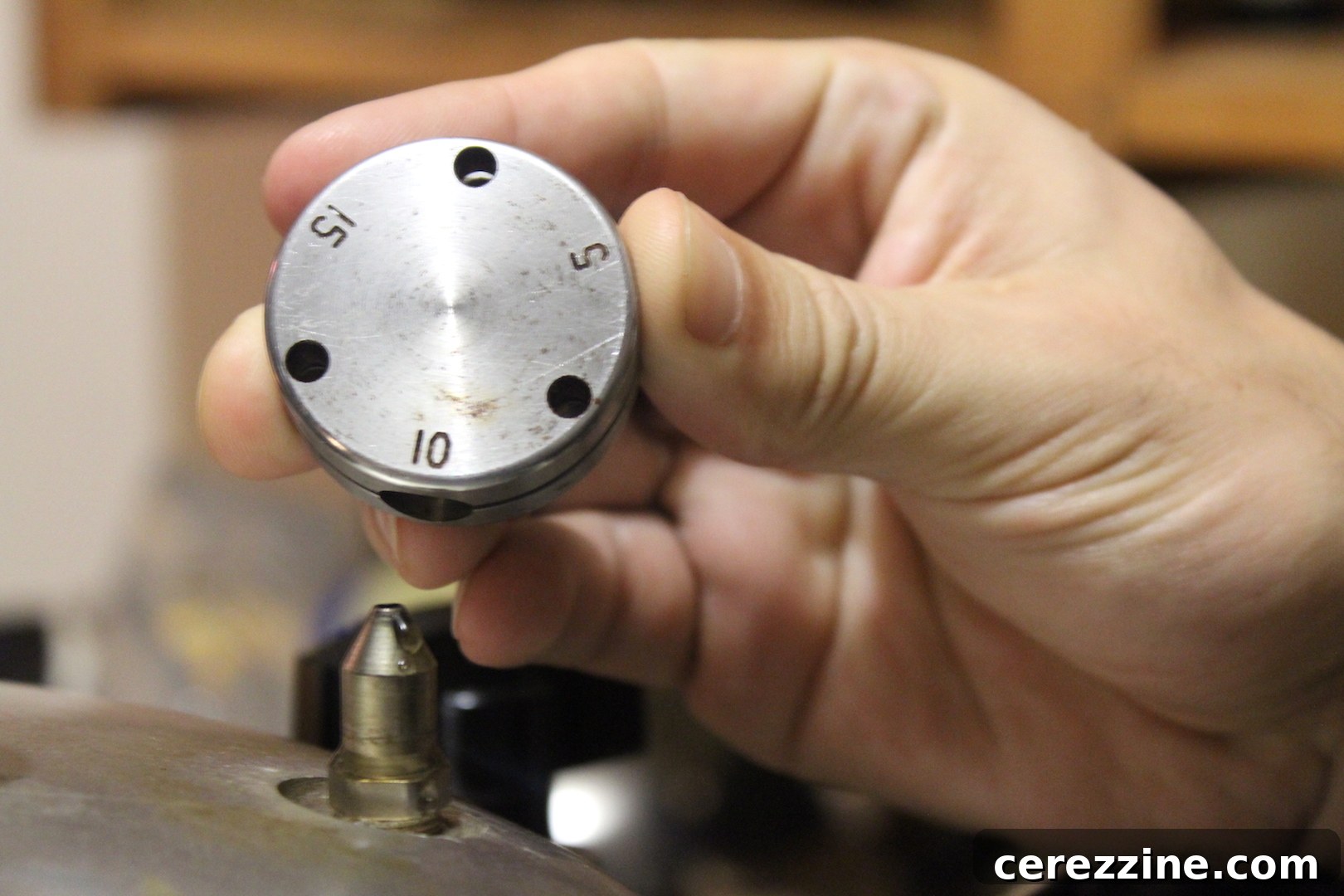
This fixed-setting characteristic is also why weighted-gauge canners are often perceived as simpler for everyday use, as they require fewer minor pressure adjustments during the canning process. However, this higher minimum pressure can sometimes have a marginal impact on the texture or quality of certain foods, making them slightly softer than if a more precise lower pressure could be maintained.
Accurately Determining Your Altitude for Canning
Before you can apply any altitude adjustments, the first crucial step is to accurately determine your specific elevation. Fortunately, this process has become significantly easier and more accessible with modern resources.
One of the most straightforward and frequently recommended methods, endorsed by many Cooperative Extension offices, is to perform an online search for your town’s name followed by terms like “altitude” or “elevation.” Many states and local authorities also publish town-by-town or county-by-county altitude charts specifically for canners, which can serve as an excellent quick local reference. The National Center for Home Food Preservation (NCHFP), a highly respected authority, further suggests contacting your local planning or zoning office, checking your town or city’s official website, or reaching out to your local Cooperative Extension office for precise information.
Online mapping tools, such as Google Maps, can also be incredibly helpful, particularly if you need to determine the elevation of a specific property or a rural location that might be distinct from a town’s general elevation. When using these online tools, ensure that the elevation displayed is in feet above sea level, as this is the standard unit used in all canning adjustment charts and guidelines.
If your home or canning location is situated near an altitude cutoff point (e.g., close to 1,000 or 2,000 feet), it is always prudent to seek the most precise elevation number you can obtain. When in doubt, it’s best to round conservatively in the safe direction, meaning rounding up to the next higher altitude category if you are on the cusp. Once you have identified your exact altitude, it’s highly recommended to record it in a visible place—perhaps in your canning notebook or taped inside a cabinet door—to eliminate the need to look it up for every canning session.
For instance, in my experience, Google Maps proves invaluable. Living in Vermont, a state characterized by rolling hills, my town center might be nestled in a river valley at 300 to 400 feet. However, my house, located just a couple of miles away, sits over 1,000 feet. In such cases, a general town-based elevation guide would be inaccurate, whereas a pinned location on Google Maps provides a much more precise and reliable altitude reading for my specific canning location.
Essential Practical Notes for Safe Pressure Canning at Altitude
Beyond understanding the charts and your elevation, a few practical considerations are paramount for safe and successful pressure canning at any altitude:
- Location Matters: The altitude adjustment is strictly based on where the canner is actively being used. It is not determined by where your ingredients were grown, where the recipe author resides, or the elevation listed for the nearest major city. If you are canning at your residence, particularly if it’s on a hill or distinct from the main town center, use the actual elevation of your canning location whenever possible.
- Adhere to Tested Recipes: These altitude adjustments are designed to be applied to scientifically tested pressure canning recipes. You are adjusting the pressure within an already approved and validated process, not creating or modifying your own canning procedures. Never attempt to invent a new recipe or processing method; always rely on authoritative sources like the USDA or Cooperative Extension for tested guidelines.
- Gauge Accuracy is Critical: If you use a dial-gauge pressure canner, it is imperative to have the gauge checked for accuracy on a regular basis. Many Extension services across various regions offer this crucial verification service. Dial gauges are the type that requires this extra attention, as they can drift out of calibration over time due to wear, drops, or general use. Annual testing, especially before each canning season, is a best practice to ensure your pressure readings are always reliable.
FAQs About Altitude Adjustments for Pressure Canning
For weighted-gauge canners following the standard chart, usually no adjustment is needed for elevations up to and including 1,000 feet. The increase to 15 pounds pressure begins *above* 1,000 feet. For dial-gauge canners utilizing the common USDA-style 11 PSI table, the initial pressure increase typically becomes necessary when canning above 2,000 feet.
While it might seem safer to always use 15 pounds pressure, it is generally recommended to use the precise pressure specified for your altitude. Using higher pressure than necessary is only advisable if it aligns with the safe guidance for your specific canner and recipe. However, consistently using excessively high pressure can negatively impact the quality of your preserved foods. It can lead to vegetables becoming overly soft or mushy, increase the likelihood of liquid loss from your jars, and potentially degrade the overall texture and appearance of your product. For instance, when canning corn or canning sweet potatoes, applying more pressure than needed can significantly soften the texture, exacerbate liquid siphoning, and even cause naturally sugary foods to darken more than desired. The primary objective is always to employ the correct, tested pressure for your specific altitude, not merely the highest available setting.
No, this is a common misunderstanding. For pressure canning, the standard and critical guidance from all reputable food preservation authorities is to increase only the pressure setting, not the processing time. The processing time specified in tested recipes is determined to be sufficient once the correct internal temperature (achieved through proper pressure adjustment) has been reached.
These two canning methods address the challenge of altitude in fundamentally different ways, primarily due to their temperature capabilities. Water bath canning processes food at the boiling point of water, which decreases at higher elevations. Since a water bath canner cannot significantly raise the temperature beyond this variable boiling point, it compensates for the lower temperature by increasing the duration of the processing time to ensure adequate heat penetration for safety. Pressure canning, conversely, has the inherent ability to achieve much higher temperatures than the boiling point of water. Therefore, to counteract the effect of lower atmospheric pressure at altitude, it compensates by increasing the PSI. This elevated pressure directly raises the boiling point and internal temperature within the canner, ensuring that the required high target processing temperature is consistently maintained throughout the specified (and unchanging) processing time.
If you are using a dial-gauge pressure canner, it is highly recommended to have the gauge checked for accuracy on a regular basis. Many Cooperative Extension offices suggest testing it annually, ideally before the start of each canning season. Additionally, the gauge should be tested any time the canner has been dropped, visibly damaged, or if you suspect its readings might be inaccurate or “off.” This ensures that the pressure displayed on your dial accurately reflects the internal pressure and corresponding temperature, maintaining the safety of your home-canned foods.
In conclusion, altitude adjustments for pressure canning are far less complicated than they initially appear. Once you accurately determine your specific elevation and identify whether you are using a dial-gauge or weighted-gauge canner, the entire process typically boils down to a single, quick reference to an altitude chart. This simple step is critical for ensuring food safety.
The good news is that implementing these adjustments is straightforward. The truly important aspect is recognizing that these adjustments genuinely matter. Pressure canning relies on reaching and sustaining precise temperatures for the full, scientifically tested processing time, and altitude directly impacts the boiling point and, consequently, the achievable temperature within your canner. Ignoring altitude adjustments compromises this critical safety equation.
Therefore, if you engage in pressure canning at any elevation above sea level, always take that crucial extra minute. Confirm your altitude, consult the appropriate chart, and consistently apply the correct pressure every single time. Your vigilance ensures the safety and quality of your homemade preserved foods.