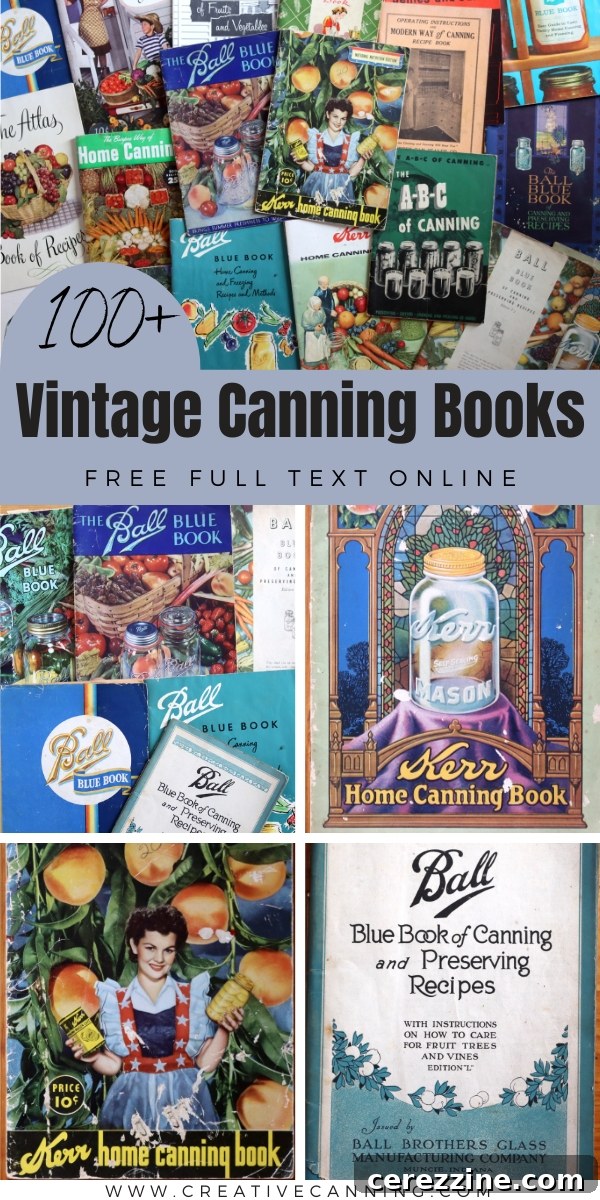
Historical canning books offer a fascinating window into the past, revealing vastly different practices, terminology, and even a divergent understanding of what “canning” truly meant a century ago. Delving into these vintage texts highlights not only the ingenuity of previous generations but also the remarkable evolution of food preservation science and safety.
(Please note: These books and resources are provided solely for historical reference and academic interest. The National Center for Home Preservation unequivocally advises against using any canning guide published before 1994. Such older guides contain practices that are now considered outdated and do not meet contemporary food safety standards. This article does not endorse or recommend the use of these historical canning methods for modern food preservation.)
As an enthusiastic home canner, I find immense joy in exploring old cookbooks, and vintage canning guides hold a special allure. Home canning in the early 1900s was a distinctly different endeavor compared to today. Not only has the terminology shifted, but the fundamental practices and underlying scientific understanding of food safety have undergone significant transformations.
Many stories circulate about grandmothers and great-grandmothers who would water bath can green beans for three hours or more. While these practices indeed existed, studying the original source material reveals nuances often lost through generations. Though such methods are no longer endorsed by modern food safety authorities like the USDA, they did, to some extent, achieve preservation, albeit with **critically important caveats**. The resulting products were far from what we now associate with the “canned goods” found on supermarket shelves today.
To be absolutely clear, I do not endorse any of these historical canning methods, and there are compelling scientific reasons why they are no longer considered safe. However, understanding these past practices can shed light on why previous generations utilized them and often lived long lives. It’s akin to understanding that, while statistically unlikely, engaging in Russian Roulette is perfectly safe five out of six times – but that certainly doesn’t make it a recommended activity.
(Interestingly, you may find that many recipes for high-acid foods like jams and pickles are surprisingly similar to those in modern sources. Some aspects of preservation endure, while others evolve significantly over time.)
My aim in presenting these historical resources is to offer a more accurate understanding of how canning was historically performed. The entire process of canning, and even the basic definition of “canned food,” was interpreted differently in the early 20th century. For me, as a passionate home canner, it’s incredibly enlightening to recognize the vast changes that have occurred and to immerse myself in the rich history of food preservation. This enjoyment of historical context, however, must never be mistaken for a recommendation to implement these outdated guides in your contemporary kitchen.
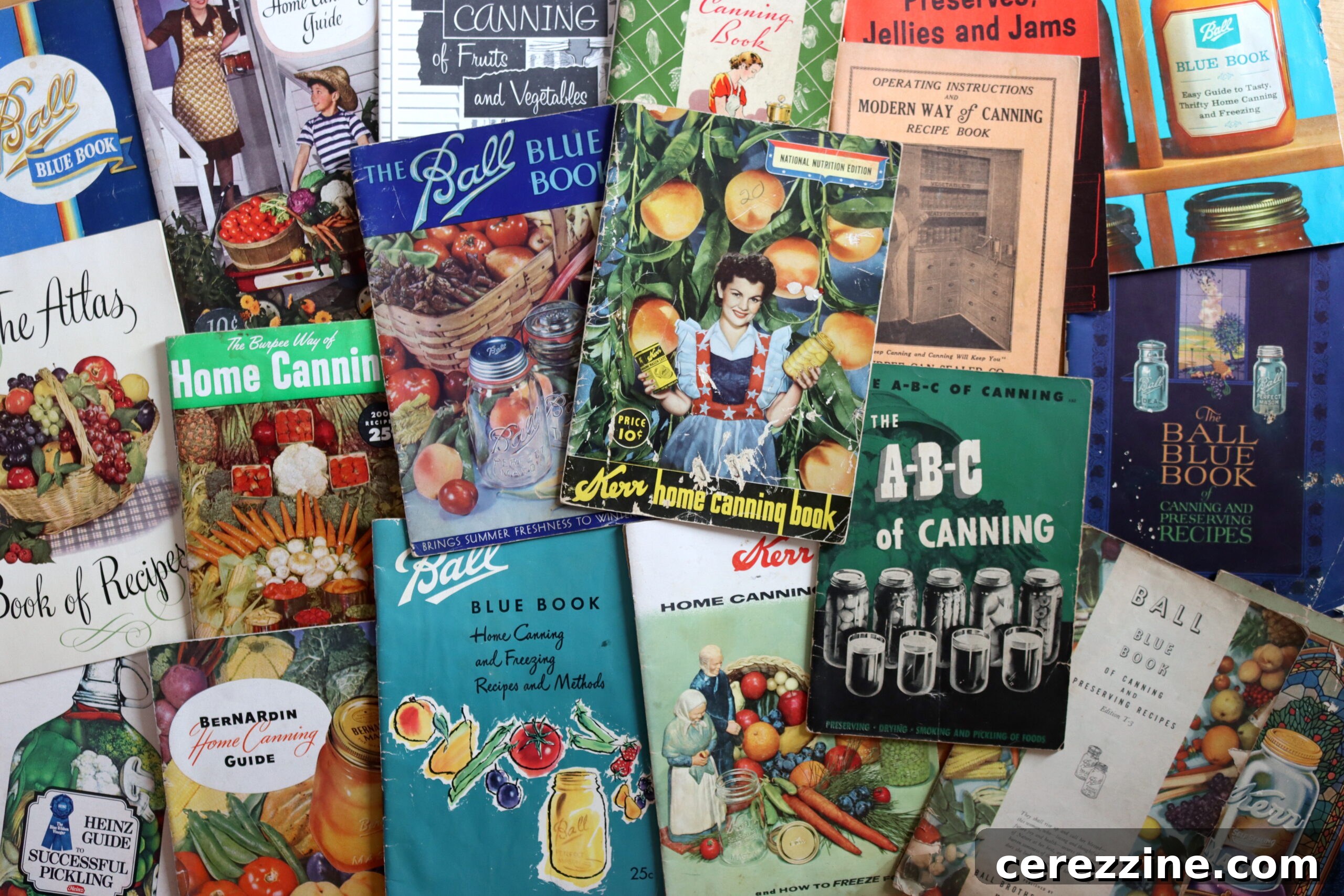
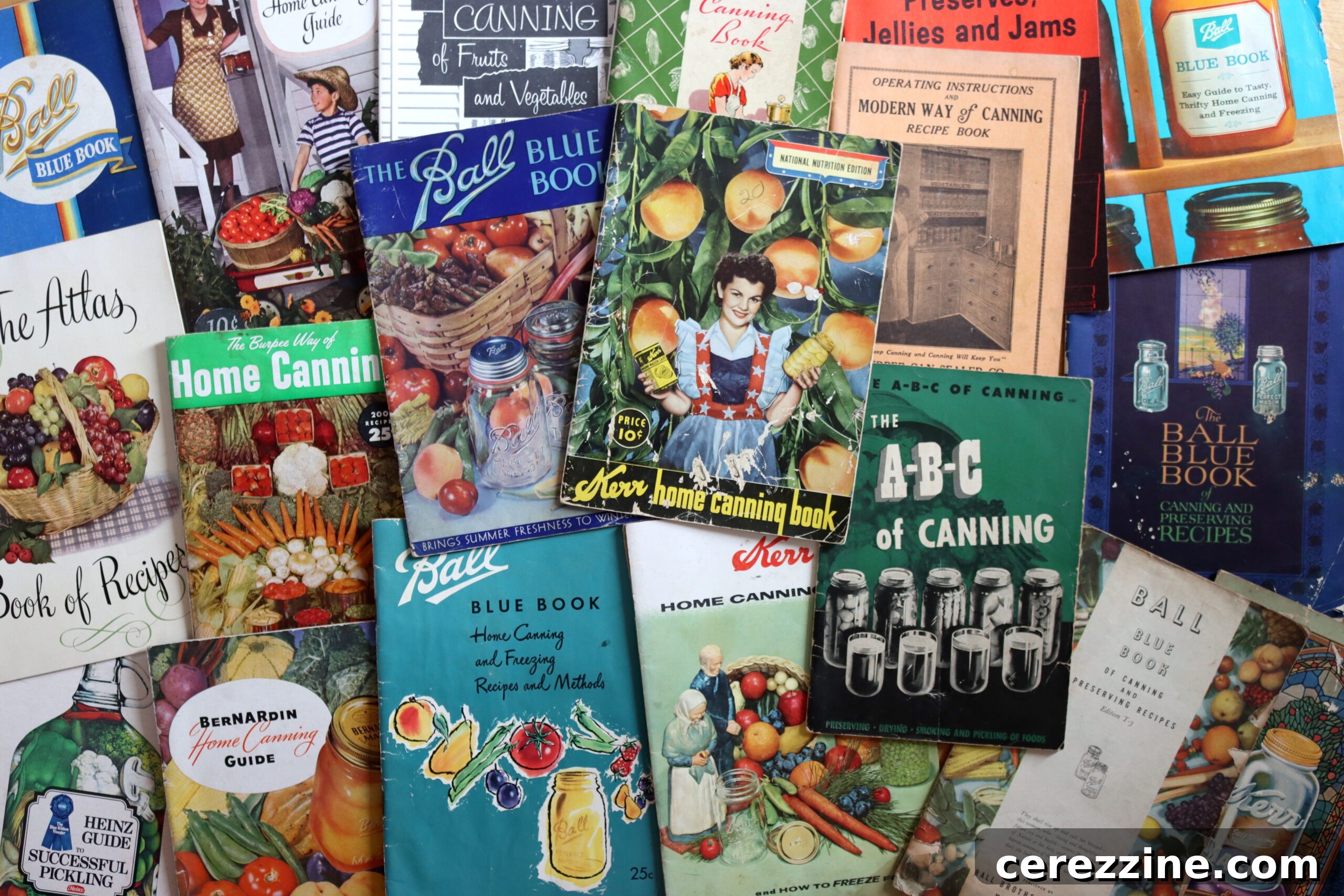
Over the years, I’ve amassed a considerable collection of vintage canning books from various sources, including garage sales, eBay, and Etsy. I treasure them as tangible links to the past, much like my collection of antique canning jars used for display. Many of these historical texts are now available in free PDF formats online. Below, you’ll find links to dozens of these resources, inviting anyone curious about the history of canning to explore them.
Before diving into the extensive list of over 100 historical canning books, it’s crucial to grasp some of the unique terminology and practices you’ll encounter within their pages.
Historical vs. Modern Canning: A Paradigm Shift in Food Preservation
In contemporary canning, high-acid foods such as jams, jellies, and pickles are water bath canned at 212 degrees Fahrenheit (100 degrees Celsius). This process effectively sterilizes them because the high acidity prevents the survival of dangerous bacteria like Clostridium botulinum. Conversely, low-acid foods, which include most vegetables and all meats, absolutely *must* be canned in a pressure canner at significantly higher temperatures—typically above 240 degrees Fahrenheit (116 degrees Celsius). This elevated temperature is essential to sterilize the jar’s contents completely. In the modern era, we equate canning with sterilization, expecting to be able to safely consume the contents directly from the jar with a fork.
However, this expectation of immediate edibility and complete sterilization was not always the norm. Historically, “canned food” did not automatically imply that the contents of the jar were safe for immediate consumption as-is.
Processing vs. Sterilization: Understanding the Historical Distinction
Even as late as the 1920s, canning manuals explicitly discussed the difference between mere “processing” and true “sterilization.” Canners of that era were acutely aware that water bath canning low-acid vegetables and meats did not genuinely sterilize the contents. Instead, this older practice merely “processed” them sufficiently to allow the canned goods to be stored in a cold cellar for a limited period, often preventing visible spoilage like mold or bubbling, but not eliminating all dangerous microorganisms.
A USDA publication from 1923 starkly illustrates this awareness: “The spores of some bacteria have been found to resist the temperature of boiling water for 38 hours. Of course, no one would think of cooking young, tender vegetables for that length of time.” Despite this knowledge, the same publication recommended processing jars for 1 to 3 hours. This processing time was understood to merely extend shelf life in cool storage, acknowledging that botulism spores could still survive, even at the time these canning books were being written. Botulism, a deadly neurotoxin, does not affect the flavor of food, necessitating additional precautions at the point of serving to de-toxify the jar’s contents.
The Re-Boiling Imperative: A Crucial Safety Step of the Past
Home canners in the early 1900s knew that if they chose to water bath can low-acid items like vegetables and meats, these products could absolutely not be served raw. The contents of the jars had to be boiled on the stovetop for a minimum of 15 minutes immediately before serving. This critical step was specifically designed to denature any botulism toxin that might have developed within the jar. While botulism was rare, historical canners understood the risk and chose not to take chances. Jars were kept in cool cellars, and their contents were invariably re-cooked prior to consumption.
Every old canning book from the 1930s and 40s rigorously stipulated that vegetables and meats, without exception, *must* be re-boiled before serving. Even when these books offered dual recommendations—pressure canning meat for under an hour alongside water bath canning meat for three or more hours—the end result was treated identically: all required re-boiling. It was explicitly warned that one should not even taste or lick one’s fingers after opening a jar that hadn’t yet been re-boiled. Can you envision such a warning label on a modern supermarket product? “Warning: Do not eat raw; it is deadly toxic. Boil for 15 minutes before serving.” Clearly, our modern expectations of food preservation are fundamentally different from those of the past. Preservation, historically, did not imply an infinite, unconditionally safe shelf life.
Today, the term “canning” carries a very different meaning. We expect low-acid meats and vegetables to be processed to complete sterilization at high temperatures in a pressure canner (240°F or higher). We anticipate being able to store canned goods safely at room temperature, implicitly assuming that the canning process has rendered the contents entirely sterile. This crucial shift in definition and expectation is precisely why modern canning authorities no longer endorse historical practices, underscoring the vital evolution of food safety standards.
Serial Canning: A Creative, Yet Risky, Approach to Spore Management
Among the various historical techniques, “serial canning” stands out as a particularly intriguing, yet highly risky, method. This process involved water bath processing jars of meat and vegetables for several hours, not once, but repeatedly over the course of multiple days. The audacious goal behind this multi-day approach was to intentionally encourage botulism spores, which are dormant, to sprout within the anaerobic (oxygen-free) conditions created during the first day’s processing. The jars would then be reprocessed the following day, with the aim of killing off these newly germinated, more vulnerable spores. A third reprocessing on day three was intended to eliminate any remaining, late-hatching spores.
Once again, this method clearly demonstrates that home canners of the era understood that while boiling temperatures could kill active bacteria, even prolonged boiling (3+ hours) was insufficient to destroy resilient botulism bacterial spores. Serial canning was a creative, albeit unproven and dangerous, attempt to circumvent this problem. However, even with this elaborate multi-step process, it was still universally understood that the contents of serial-canned jars absolutely *required* thorough recooking at serving time to ensure any surviving toxins were denatured.
Open Kettle Canning: Simplicity with Significant Sacrifices in Safety
The practices for high-acid foods like jams, jellies, and pickles also differed significantly in the past. Today, these are safely sterilized through water bath canning, a method effective because botulism and other dangerous toxins cannot thrive in acidic conditions. However, “open kettle canning,” an older practice for jams and pickles, is still surprisingly employed in some parts of the world, particularly in Europe. In this method, jams and jellies are simply ladled directly from a boiling pot into sterilized jars and then sealed with lids, without any subsequent water bath processing.
These open-kettle practices were also common in the early 1900s in America. What European canners continue to understand today, and what Americans understood back then, is that open-kettle canned jars of jam are *not* truly sterilized and remain susceptible to spoilage. This method is typically reserved for high-sugar jams, where the exceptionally high sugar content acts as a preservative, inhibiting bacterial growth. Even with high sugar, historical guidance (and modern European practice) acknowledged that these jars must be kept in cool conditions and are still prone to molding over time, highlighting a compromise in long-term stability and safety compared to modern water bath canning.
Oven Canning: A Flawed Experiment in Heat Transfer
Oven canning, sometimes utilized for high-acid preserves, involved heating jars in a conventional oven instead of a boiling water bath. At the time, the logic seemed straightforward: heat is heat, and why steam up the kitchen with a water bath when you could simply process jars in the oven? This method offered a perceived convenience that ultimately proved to be unsafe and unreliable.
It was later discovered that the dry heat of an oven is far less efficient at transferring heat into the contents of canning jars than boiling water. This inefficiency meant that achieving proper processing temperatures throughout the jar took considerably longer, if it was achieved at all. Furthermore, oven canning significantly increases the risk of jar breakage due to thermal shock, a problem far less prevalent with water bath canning. For these critical safety and practical reasons, this method has been entirely abandoned. While perhaps marginally more dependable than open kettle canning in preventing immediate spoilage, it’s virtually impossible to determine accurate oven canning times due to the inconsistent heat circulation within an oven compared to a pot of boiling water.
Despite its drawbacks, specific oven-canning books from the 1910s and 1920s documented the process and even attempted to market specialized “canning ovens,” like this historical example.
A contemporary misunderstanding often associates “oven canning” with practices like canning flour or cakes – items that were decidedly *not* canned historically. Attempting to can these dry or baked goods can introduce significant spoilage risks and food safety hazards. While raw flour, properly stored in a cool, dry, and sealed container, can last a long time, “canning” it in a jar can actually create anaerobic conditions favorable for spoilage and toxin production. This particular misinterpretation is a prime example of how old-time canning practices are vastly misunderstood in the modern era, and it’s certainly not something our great-grandmothers would have done for preservation!
Decoding Historical Canning Terminology: Understanding the Language of Past Preservation
The canning books from the early 1900s also shed light on the pervasive issue of spoilage, acknowledging that a shorter shelf life was an inherent consequence of methods like open kettle canning (then often referred to as “hot pack canning”). These historical texts frequently dedicate entire pages to methods for managing and periodically checking for spoilage in jars, recognizing that these items were “processed” but not truly sterilized.
Ironically, what we refer to today as “Water Bath Canning” or “Hot Water Bath Canning” was historically known as “Cold Pack Canning.” This nomenclature stemmed from the fact that the jars were packed with cooler (not boiling hot) food, and then processed in boiling water to create a seal and aid preservation. The term “Hot Pack” then referred to methods like open kettle canning, where boiling hot food was poured directly into jars and capped without further processing in a water bath.
Once you recognize that these vintage books describe a preservation paradigm fundamentally different from our modern understanding of “canned goods,” they become incredibly educational and genuinely enjoyable to read. They serve as primary sources, allowing us to learn about food preservation as it genuinely existed in the past.
It is true that some individuals still practice these traditional canning techniques today. For those who choose this path, it is absolutely essential to fully understand that while these methods *can* achieve a form of preservation, they do not operate with the same safety assurances as modern canning. As our great-grandmothers intuitively knew, if one intends to revive these older practices, it is paramount to do so correctly, adhering to all the original, often stringent, steps and precautions that were understood to be critical for ensuring safe food at the table.
Even with historical precautions, there’s a compelling reason why pressure canning remains the *only* recommended method for safely preserving low-acid meats and vegetables today. The inherent risks associated with even handling jars that could potentially harbor botulism toxin are significant. Modern pressure canning, meticulously following current published processing times, offers a vastly superior and scientifically validated level of safety that outdated methods simply cannot match.
A Curated Collection of Vintage Canning Books and Historical Resources
This extensive list comprises old canning books and related resources that are now in the public domain, meaning their copyrights have expired. You’ll find works by individual authors, alongside publications from prominent canning companies and government agencies, each offering unique insights into historical food preservation.
General Vintage Canning Books by Individual Authors
These are early works often penned by individuals, distinct from the corporate giants or government bodies that would later dominate the canning literature.
- The Book For All Households: Preserving Animal and Vegetable Substances (1811) – A landmark publication, this is among the very first canning books ever produced. It was commissioned by the French Minister of the Interior with the goal of creating a comprehensive guide for preserving foods, particularly for long sea voyages. Available via the Library of Congress.
- The Preservation of Food (1857)
- The Art and Mystery of Curing, Preserving and Potting All Kinds of Meats, Game and Fish; Also the Art of Pickling and The Preservation of Fruits and Vegetables (1864) By A Wholesale Curer of Comestibles
- The art and mystery of curing, preserving, and potting all kinds of meats, game, and fish; also, the art of pickling and the preservation of fruits and vegetables (1864)
- Peterson’s Preserving, Pickling and Canning Fruit Manual (1869)
- Canning and Preserving (1887) by Mrs. S.T. Rorer
- The Secrets of Canning: A Complete Exposition of the Theory and Art of the Canning Industry (1890) By Ernest Schwaab
- Ayers Preserve Book(1893)
- The Art of Canning and Preserving as an Industry (1901) by Jan Packrette
- The Story of Canning and Recipes (1910)
- Canned Foods: Fruits and Vegetables (1913) by Florence Corbett
- Canning, Preserving, and Pickling (1914) by Marion H Niel
- Successful Home Canning(1914) by Muriel Gilbert
- Canning, Preserving and Jelly Making (1915) by Janet M Hill
- The Canning of Fruits and Vegetables (1916) by Justo Zavalla
- Canning and How to Use Canned Foods (1916) by AW and KG Bitting
- Jam Book (1916) by May Byron
- Canning and Preserving(1917) By Mary Wright
- War food; practical and economical methods of keeping vegetables, fruits and meats (1917)
- Successful Canning and Preserving: A Practical Handbook for Schools, Clubs and Home Use (1917) by Ola Powell
- Canned Fruit, Preserves, and Jellies (1917) By Maria Parloa
- Every Woman’s Canning Book: The A B C of Safe Home Canning and Preserving (1918) by Mary B. Hughes
- Home and Farm Food Preservation (1918) William Vere Cruess
- Preserving and Pickling (1919) by Gesine Lemcke
- Home Canning and Drying Of Fruits and Vegetables (1918, National War Garden Commission)
- Cold Pack Canning (1919)
- Every Step in Cold Pack Canning (1920) Grace Gray
- A Little Preserving Book for a Little Girl (1920) Amy Waterman
- Canning, Pickling and Preserving (1920s) By Winthrop College for Women in South Carolina
- Laboratory Manual of Fruits and Vegetable Products (1922) William Vere Cruess and AW Christie
- A Complete Course in Canning (1924)
- Lorain Oven Canning (1928)
- Best Pickle Recipes (1931) From the Readers of Better Homes and Gardens
- Home Canning for Better Family Meals (1932) Emma Sparks
- The A.B.C. of canning : preserving, drying, smoking and pickling of foods (1942) by Ruth Berolzheimer
- Old Time Pickling and Spicing Recipes (1953)
Vintage Cookbooks That Include Canning Recipes
While not exclusively dedicated to canning, these vintage cookbooks reflect a time when preserving was an integral part of home economics. They often contain a rich selection of canning and preserving recipes, especially for popular items like jams, jellies, pickles, and relishes, offering a glimpse into broader culinary practices.
- Practical Housekeeping: A Careful Compilation of Tried and Approved Recipes (1883)
- What to Eat and How to Cook It With Rules For Preserving, Canning and Drying Fruits and Vegetables (1874) by John Cowan
Old Ball Blue Book Editions: Tracing a Canning Legacy
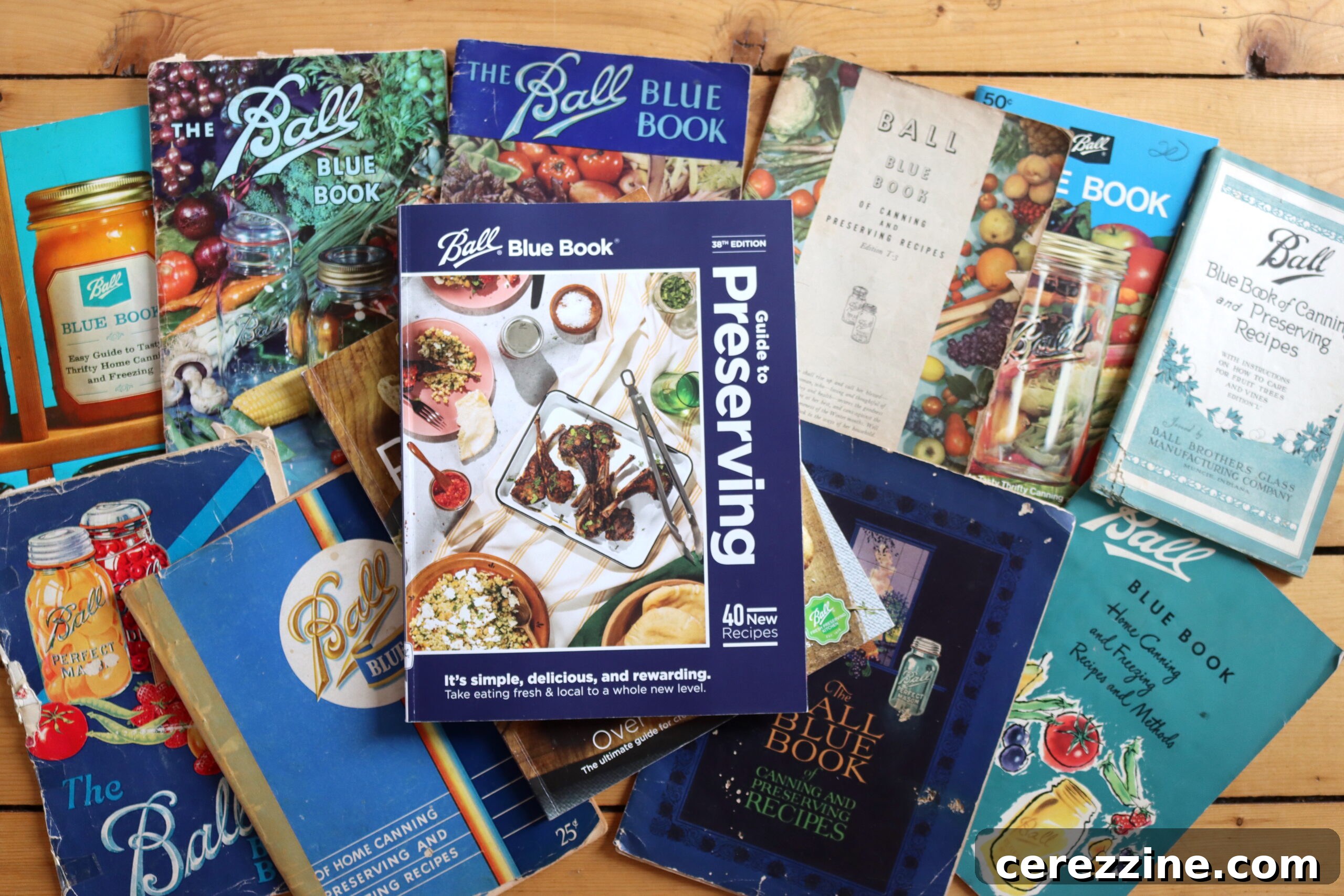
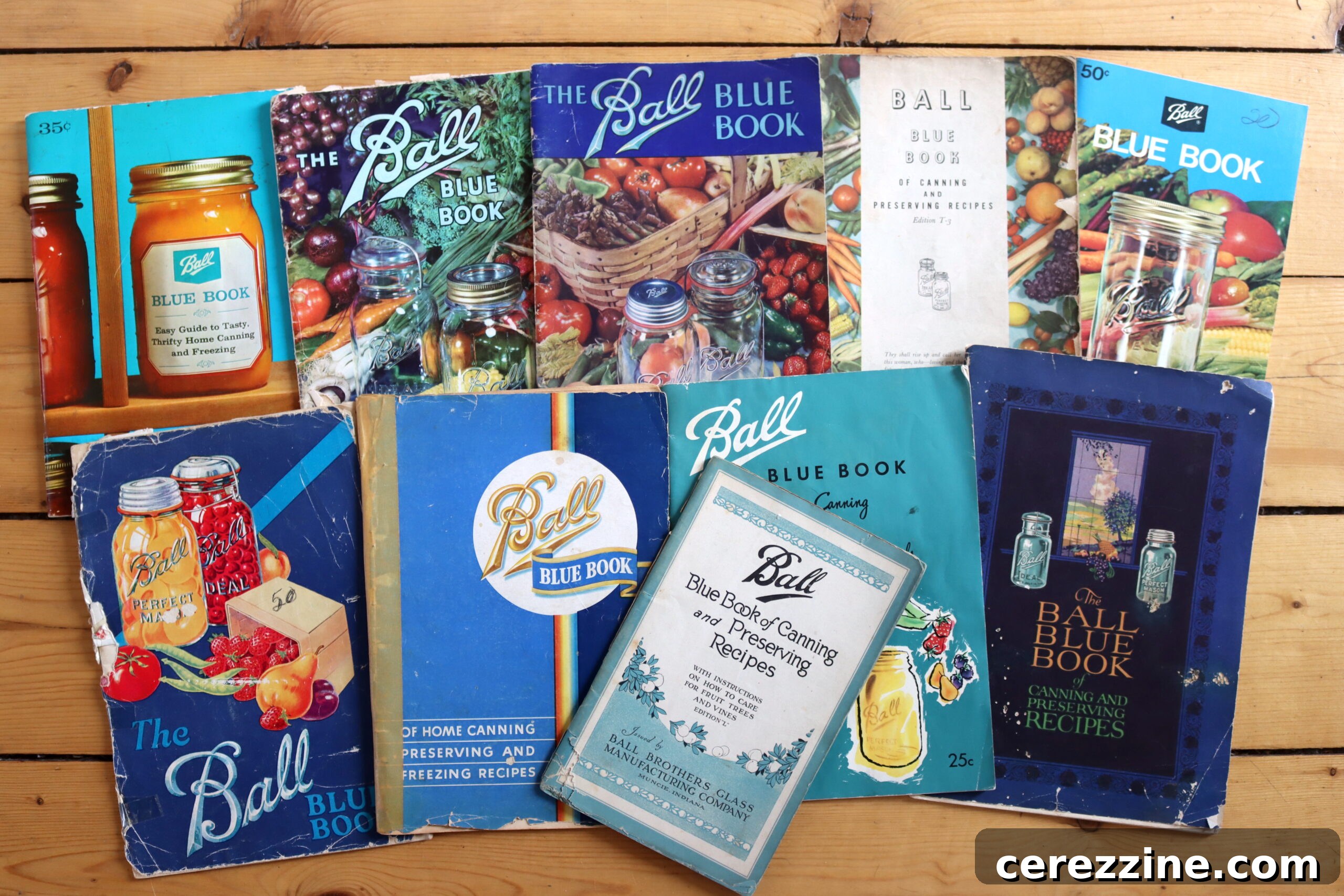
The Ball Blue Book has long been a cornerstone resource for home canners, recently celebrating its legacy with a 100th-anniversary edition and its new 38th edition in 2024. These editions offer a blend of tradition and updated scientific guidance. Many of the earliest editions are now out of copyright and are digitally archived on various university library websites, allowing us to trace the evolution of Ball’s recommendations and the broader history of home canning. (For more on the latest updates, see the 38th edition of the Ball Blue Book, and explore the history of the Ball Blue Book.)
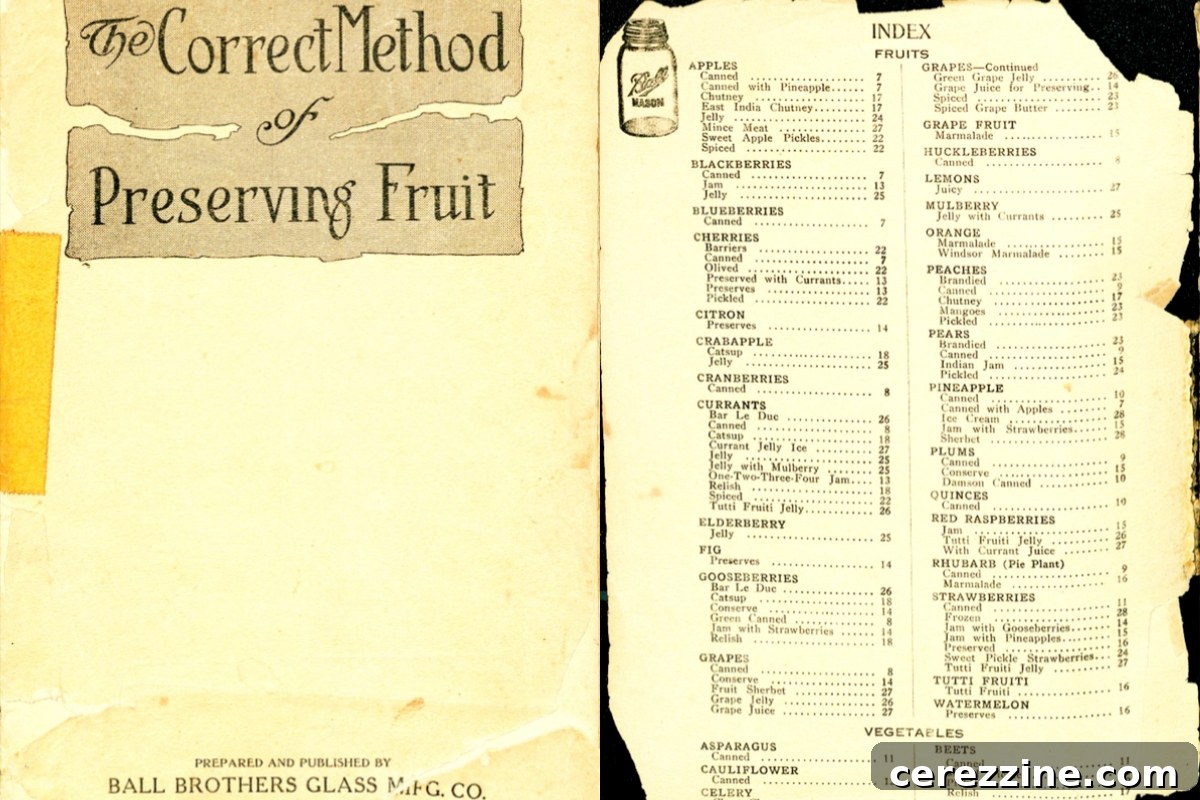
- The Correct Method of Preserving Fruit (1909): This seminal publication marks the true first edition of what would evolve into the “Ball Blue Book,” though it carried a different name until 1916. Initially a concise pamphlet from the jar manufacturer, it eventually expanded into a comprehensive book with over 100 printings. A digital copy of this historical document was graciously scanned for me by the University of Iowa.
- Ball Blue Book Edition M (Circa 1920/1921): This particular copy lacks a definitive print date. However, its use of the “Ball Brother’s Glass Manufacturing Company” name, which was updated to “Ball Brother’s Company” in 1922, helps date it. Given that the preceding “Edition L” was released shortly after WWI (around 1919 or 1920), Edition M is estimated to be from 1920 or 1921.
- How to Use the Foods You Can (1924, Ball Brother’s Company): This companion guide to the Ball Blue Book wasn’t primarily a canning manual itself, but rather focused on transforming home-canned ingredients into delicious meals and baked goods. Its recipes directly reference content from Blue Book Edition M, offering creative ways to incorporate pint and quart jars of fruit, meat, and more into everyday cooking.
- Ball Blue Book of Canning and Preserving (1943) Edition “V”
Old Atlas Canning Company Book Editions
While perhaps not as widely recognized as Ball Canning today, Atlas was a significantly influential brand in the early 1900s canning landscape. Tracing their early publications can be challenging, but new discoveries will be added as they become available.
- It’s All In the Jar: Preserving Recipes Worth Preserving (Circa 1900, Atlas Mason Jars)
Old Kerr Canning Guides: Comprehensive Preservation Advice
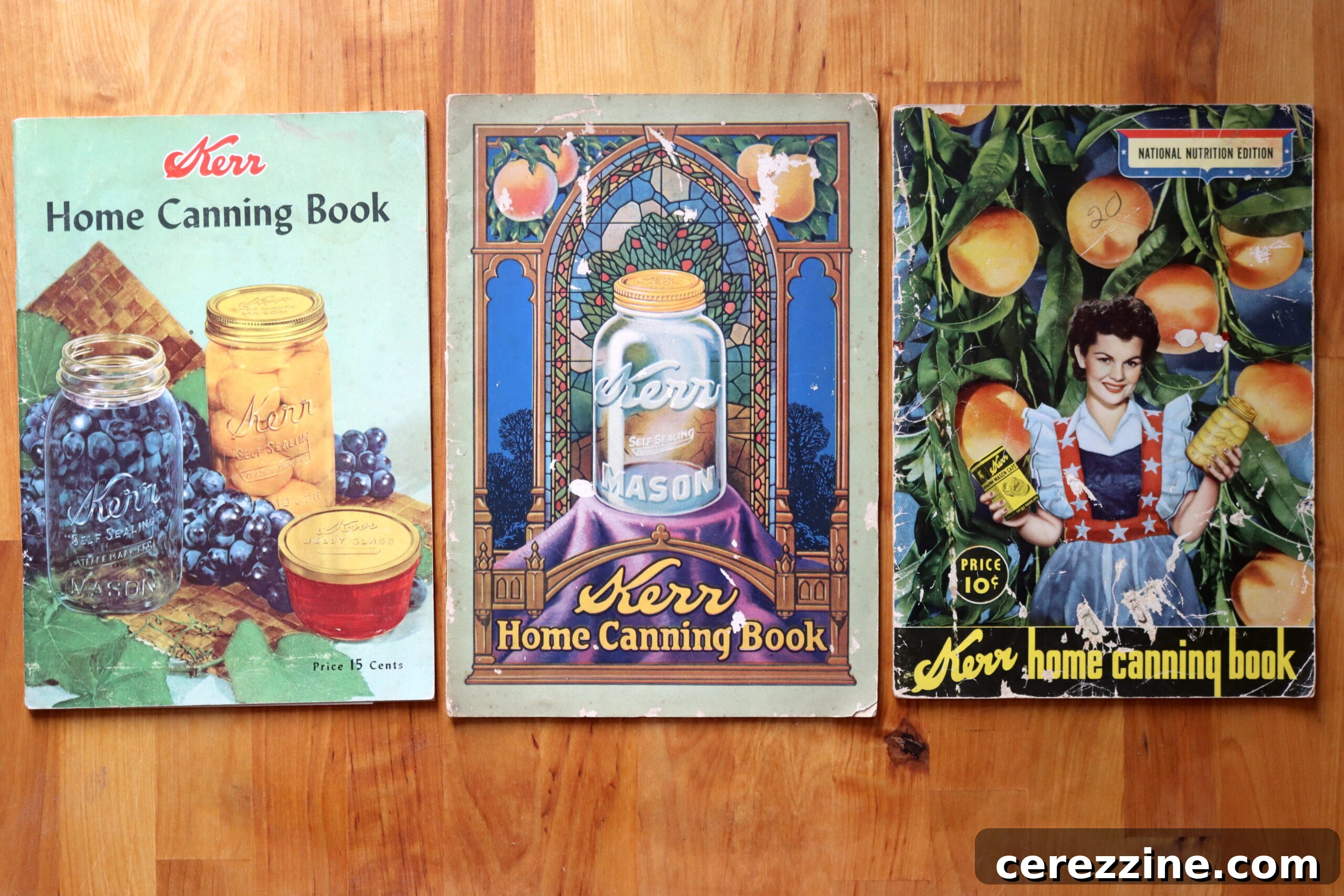
Similar to Ball Canning, Kerr also produced a series of valuable recipe books and canning guides. These booklets, typically 40 to 80 pages in length, provided detailed instructions and recipes for preserving a wide range of garden produce, encompassing both water bath and pressure canning techniques.
- The Kerr Home Canning Book and How to Freeze Foods(1936)
- Your Guide to Home Canning from Kerr(1938)
- The Kerr Home Canning Book(1940)
- The Kerr Treasure Chest of Home Canning(1945)
- The Kerr Home Canning Book (1955)
Old Canner Manufacturer Guides: Instructions and Vintage Product Insights
These pamphlets and instruction booklets were typically included with the purchase of new canners. Today, modern appliances like the All American Canner come with comprehensive manuals, often nearing 100 pages, detailing instructions for pressure canning nearly every type of food. Similarly, early canner manufacturers provided extensive guidance upon the product’s initial introduction.
Beyond canning instructions, these vintage guides often feature captivating advertisements for long-discontinued canning products, such as massive wood-fired home tomato canners that would have likely required their own dedicated shed, reminiscent of a modern maple sugar house, but solely for tomato preservation.
- The All-American Way of Canning and Cooking with All-American Pressure Cookers of Molded Aluminum (Undated, but likely 1930 to 1940)
- Everything For Canning From National Canning Supply Co. (Undated, but likely 1910 to 1930)
Old US Department of Agriculture & Extension Service Canning Books and Pamphlets
The United States government played a significant role in promoting home canning and food preservation, particularly during World War I and World War II. Beyond encouraging “victory gardens,” they issued countless pamphlets and guides on how to properly store and preserve homegrown produce. Since these publications were produced by the US government, they are generally not subject to the same copyright restrictions as privately published works.
The government’s involvement in canning education continued, albeit less prolifically, into peacetime, with free resources from the 1960s, 70s, and 80s still readily available. Today, most of their up-to-date preservation guidance is provided online via their official websites, rather than through specific printed guides.
- Canned Fruit, Preserves, and Jellies: Household Methods of Preservation (1905, US Department of Agriculture, Farmer’s Bulletin 203)
- Canning Vegetables at Home (1909, US Department of Agriculture, Farmer’s Bulletin 359): This was the inaugural publication by the US Department of Agriculture offering instructions for home vegetable canning. An alternative copy of this bulletin is also available here.
- Home Canning of Fruits and Vegetables (1910) North Carolina Department of Agriculture
- Canning Business for the Farm Home (1913) Cornell University Extension
- Home Canning (1914) Texas Agriculture Extension Service
- Good Quality and Safe Home Canned Foods (1914) Texas Agricultural Extension Service
- When, what, and how to can and preserve fruits and vegetables in the home (1915) Tuskegee Institute Agriculture Station, Bulletin 26
- Canning, Preserving and Picking (1915) US Department of Agriculture
- Canning Fruits and Vegetables on the Farm (1915) University of Idaho Extension
- Preserves, Pickles and Relishes (1916) West Virginia Agriculture Extension
- Home Canning By the One Period Cold Pack Method (1917 US Department of Agriculture, Farmer’s Bulletin 853): This pamphlet introduced the “cold pack method,” which is essentially what we now call modern water bath canning, where food is packed into jars and then processed in boiling water. In contrast, “open kettle canning” was then referred to as “hot pack,” involving simply placing hot food into jars and sealing without further boiling water processing. This specific bulletin was created to instruct university extension classes in the Southern United States.
- Canning and Preserving with 4H Recipes (1917) North Carolina Extension Service
- Principles of Jelly Making (1917) Cornell University Extension
- Home Canning (1917) Connecticut Committee of Food Supply, US Government
- Pickles and Relishes (1917) University of Missouri Extension Service
- Food Saving in Texas: Drying, Brining, Canning and Curing (1917) Texas A&M Extension
- Cold Pack Method for Home Canning (1919) Perdue Extension Bulletin 82
- Jelly Making (1920s) Winthrop College and the US Department of Agriculture
- Home Canning of Fruits and Vegetables (1923, US Department of Agriculture, Farmer’s Bulletin 1211): This pivotal publication was among the first to explicitly acknowledge that “processing” with boiling water alone did not achieve sterilization of jar contents, and that pressure canning was essential for true sterilization.
- Preservation of foods: A guide for canning club members (1924) Virginia A&M Extension
- Homemade Fruit Butters (1928) US Government
- Canning for the Home (1932) Virginia A&M Extension
- Jams, Jellies and Preserves (1936) US Department of Agriculture
- Homemade Jams, Jellies and Preserves (1938) US Department of Agriculture
- Home Canning of Fruits and Vegetables (1941, US Department of Agriculture, Farmer’s Bulletin 1762): A later, revised version of the earlier bulletins 359 and 1211, reflecting updated guidance.
- Cooperative Canning of Fruits and Vegetables (1941, US Department of Agriculture, Cooperative Research and Service Division, Bulletin 47)
- Canning for Victory for Home and Country (1942) University of Georgia Extension
- Canned Food Manual Prepared for the United States Army (1942)
- Wartime Canning of Fruits and Vegetables(1943) US Government
- Canning For The Home (1944) Bulletin 128 Virginia Agricultural College
- Pickle and Relish Recipes (1944) US Government
- Home Canning of Meat (1945) US Government
- Home Canning Processes for Low Acid Foods (1946) US Department of Agriculture Bulletin No. 930
- Home Canning of Fruits and Vegetables (1965) US Department of Agriculture, Home and Garden Bulletin No. 8
- Jellies, Jams, Preserves, Marmalades and Butters (1973) Texas A&M Extension
- Canning, Freezing and Storing Garden Produce (1977) US Department of Agriculture
- Home Canning of Fruits and Vegetables (1983) US Department of Agriculture, Home and Garden Bulletin No. 8
Specific Crop Guides
These publications are not general canning guides, but rather focused resources issued by the US government to assist growers in particular agricultural regions. They offer in-depth information tailored to specific crops, encompassing cultivation and preservation strategies.
- Canning Peaches on the Farm (1910, US Department of Agriculture, Farmer’s Bulletin 426)
- Canning Tomatoes At Home, In Clubs, or For Market (1913, US Department of Agriculture, Farmer’s Bulletin 521)
Additional Historical Canning Book Sources and Further Reading
For those eager to delve even deeper into the rich history of food preservation, these online archives and libraries provide access to an even broader collection of free, digitized canning books and related historical documents.
Canning Book Sources
- UPenn Online Canning and Preserving Library
- Texas Tech Historical Cookbook Archive
- University of Iowa Digital Library
- The Hathi Trust
- Survivor Library Canning Books
- Archive.org Canning and Preserving
Other Helpful Resources on Canning History and Evolution
- The Early History of USDA Home Canning Recommendations
- USDA National Agriculture Library Timeline of Canning History
- How Did We Can? The Evolution of Home Canning Practices
Old Canning Posters, Ads, Cartoons, and Photographs: Visual History of Preservation
These visual resources provide a captivating look at the cultural context of canning throughout history, from government-issued wartime posters to humorous cartoons and candid photographs of home preservers.
- 1946 Patriotic US “Fighting Famine by Canning At Home” Poster
- Canned Goods in a Root Cellar in the 1940’s
- The Weaker Sex (Cartoon)
- Uncle Sam’s Canning Recipe
- Nearing the End of Canning Season