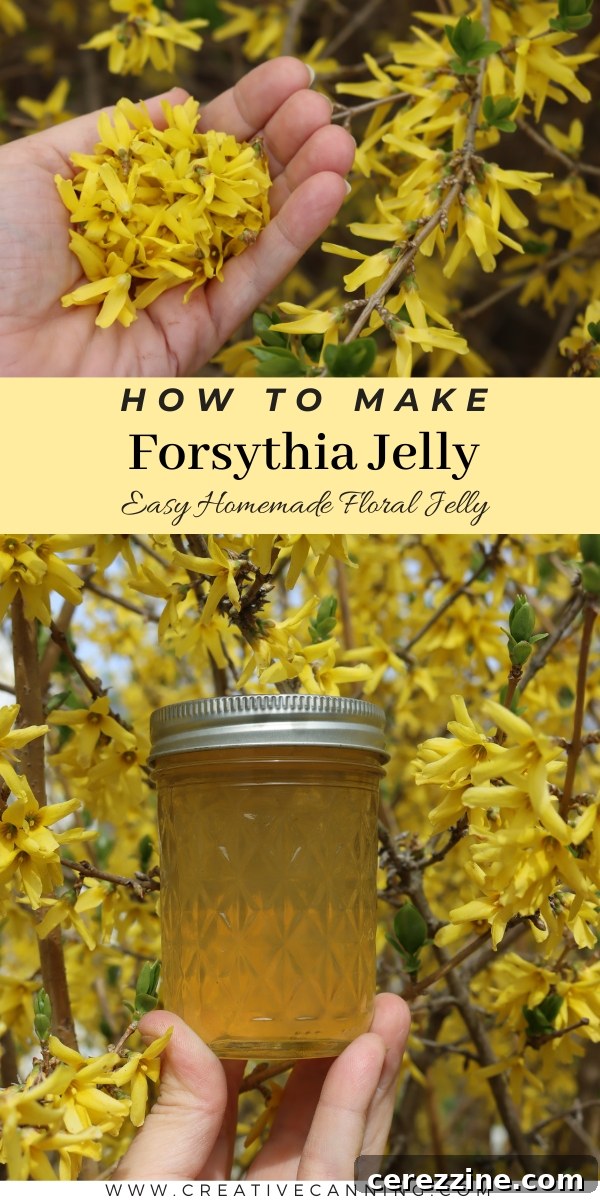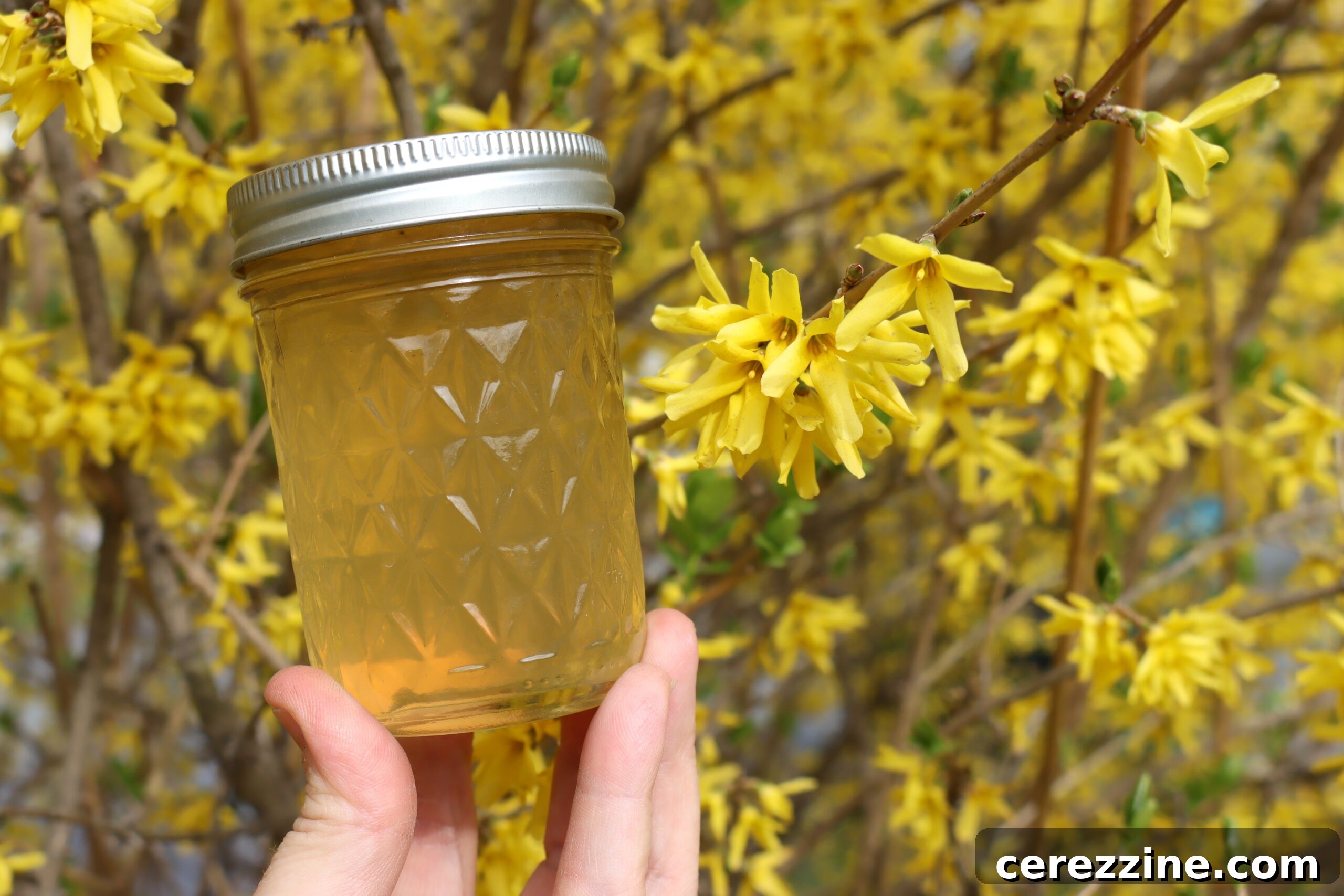
Step into the vibrant awakening of spring with a taste of pure sunshine. Forsythia Jelly encapsulates the ephemeral beauty and delightful flavor of these iconic early spring blossoms, offering a golden jar of warmth to brighten your table throughout the year. Imagine spreading the fragrant essence of spring on your morning toast, even as winter snows still linger or autumn leaves begin to fall.
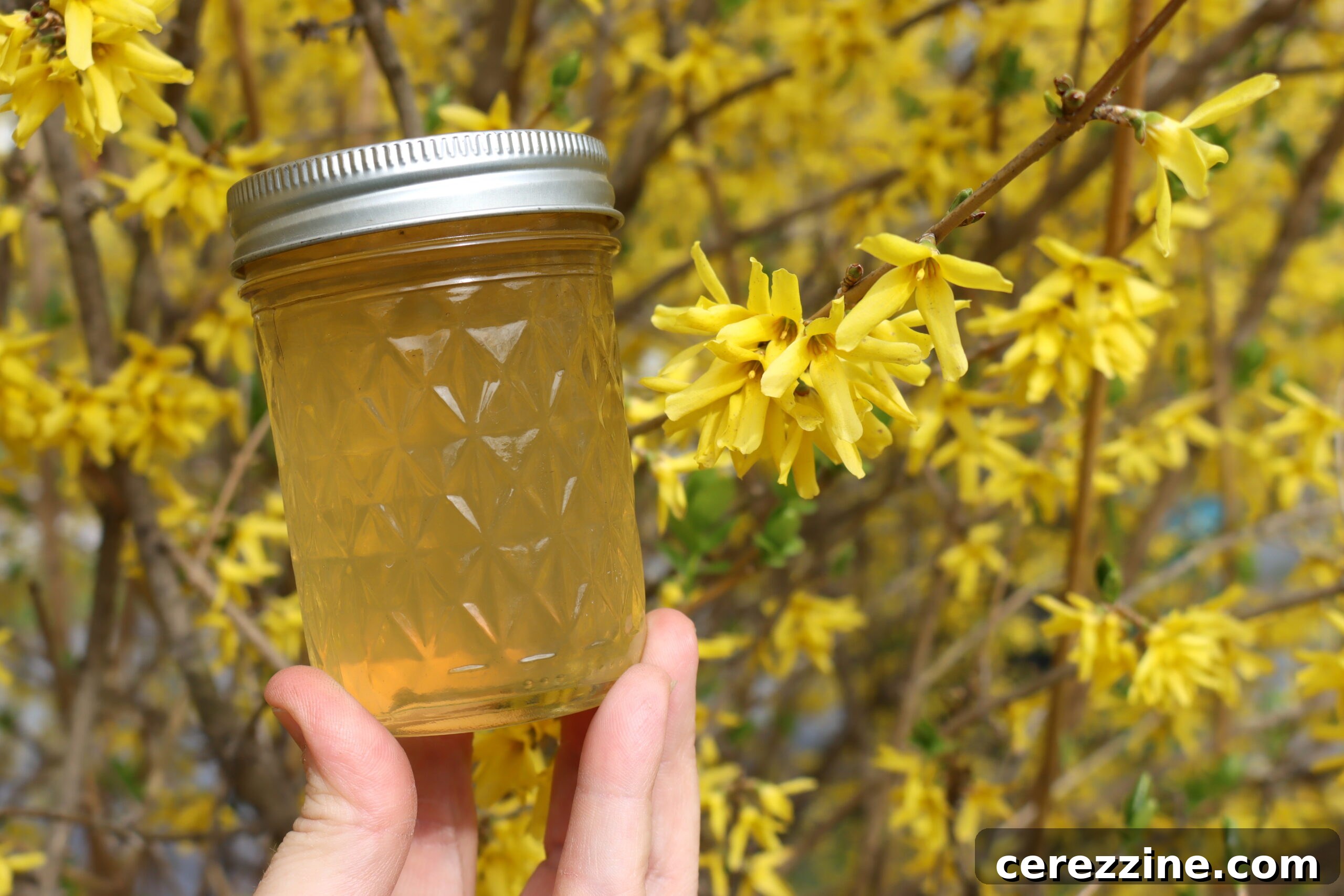
As the last vestiges of winter snow recede, a breathtaking spectacle unfolds across landscapes, particularly in the northern regions where spring’s arrival is eagerly anticipated. The humble forsythia bush, often unremarkable for much of the year, suddenly bursts into a glorious profusion of golden-yellow flowers. This dazzling display is even more striking because it occurs before any leaves emerge, painting the branches in a brilliant, almost incandescent hue that signals the season of renewal. These resilient and incredibly popular bushes are a beacon of hope and a promise of warmer days to come.
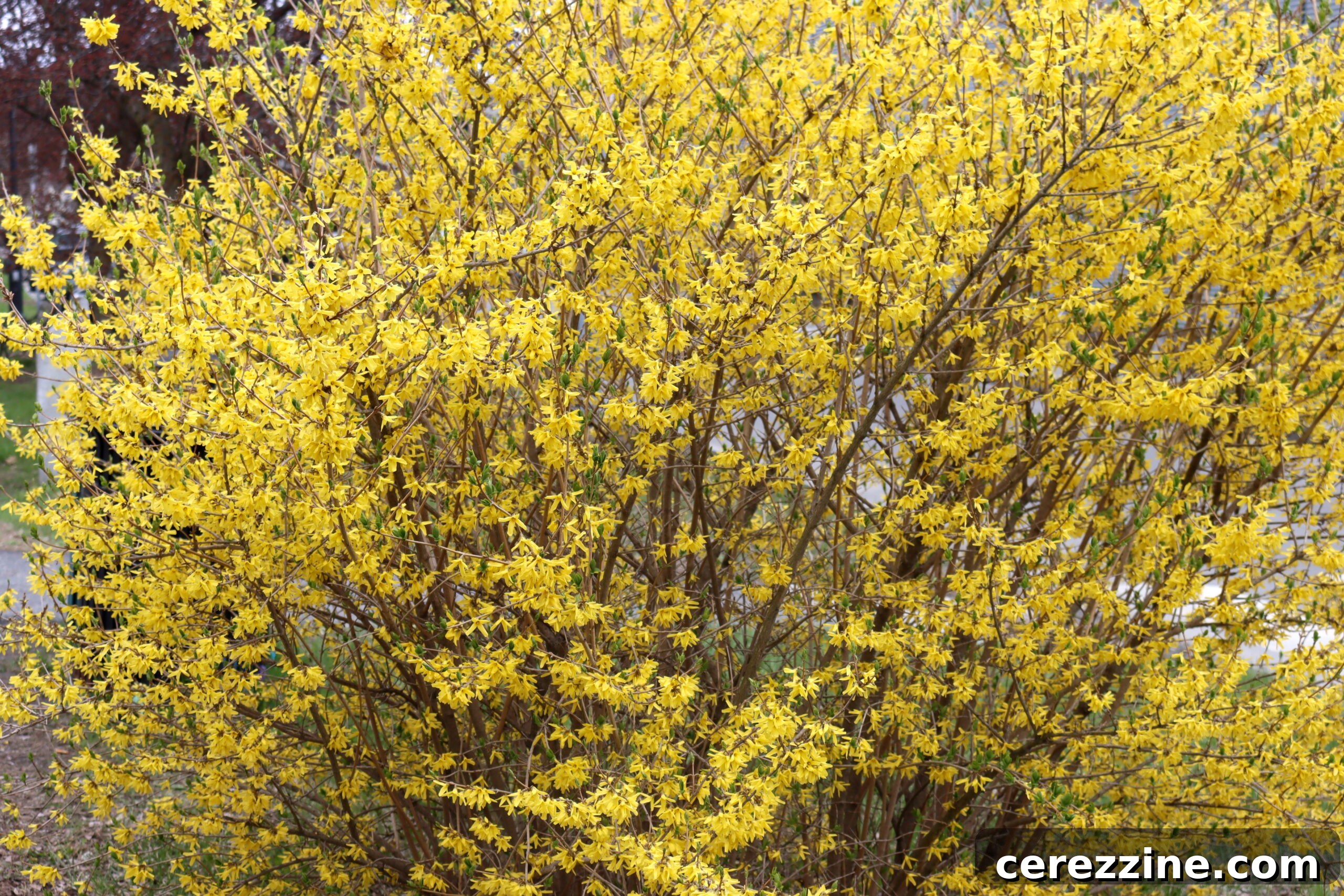
While many admire forsythia for its ornamental charm, fewer realize that its bright, cheerful flowers are not just a treat for the eyes but also a delightful culinary secret. Yes, forsythia blossoms are entirely edible and can be transformed into a variety of gourmet delights! From delicate cookies and refreshing teas to surprisingly complex jellies, these blossoms offer a unique opportunity to infuse your kitchen with the fresh, floral notes of spring. Among the most enchanting creations is forsythia jelly, a simple yet elegant preserve that captures the very essence of the season in a jar.
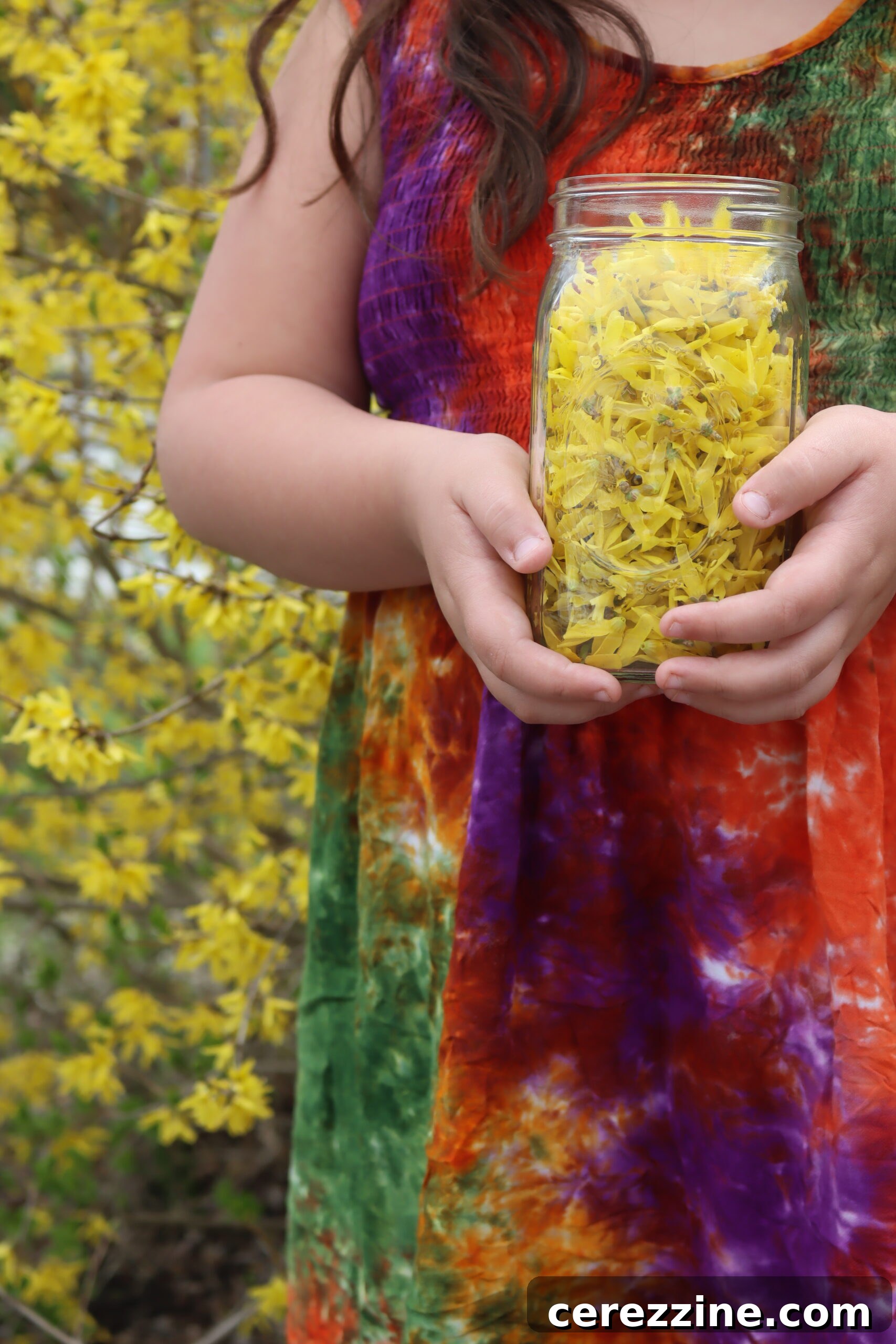
Recipe Snapshot: Forsythia Jelly
- Recipe Name: Forsythia Jelly
- Recipe Type: Edible Flower Jelly
- Canning Method: Water Bath Canning (Optional)
- Preparation & Cook Time: Approximately 30 Minutes
- Canning Time: 10 Minutes (if canning)
- Yield: 4 to 5 half-pint (8 oz) jars
- Recommended Jar Sizes: Quarter Pint, Half Pint, or Pint
- Headspace for Canning: 1/4 inch
- Key Ingredients: Fresh Forsythia Blossoms, Water, Lemon Juice (essential!), Granulated Sugar, Pectin
- Difficulty Level: Easy! This recipe is approachable for beginners, involving a simple infusion and gelling process.
- Similar Floral Jelly Creations: The method mirrors that of other springtime floral jellies, including Tulip Jelly, Dandelion Jelly, Redbud Jelly, Grape Hyacinth Jelly, Violet Jelly, Pansy Jelly, and Lilac Jelly.
Unveiling the Flavor: What Does Forsythia Jelly Taste Like?
This is often the most intriguing question surrounding any novel ingredient, and for forsythia jelly, the answer is wonderfully surprising. As expected, it boasts a delicate floral aroma and a subtle fragrance that evokes the fresh scent of the blossoms themselves. However, its flavor profile extends beyond mere florality. When you close your eyes and savor a spoonful, many people discover an astonishing resemblance to peach jelly. It’s a fruity, bright taste, but with an added layer of complexity and an aromatic depth that sets it apart.
For those of us in northern climates where fresh peaches are a rare and cherished summer indulgence, this forsythia jelly offers a truly special treat. It allows us to experience a similar juicy, sweet, and slightly tangy flavor during the early spring months, long before any peach tree has even begun to fruit. This unique characteristic makes forsythia jelly not just a delicious preserve, but a delightful culinary illusion, bringing the warmth of summer fruits to the cusp of spring.
Harvesting Forsythia for Your Golden Jelly
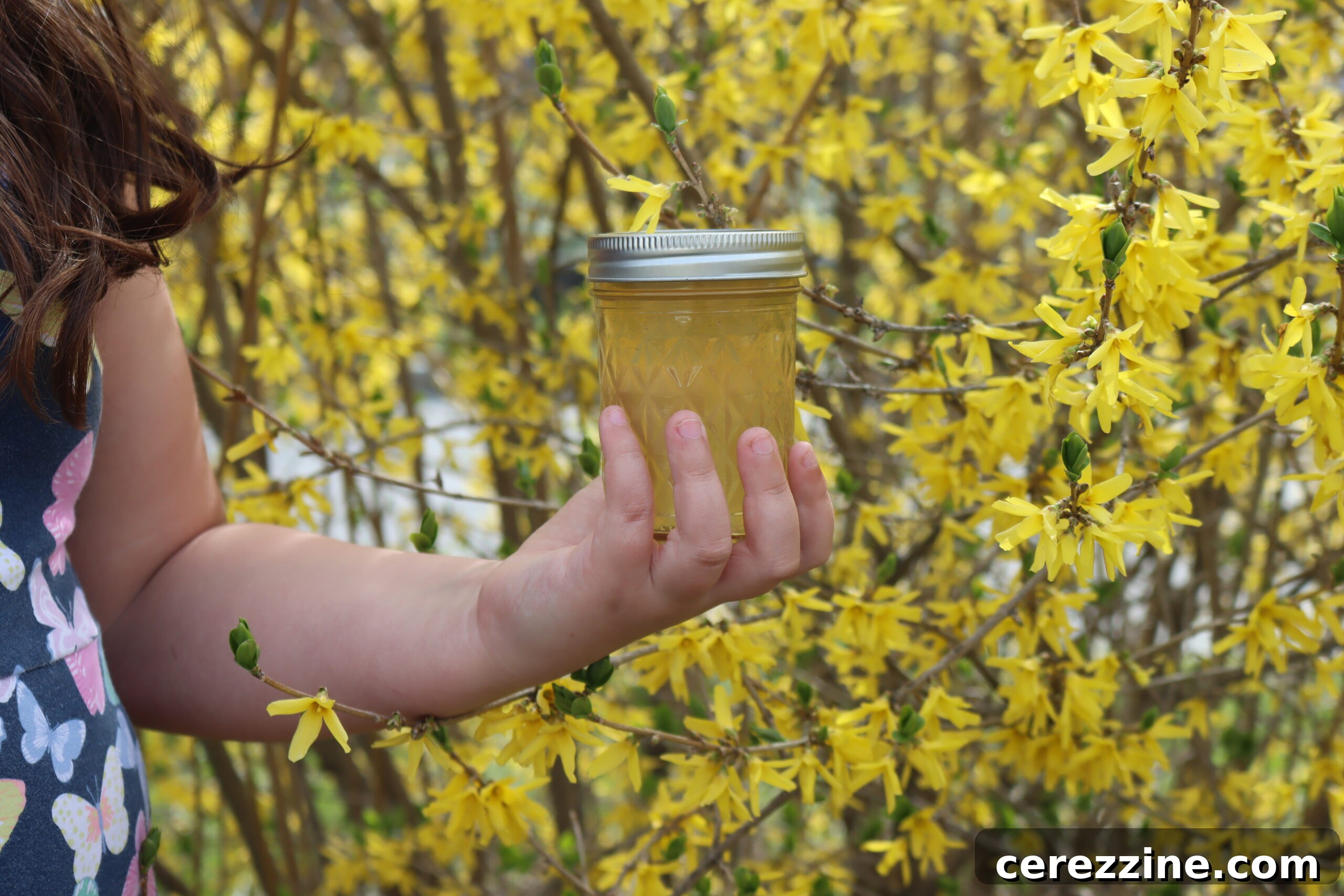
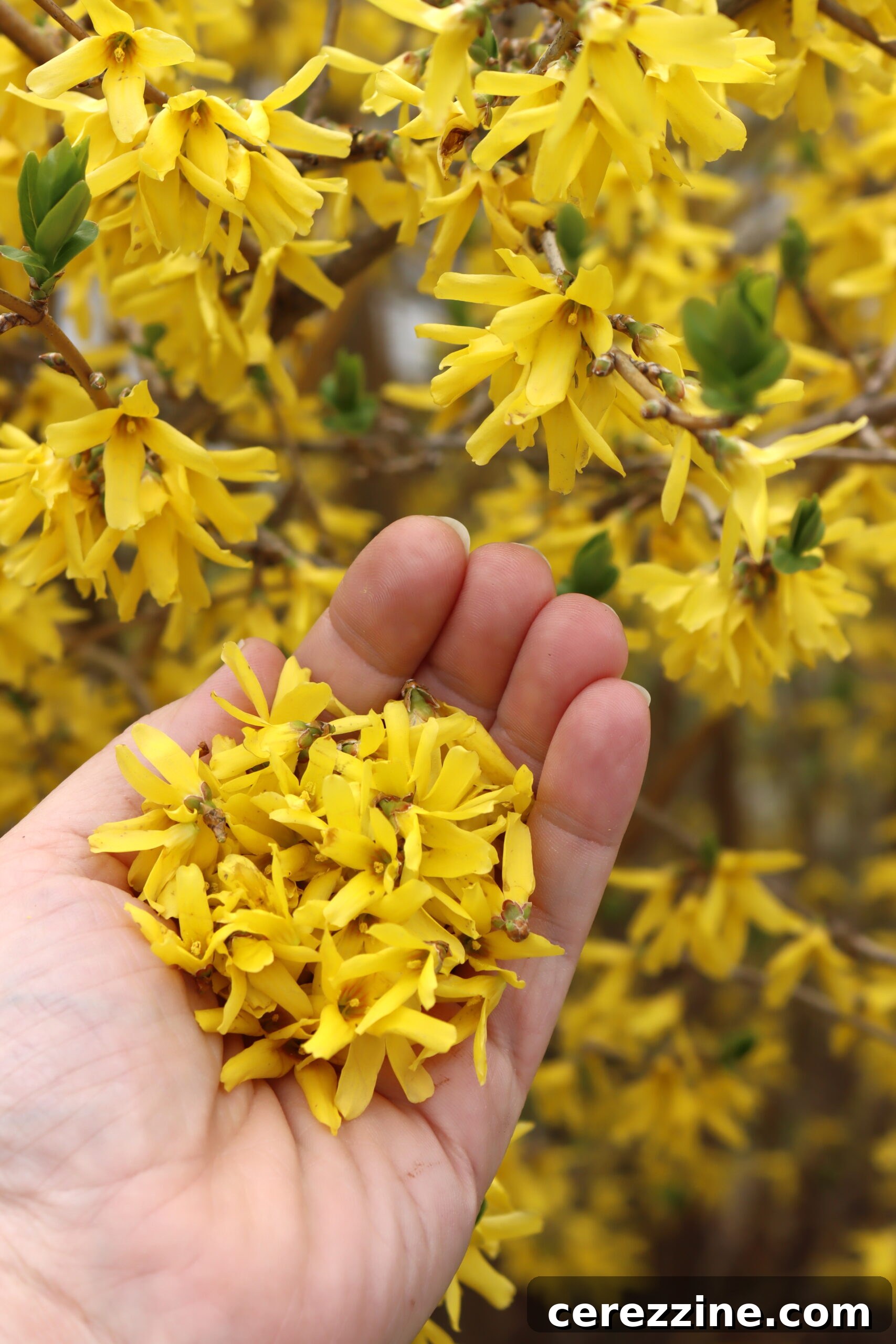
Gathering forsythia blossoms is a simple and rewarding task. The delicate flowers readily detach from their branches with a gentle tug, making collection quick and easy. A single mature forsythia bush can produce an astonishing abundance of flowers each spring – literally gallons of them! This means that harvesting a few cups of blossoms for your jelly will barely make a dent in the bush’s overall display, allowing you to enjoy both its beauty and its edible bounty.
For the best flavor and quality, aim to harvest blossoms on a dry, sunny morning after the dew has evaporated but before the sun is at its strongest. Choose healthy, fully open flowers that are free from blemishes or insect damage. It’s best to harvest from bushes that haven’t been sprayed with pesticides or other chemicals. A good practice is to gather more than you think you’ll need, as some flowers may be discarded during the cleaning process.
Essential Ingredients for Your Forsythia Jelly
Crafting a vibrant and delicious forsythia jelly requires only a few key ingredients: freshly harvested forsythia blossoms, pure water, granulated sugar, pectin to achieve that perfect set, and a crucial touch of lemon juice. For a standard batch yielding 4 to 5 half-pint (8 oz) jars, here’s what you’ll need:
- 4 cups of fresh Forsythia flower petals (ensure green bases are carefully removed)
- 4 cups of clean water
- 2 tablespoons of fresh lemon juice (or ½ teaspoon of citric acid powder)
- 1 to 4 cups of granulated sugar (refer to the detailed note below on sugar quantity)
- 1 box (1.75 oz) of powdered pectin (either regular or low-sugar variety, such as Sure-Jell)
The **lemon juice** serves multiple vital roles in this recipe. Firstly, it brightens the overall flavor of the jelly, providing a pleasant tart contrast to the sweetness of the sugar and enhancing the delicate floral notes of the forsythia. More importantly, lemon juice is critical for the gelling process; its acidity lowers the pH of the mixture, which is essential for pectin to activate and set correctly. Furthermore, this acidity is a fundamental component for safe water bath canning, ensuring the jelly is preserved properly and can be stored at room temperature for an extended period. Even if you don’t plan to can your jelly, lemon juice is indispensable for achieving the right flavor balance and set. If you prefer a more neutral flavor profile, or if fresh lemons are unavailable, citric acid powder can be used as a substitute. Citric acid is more concentrated than lemon juice; approximately 1/4 teaspoon of citric acid powder is equivalent to 1 tablespoon of lemon juice. For this recipe, that means 1/2 teaspoon of citric acid would replace the 2 tablespoons of lemon juice.
Choosing the right **pectin** is also key to your jelly’s success. I generally rely on Sure-Jell regular or Sure-Jell low sugar pectin due to their consistent and dependable results, yielding an excellent texture. With regular pectin, you’ll need to use a minimum of 4 cups of sugar to 4 cups of liquid, as it requires a 1:1 sugar-to-liquid ratio to gel properly. This produces a traditional, very sweet jelly. However, if you prefer a less sweet option, Sure-Jell low sugar pectin is incredibly versatile. It will gel effectively with any amount of sugar, allowing you to use as little as 1/2 to 1 cup for a barely sweet jelly, or 1 to 2 cups for a moderately sweet but reduced-sugar preserve. As low-sugar pectin works well with both full-sugar and reduced-sugar recipes, it’s a smart choice to keep on hand for various jelly-making projects.
For those using Ball Flex Batch Pectin, you’ll typically need 6 tablespoons, which corresponds to the standard 1.75 oz box size of other pectin brands, applicable for both their regular and low-sugar varieties. While liquid pectin is an option and instructions are often provided on its packaging, it typically demands a significantly higher sugar content (often 7 cups of sugar per 4 cups of liquid) to achieve a proper set. Due to this high sugar requirement, powdered pectin is generally recommended for a more balanced flavor and flexible sugar usage.
Crafting Your Golden Delight: Step-by-Step Forsythia Jelly
Making jelly from forsythia flowers follows a similar, straightforward process to other floral jellies, with one crucial preparatory step. Here’s how to create your own sun-kissed forsythia jelly:
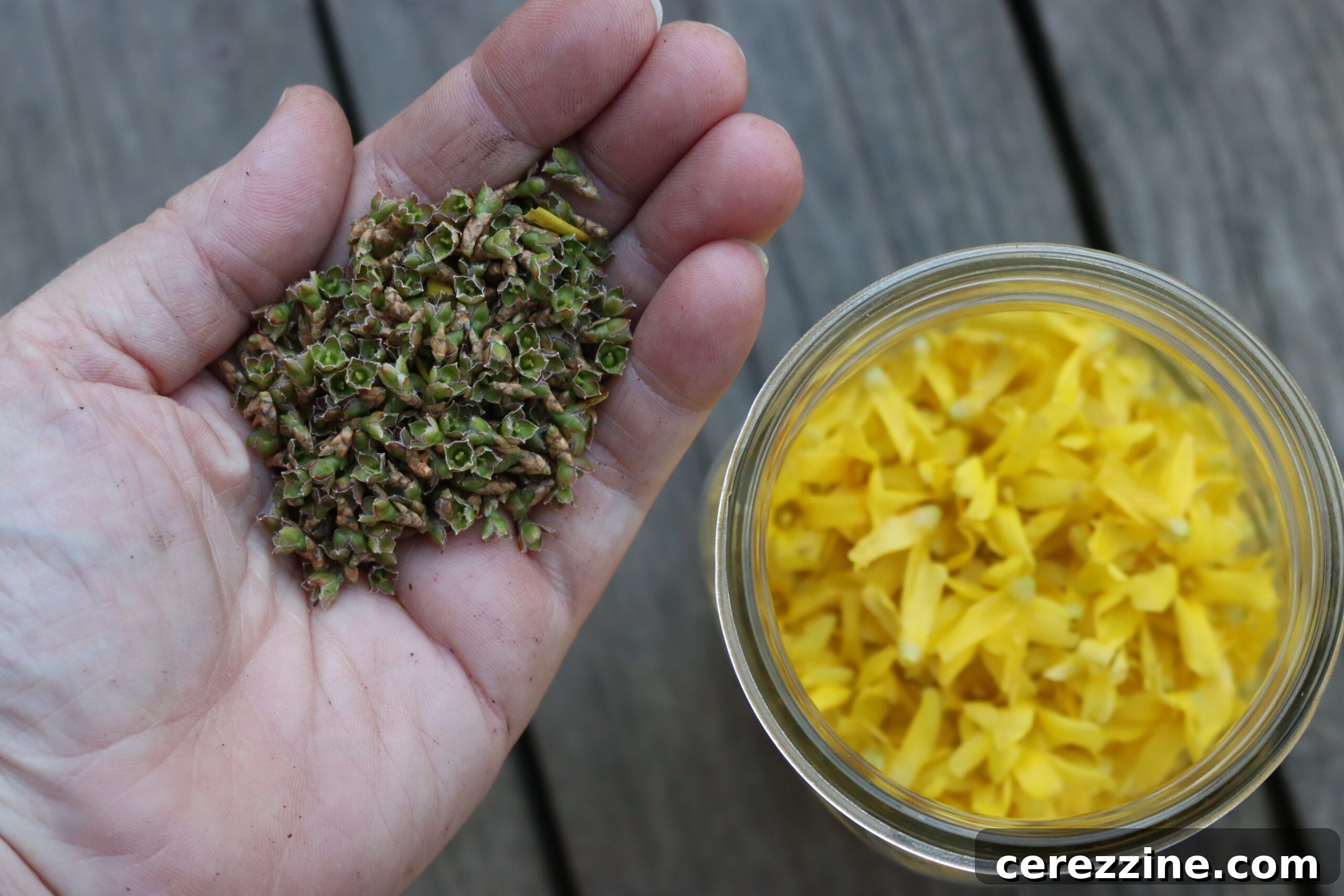
- Prepare the Blossoms: Begin by carefully selecting and gathering about 4 cups of fresh forsythia blossoms. This is the most delicate step: you must remove the tiny green bases (sepals) from each flower. While the yellow petals are sweet and fragrant, these green parts can impart an undesirable bitter taste to your finished jelly. They are usually easy to pinch off. This meticulous step is vital for the jelly’s flavor, similar to what’s required for making lilac jelly.
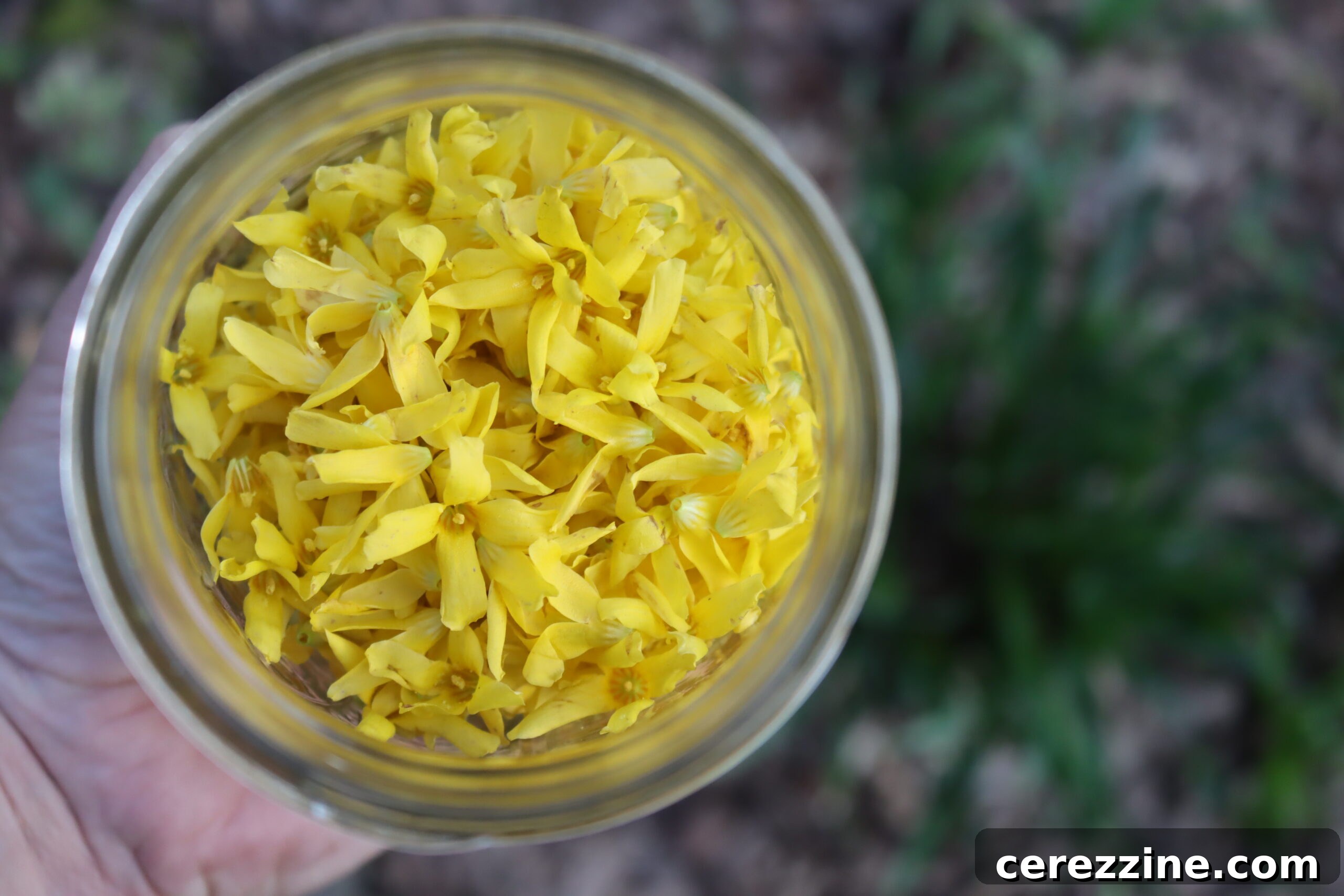
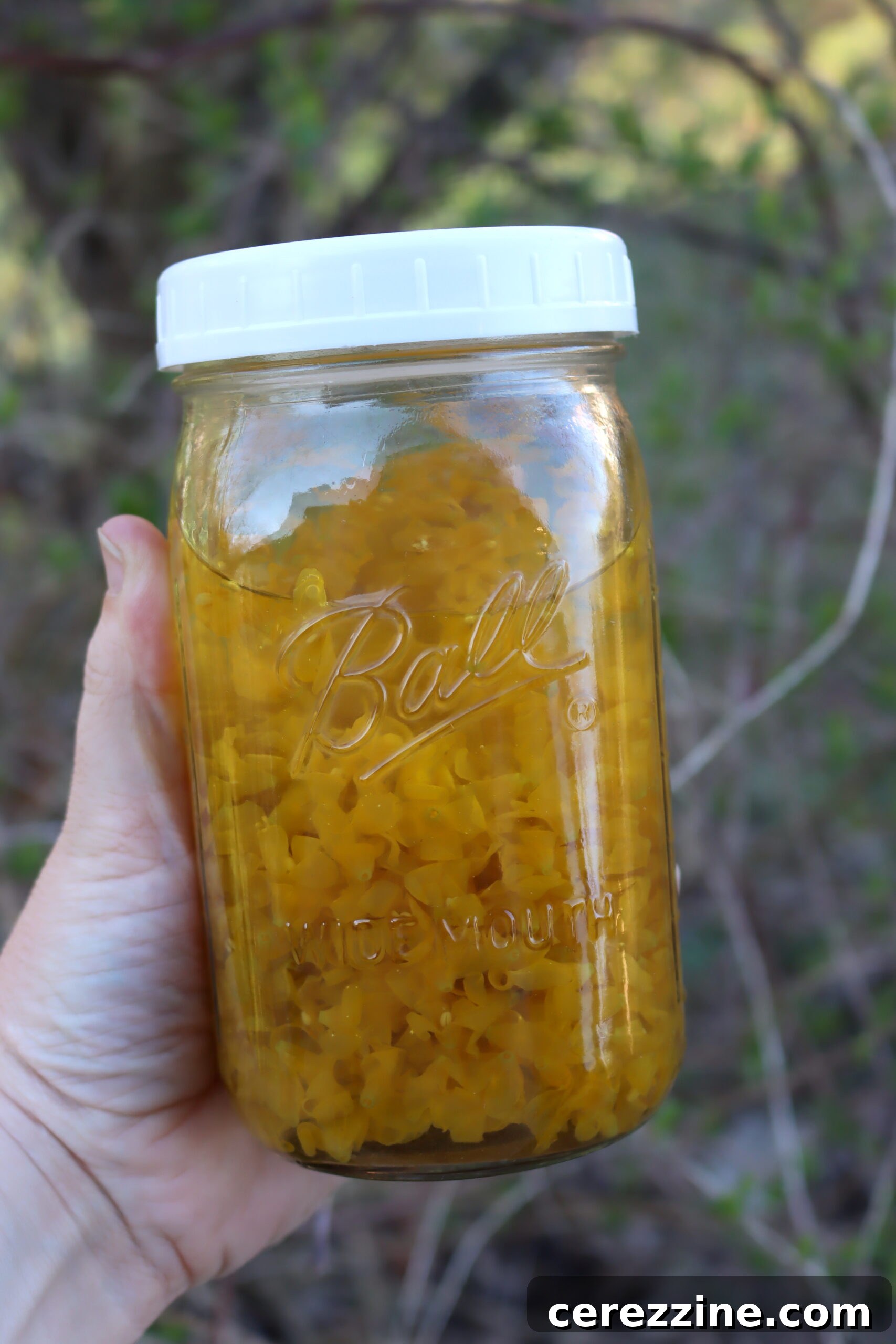
- Infuse the Tea: Place your meticulously cleaned forsythia petals into a heat-proof container, such as a large mason jar or a ceramic bowl. Pour 4 cups of freshly boiled water over the petals. Allow the blossoms to steep for approximately 15 to 20 minutes. This process extracts the beautiful color and delicate flavor of the forsythia into a fragrant tea.
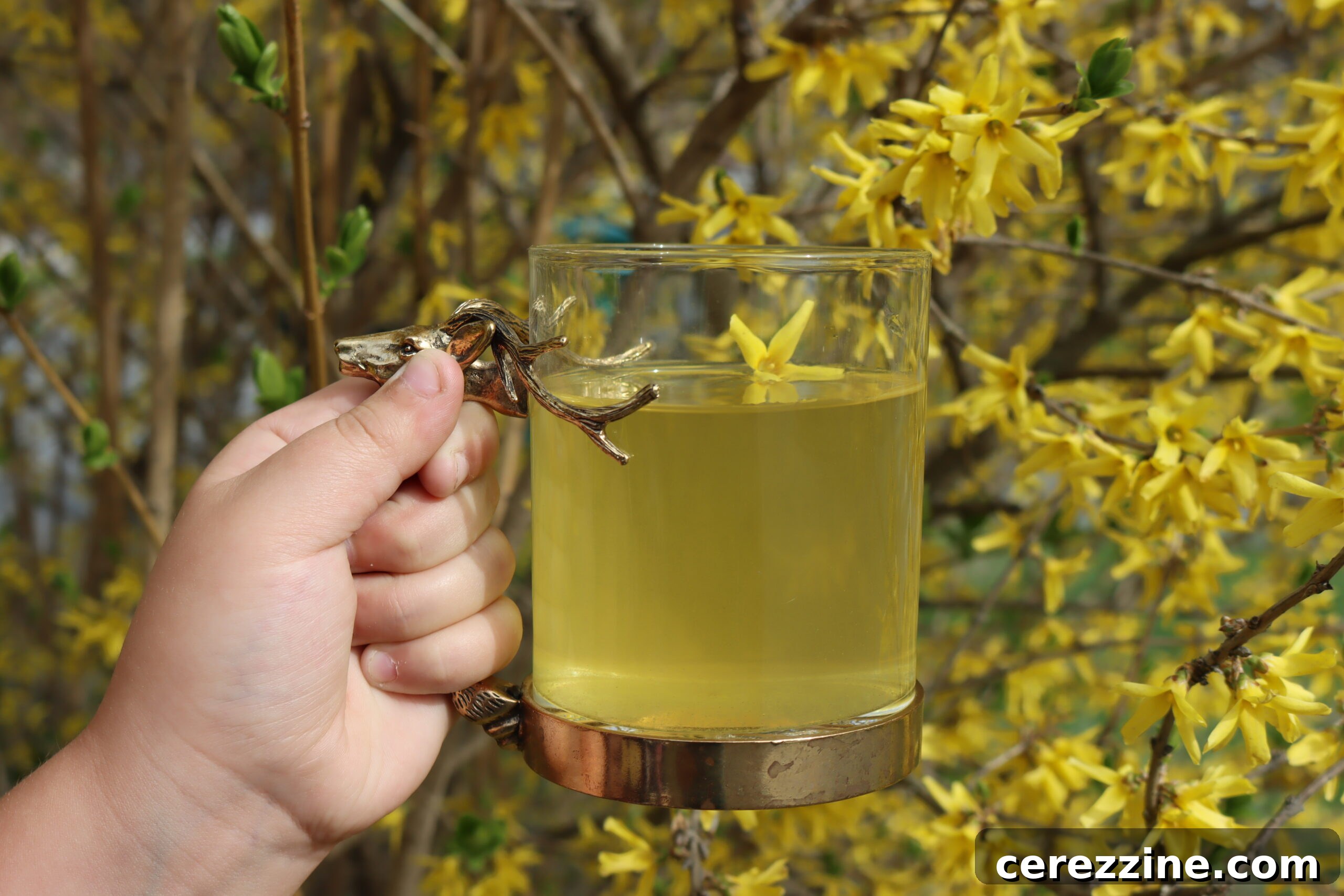
- Strain the Infusion: Once steeped, strain the forsythia tea through a fine-mesh sieve or cheesecloth into a clean saucepan or jelly pot, discarding the spent blossoms. At this stage, you have a lovely forsythia tea, which can be enjoyed as is with a touch of sweetener, offering a preview of your jelly’s final flavor.
- Add Lemon Juice and Pectin: Pour the strained forsythia tea into a jelly pot. Stir in the 2 tablespoons of lemon juice. This addition is crucial for both balancing the sweetness and providing the necessary acidity for pectin activation and canning safety. Bring the tea to a rolling boil. Once boiling, thoroughly whisk in the entire box of powdered pectin until it is completely dissolved. Continue to boil vigorously for a full minute to ensure the pectin is fully activated.
- Introduce Sugar: Now, add the granulated sugar. Remember, if using standard pectin, a 1:1 ratio of sugar to liquid is typically required for proper gelling (so, 4 cups of sugar for 4 cups of tea). If you’re using a “low sugar” pectin, you have the flexibility to use less sugar—anywhere from 1/2 to 2 cups, depending on your preferred sweetness level. After adding the sugar, stir continuously until it is completely dissolved. Return the mixture to a hard, rolling boil for exactly 1 minute.
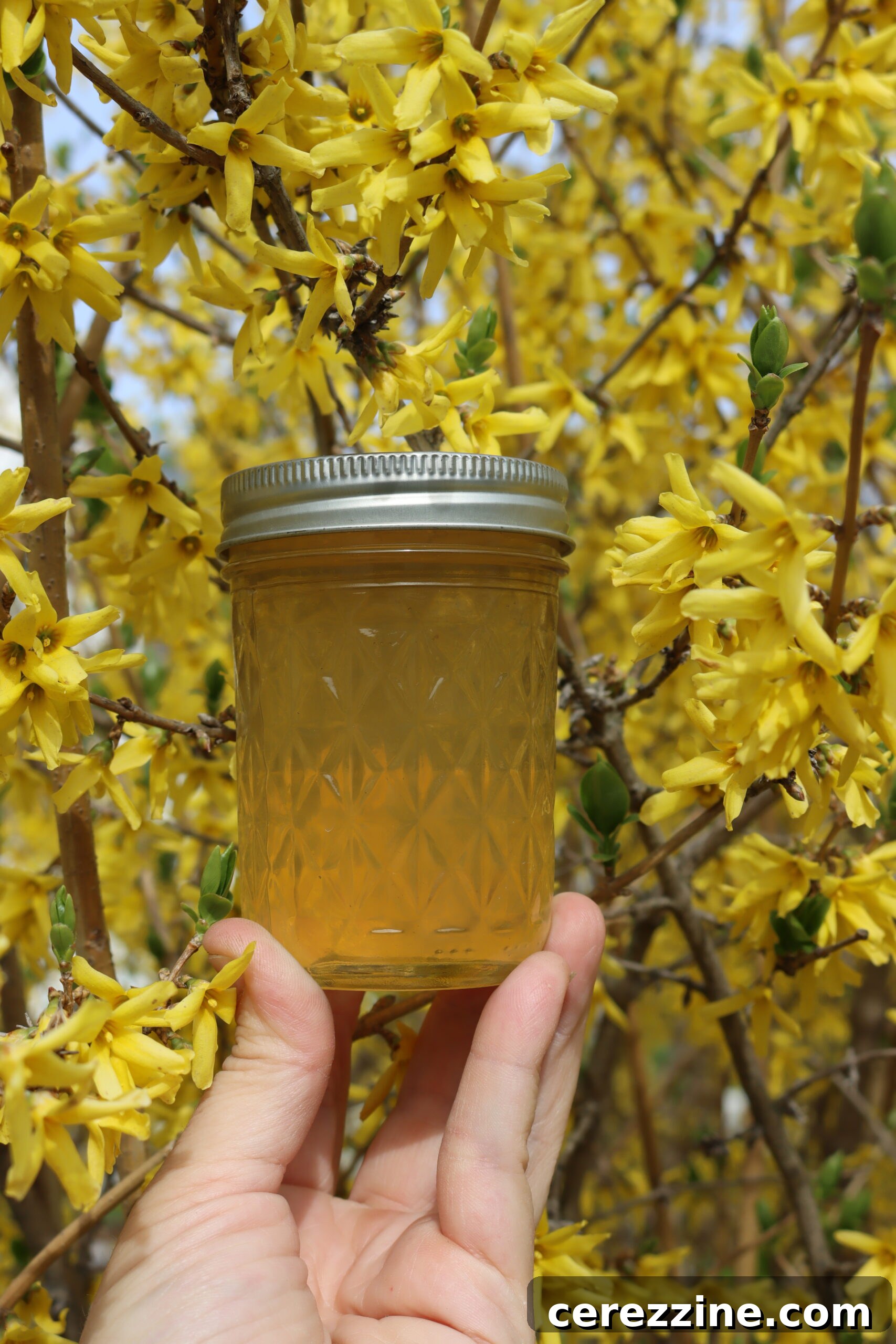
- Fill Jars: Immediately remove the jelly mixture from the heat. Carefully ladle the hot jelly into your prepared canning jars, ensuring you leave precisely 1/4 inch of headspace at the top of each jar.
Preserving Your Golden Harvest: Water Bath Canning Forsythia Jelly
While enjoying your fresh forsythia jelly straight from the refrigerator (where it will last for several weeks) or freezer (in freezer-safe jars for up to 6 months) is certainly an option, the true magic of preserving lies in water bath canning. This traditional method allows you to store your radiant forsythia jelly safely on your pantry shelf for a year or more, making it accessible whenever you crave a taste of spring, without occupying valuable refrigerator or freezer space.
To safely water bath can this floral jelly, the inclusion of lemon juice is non-negotiable, as its acidity lowers the pH sufficiently for safe long-term storage. Before you even begin making your jelly, it’s essential to prepare your canning setup: gather a large water bath canner, clean canning jars (half-pint or quarter-pint are ideal), and new, two-part canning lids (flats and rings). Ensure your jars are hot and sterilized according to canning guidelines.
Once your forsythia jelly is cooked and ready, ladle it into the prepared hot jars, leaving the critical 1/4 inch of headspace. Wipe the jar rims clean to ensure a proper seal, center the lids on the jars, and screw on the bands fingertip-tight. Carefully place the filled jars onto the rack in your preheated water bath canner, ensuring they are fully submerged by at least 1 inch of water. Bring the water to a rolling boil and process the jars for 10 minutes. If you reside at an elevation above 6,000 feet, increase the processing time to 15 minutes to account for the lower boiling point of water.
After the processing time is complete, turn off the heat and let the jars rest in the canner for 5 minutes before carefully removing them. Place the hot jars on a clean towel on your counter, allowing them to cool undisturbed for 12 to 24 hours. As they cool, you’ll hear the satisfying “ping” sound, indicating a successful seal. Once completely cool, check all seals; any unsealed jars should be refrigerated and consumed within a few weeks. Properly canned and sealed jars will maintain their quality on the pantry shelf for 12-18 months. Always refrigerate a jar once opened.
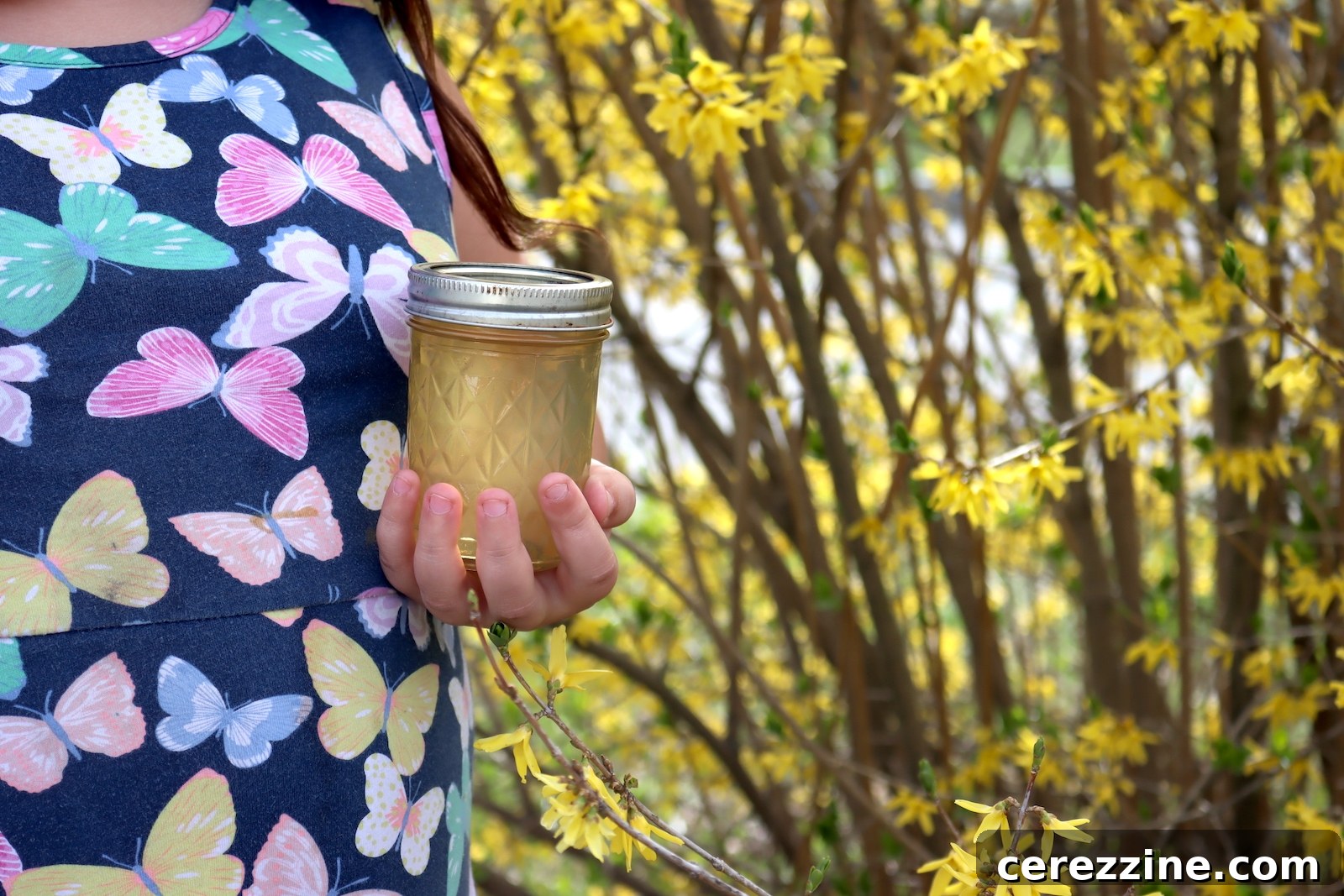
Expand Your Culinary Horizons with More Forsythia Recipes
Once you’ve experienced the magic of forsythia jelly, you might find yourself eager to explore other ways to incorporate these beautiful, edible forsythia flowers into your culinary repertoire. Their mild, sweet, and slightly peachy flavor lends itself to a variety of delightful creations beyond preserves:
- Forsythia Flower Honey Syrup: A wonderful way to sweeten beverages or drizzle over desserts.
- How to Make Flower Wines (With any edible flower): Venture into the world of homemade floral wines and meads using forsythia for a truly unique fermentation project.
If you tried this Forsythia Jelly Recipe, or any other recipe on Creative Canning, we’d love to hear from you! Please leave a ⭐ star rating and share your thoughts in the 📝 comments below!
And make sure you stay in touch with me by following on social media for more creative canning and preserving ideas!
Explore More Edible Flower Jellies
Tulip Jelly: A Springtime Delight
Are Flower Jellies Safe for Canning?
Fragrant Lilac Jelly Recipe
Making Peony Jelly at Home
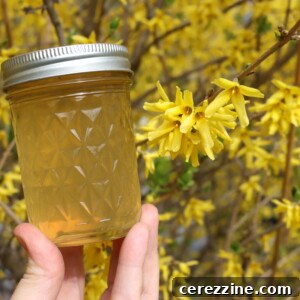
Forsythia Jelly
Ingredients
- 4 cups forsythia blossoms, green bases removed
- 4 cups water
- 2 tbsp lemon juice
- 1 to 4 cup sugar, See Note on Sugar
- 1 box Powdered pectin, 1.75 oz pectin (Regular or Low Sugar)
Instructions
-
Separate 4 cups of forsythia flower blossoms from their stems, carefully removing any green parts. The green bases of each flower are bitter, so it is crucial to remove them and use just the yellow petals. They usually slip off easily.
-
Pour 4 cups boiling water over the top of the flower blossoms and allow the tea to infuse for about 10 to 15 minutes.
-
Strain the floral tea into a saucepan or jam pot. Add the lemon juice; this will not only help enhance the jelly’s color but is also essential to balance the sugar and assist the pectin in setting. Additionally, it provides the necessary acidity for safe preservation if canning, so do not omit the lemon juice.
-
Bring the mixture to a boil and add the powdered pectin, stirring continuously to dissolve it completely. Allow the mixture to boil vigorously for 1 full minute before adding sugar. (Important Note: Do not add sugar at the same time as or before the pectin, as this can prevent the jelly from setting properly.)
-
Add the sugar, stirring until it is completely dissolved (refer to the ‘Notes on Sugar’ section below for quantity guidance). Bring the mixture back to a hard boil for 1 minute before carefully ladling it into clean jelly jars, leaving 1/4 inch of headspace in each.
-
If you plan on canning, process the sealed jars in a water bath canner for 10 minutes (or 15 minutes if you are at an elevation above 6,000 feet). If not canning, allow the jars to cool completely on the counter before storing them in the refrigerator (where they will keep for up to a month) or in the freezer (for up to 6 months in freezer-safe jars).
Notes
A note on sugar quantity:
When utilizing standard powdered pectin, it is imperative to adhere to a 1:1 ratio of liquid to sugar for the jelly to achieve a proper set. This means that for 4 cups of forsythia blossom tea, you would typically require a minimum of 4 cups of granulated sugar. This will result in a deliciously sweet, traditional “old-fashioned” style jelly. To create a jelly with reduced sugar content, simply opt for a low-sugar pectin (such as Sure-Jell Low Sugar, which is highly reliable). Follow the recipe instructions using a lesser amount of sugar, as specified by your preference, usually ranging from 1 to 2 cups for a pleasantly sweet but lower-sugar alternative.
It is important to note that lowering the sugar content will generally result in a reduced overall yield. The stated yield of 5 half-pint jars is based on using a full-sugar recipe.
Should you be using Pomona’s Universal Pectin, please follow the specific instructions provided within the Pomona’s package, often referencing guidelines for a similar recipe like mint jelly, as it is a two-part low-sugar pectin system with different preparation steps.
For those who prefer liquid pectin, the order of operations for adding ingredients is different (sugar is added first, pectin last). Liquid pectin also necessitates a significantly higher amount of sugar for successful gelling (typically 7 cups of sugar per 4 cups of liquid). While it will work, powdered pectin is generally recommended due to the lower sugar levels required.
If you possess Ball Flex Batch Pectin, you will require 6 tablespoons of the pectin, which is equivalent to the contents of a standard 1.75 oz box of other powdered pectin types. This measurement applies to both their regular and low-sugar canisters.
Nutrition
Nutrition information is automatically calculated and should only be used as an approximation.
Did you enjoy this recipe? Share your experience below!
More Enchanting Flower Jelly Recipes
If you’ve fallen in love with the idea of capturing floral flavors in a jar, expand your pantry with these equally delightful edible flower jellies. Each offers a unique taste of the garden:
- Peony Jelly: A subtly fragrant and beautifully colored jelly.
- Dandelion Jelly: Often called “sunshine in a jar,” a classic springtime favorite.
- Lilac Jelly: Capturing the intoxicating aroma of lilac blooms.
- Violet Jelly: Delicate and charming, with a lovely hue.
- Rose Petal Jelly: Elegant and aromatic, perfect for special occasions.
- Pansy Jelly: A sweet, mild jelly with a vibrant color.
- Elderflower Jelly: Light, refreshing, and deeply aromatic.
Discover the World of Herbal Jellies
Beyond the realm of flowers, many other plants from your garden can be transformed into exquisite jellies. Explore the unique flavors of these herbal infusions:
- Savory Herbal Jelly: An unexpected delight for charcuterie boards or glazes.
- Lemon Balm Jelly: Bright, citrusy, and wonderfully calming.
- Calendula Jelly (Marigold Jelly): A sunny jelly with a mild, earthy flavor and beautiful color.
- Chamomile Jelly: Soothing and subtly sweet, perfect for a peaceful moment.
- Borage Jelly: Offering a fresh, cucumber-like flavor with a hint of sweetness.