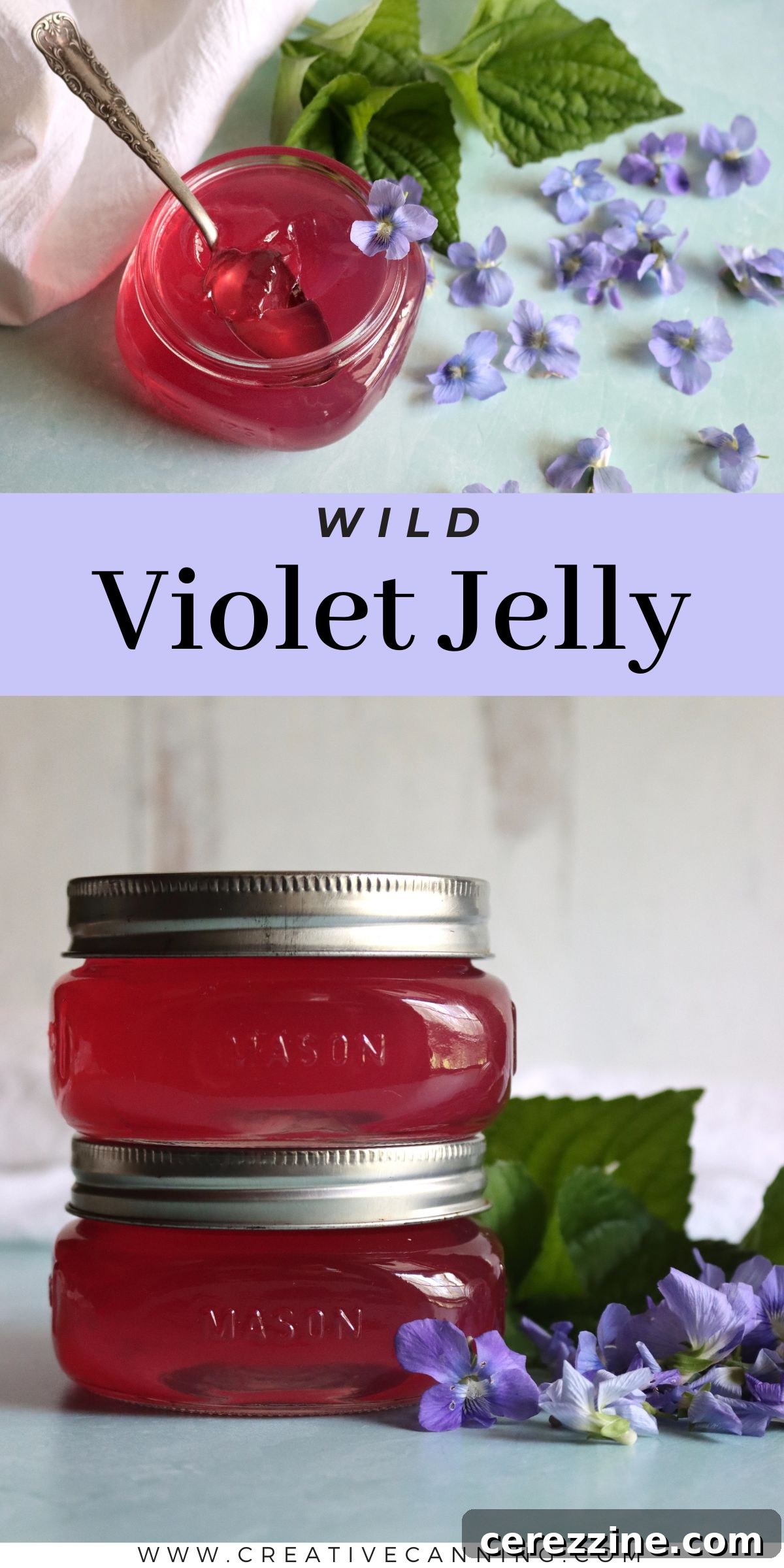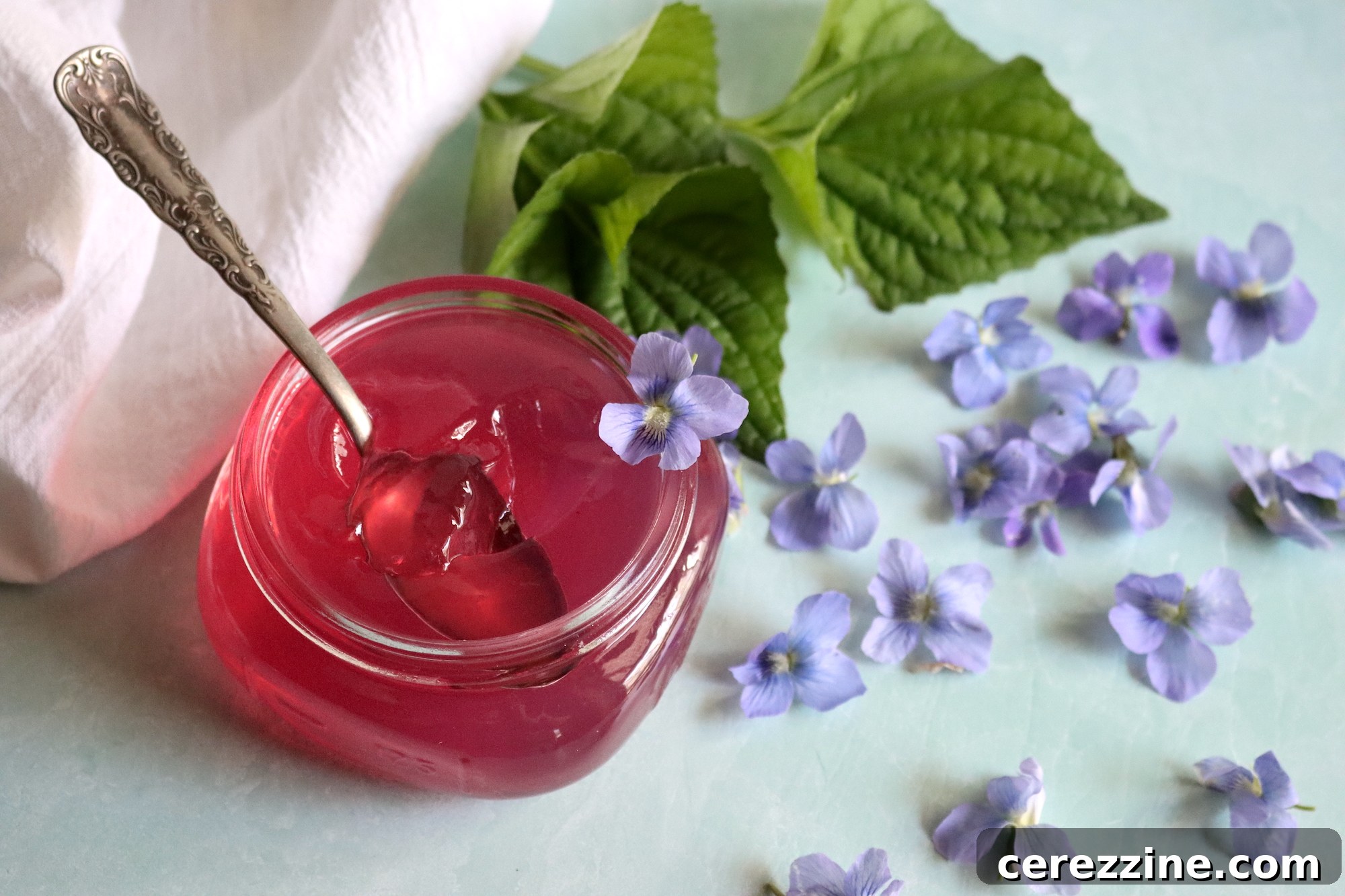
Step into a world of vibrant flavors and enchanting colors with homemade Violet Jelly. More than just a simple preserve, this exquisite creation captures the very essence of spring in a jar. Imagine a spread that boasts a delightful hue, a surprisingly fresh berry-like taste, and the unparalleled satisfaction of crafting something beautiful from the wildflowers in your own backyard. Violet jelly is a truly magical experience, perfect for sharing with loved ones or savoring yourself, promising to brighten your pantry and breakfast table throughout the year.
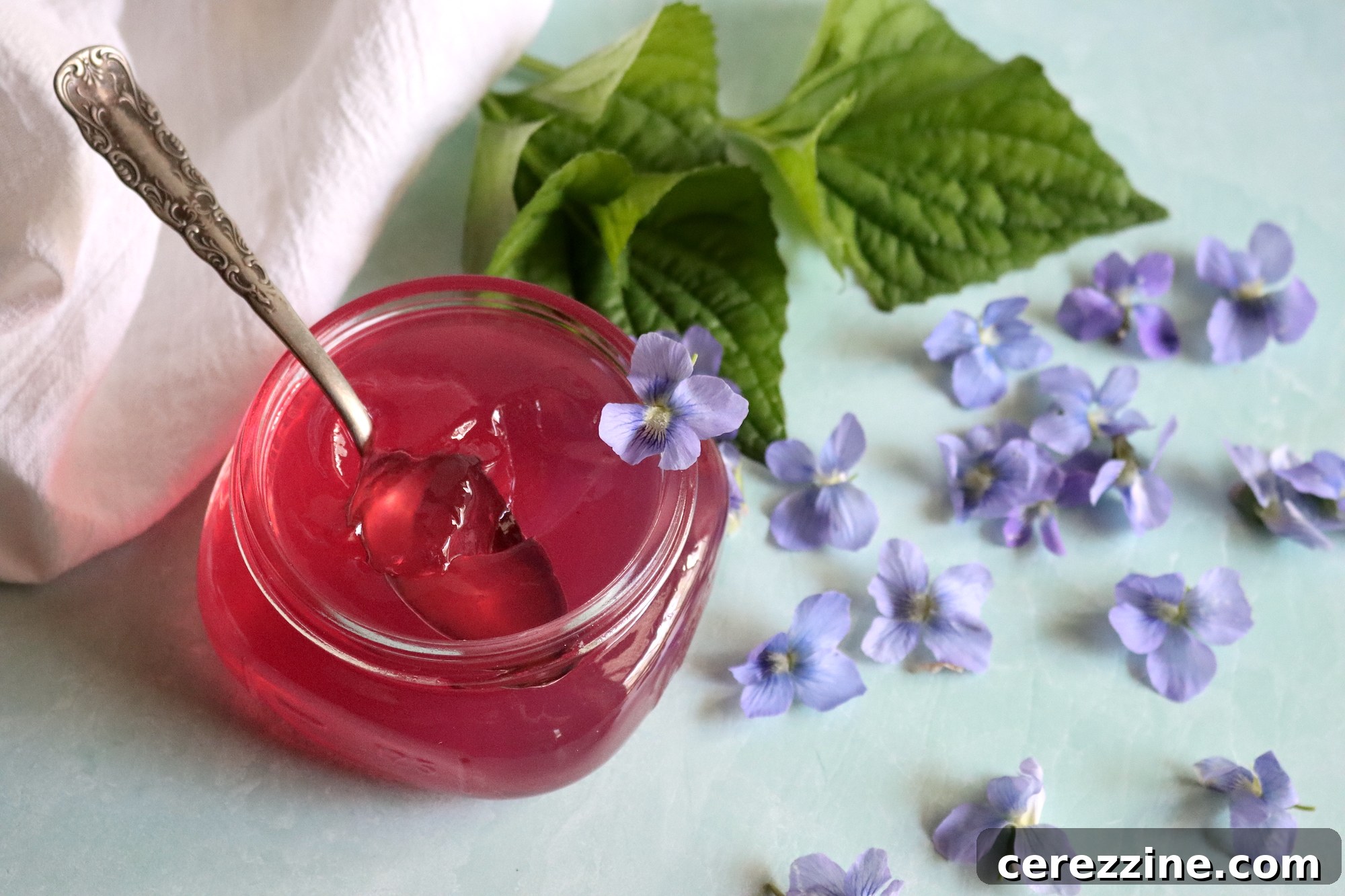
Spring invites us outdoors, and this charming floral jelly offers the perfect reason to embrace the season. Wild violets, with their delicate beauty and subtle sweetness, undergo a remarkable transformation into a delectable jelly that tastes remarkably like a medley of fresh berries. It’s an ideal accompaniment for toast, warm scones, fluffy biscuits, or any dish that could benefit from a touch of springtime sweetness and a burst of unique flavor.
Wild violets are a true gift of nature, often found growing abundantly in shaded, moist areas. Their easy identification makes them accessible even for novice foragers, transforming the art of jelly-making into a surprisingly simple yet incredibly rewarding endeavor. The results, a shimmering jar of violet jelly, are absolutely worth the minimal effort.
Spending the spring and summer outdoors with my children has opened up a world of culinary exploration, inspiring us to experiment with various floral jellies. We’ve enjoyed the tried-and-true dandelion jelly, which has a distinct honey-like flavor, for years. More recently, we’ve ventured into making forsythia jelly, reminiscent of peaches, and apple blossom jelly, tasting surprisingly like plums. This year, wild violet jelly proudly takes its place on our must-make list, promising another delightful addition to our homemade preserves.
The flavor profile of violet jelly is an intricate dance of sweet, floral notes, complemented by a subtle tang and that unmistakable hint of berry-like goodness. This versatility makes it ideal for a myriad of uses, from a simple spread on your morning toast to an elegant drizzle over vanilla ice cream for a sophisticated dessert.
And then there’s the color – a truly captivating element! What begins as a modest turquoise-colored tea undergoes a breathtaking metamorphosis, transforming into a vibrant, jewel-like pink hue with the addition of just a splash of lemon juice. It’s a spectacular display of natural chemistry, making the cooking process an educational and entertaining experience, especially for children who delight in witnessing such a dramatic color change firsthand.
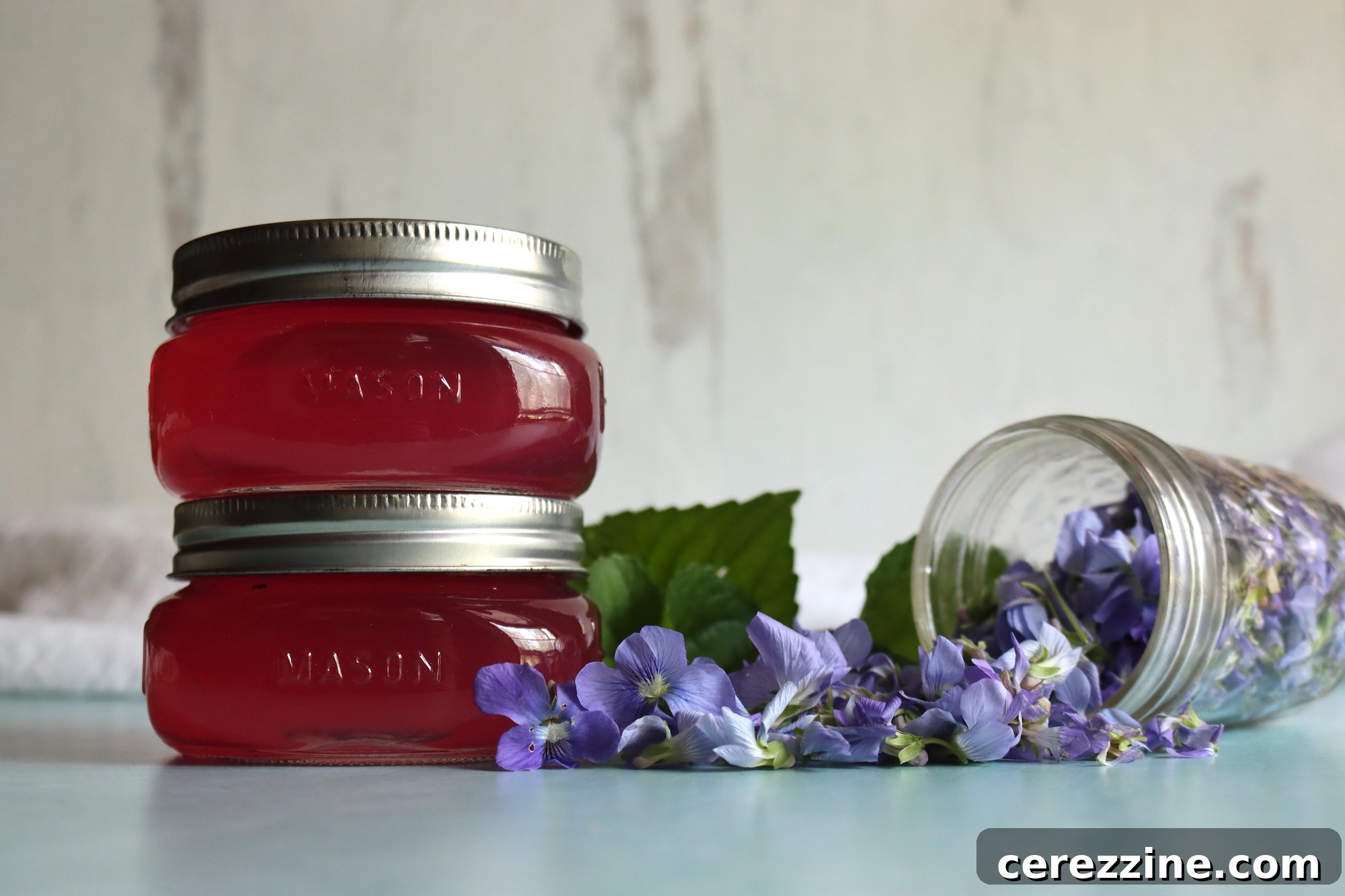
Violet Jelly: Recipe at a Glance
- Recipe Name: Violet Jelly
- Recipe Type: Floral Jelly Recipe
- Canning Method: Waterbath Canning
- Prep/Cook Time: Approximately 30 Minutes
- Canning Time: 10 Minutes
- Yield: 4 to 5 half-pint jars
- Jar Sizes: Quarter Pint, Half Pint, or Pint
- Headspace: 1/4 inch
- Ingredients Overview: Freshly harvested edible violet flowers, water, lemon juice (essential for color and safety), and sugar.
- Difficulty: Easy! The process primarily involves making a quick floral infusion and then setting it with pectin.
- Similar Recipes: The preparation closely mirrors other popular springtime floral jellies, including delightful options like Tulip Jelly, Dandelion Jelly, Redbud Jelly, Grape Hyacinth Jelly, Pansy Jelly, Forsythia Jelly, or Lilac Jelly.
Essential Ingredients for Homemade Violet Jelly
Crafting violet jelly is a wonderfully satisfying way to encapsulate the sweet fragrance and taste of spring. For a standard batch yielding approximately 4 half-pint jars, gather the following high-quality ingredients:
- 2 cups wild violet flowers (ensure they are loose and lightly packed for accurate measurement)
- 4 cups water (filtered water is recommended for the purest flavor)
- 1/4 cup lemon juice (bottled lemon juice is best for consistent acidity in canning, or 1/2 teaspoon citric acid powder for a less tart profile)
- 4 cups sugar (granulated sugar; feel free to adjust this amount based on your desired sweetness level and pectin type)
- 1 box (1.75 oz) powdered pectin (either regular or low-sugar varieties will work effectively)
The star of this recipe is undoubtedly the wild violet flowers. These delicate blooms impart the jelly with its signature sweet and floral character, surprisingly complemented by an undertone reminiscent of fresh berries. When harvesting violets, meticulously select only the flower heads, discarding any leaves or stems, as they are not needed for the jelly. If your garden or nearby natural spaces are graced with an abundance of these charming purple blossoms, this recipe provides a fantastic opportunity to transform them into a culinary delight.
Water serves as the crucial medium for steeping the violet flowers, creating the foundational “violet tea” that forms the base of your jelly. After the steeping process, you’ll observe the water transform into a captivating greenish or turquoise hue. This intriguing color will then magically shift into a vivid pink as soon as the acidity from the lemon juice (or citric acid) is introduced.
Lemon juice is indispensable for several key reasons. Firstly, it beautifully balances the sweetness of the sugar, preventing the jelly from becoming cloyingly sweet. Secondly, its acidity is vital for activating the pectin, ensuring your jelly achieves the perfect set and firm consistency. Crucially, lemon juice plays a fundamental role in making the flower jelly safe for water bath canning by lowering its pH. Skipping this ingredient is not advised for preservation. For those who prefer a less pronounced citrus flavor, citric acid powder can be used as a substitute—approximately 1/2 teaspoon for every 1/4 cup of lemon juice specified. Citric acid will still aid in setting the jelly and ensure safety, but with a milder impact on the overall taste.
For this particular recipe, I recommend using powdered pectin, with both regular and low-sugar varieties yielding excellent results. Opting for low-sugar pectin provides greater flexibility in managing the sugar content. You can reduce the sugar to as little as 2 cups for a delicately sweetened jelly, or increase it to 4 cups for a richer, sweeter profile. If you’re utilizing Ball Flex Batch Pectin, you’ll need 6 tablespoons, which is generally equivalent to one 1.75 oz box of Sure-Jell or other similar brands.
I generally do not recommend using liquid pectin for this violet jelly recipe, primarily because it typically demands a significantly higher sugar-to-liquid ratio (often 7 cups of sugar for every 4 cups of liquid). However, if liquid pectin is your preferred method, you will need to adjust the sugar content accordingly to ensure proper setting. For those considering Pomona’s Universal Pectin, which is an excellent option for low-sugar recipes, please refer to the specific instructions provided on the Pomona’s box, often aligning with their guidance for mint jelly recipes. Pomona’s works differently by requiring a separate pectin activator to achieve its set.
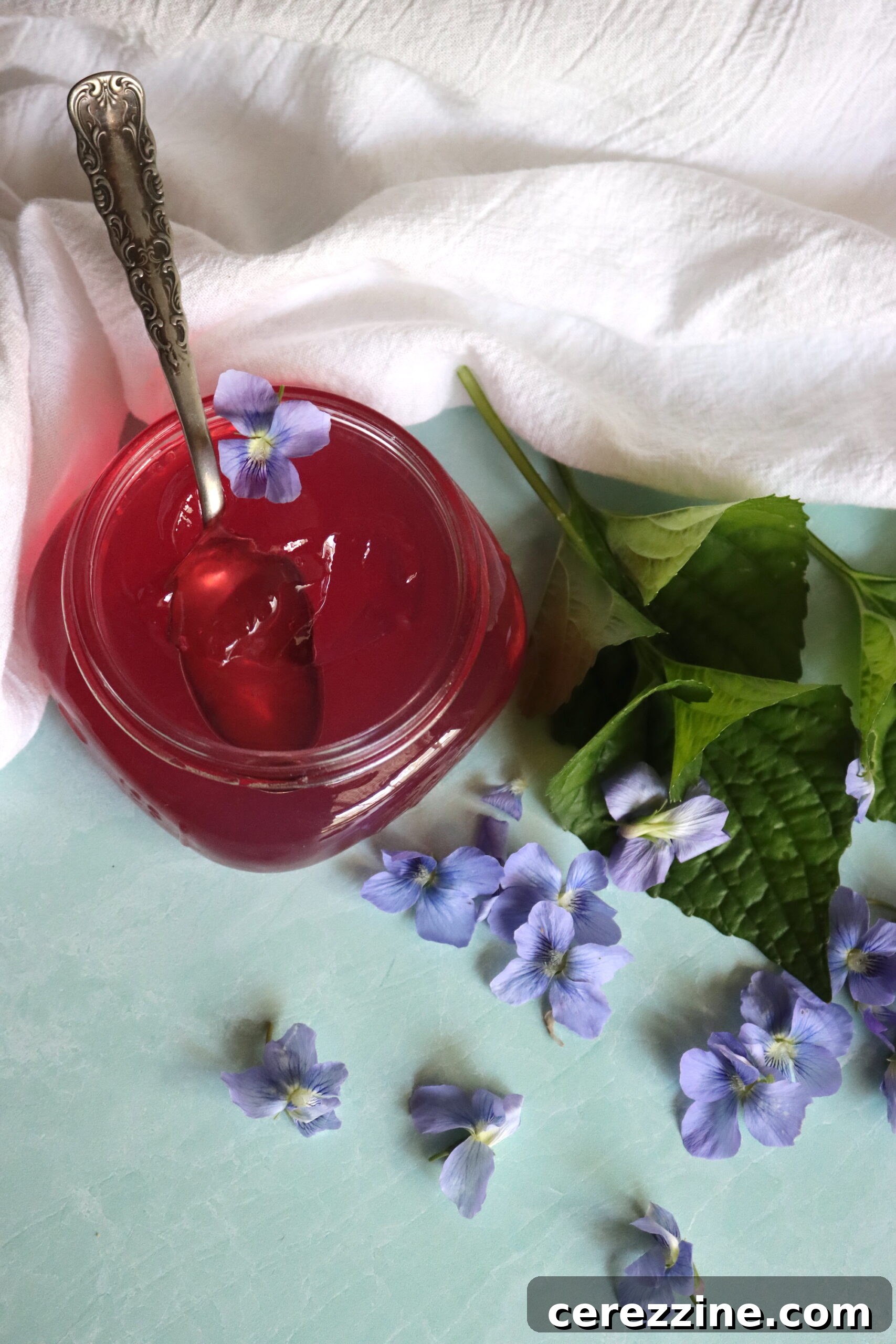
Harvesting Wild Violets for Your Jelly
The first and most delightful step in preparing violet jelly is, of course, gathering the beautiful violets themselves. If you are fortunate enough to have them flourishing in your yard, you’re already off to a fantastic start. Wild violets thrive in cool, shady, and moist environments, typically found nestled along the edges of lawns, beneath trees, or on the cooler, northern side of structures.
When picking the blossoms, exercise caution and discernment. Select only vibrant flowers that are free from any pesticides, environmental pollution, or other chemical contaminants. For this jelly recipe, only the flower heads are required, so there’s no need to gather stems or leaves. Depending on your geographical location and climate, violets generally grace us with their blooms from early spring through to early summer, making this the perfect seasonal window to create this unique preserve, often just before the main fruit harvest begins.
(If wild violets are elusive in your area, don’t despair! Other edible viola species, such as charming cultivated pansies or the cheerful johnny-jump-ups, can be used as a lovely alternative to achieve a similar floral jelly.)
You will need approximately 2 cups of violet flowers for one batch of jelly. Given their small and delicate nature, gathering this quantity might take a little time, but it can be a wonderfully calming and enjoyable activity, particularly for eager young helpers. I’ve discovered that harvesting them directly into a quart jar—filling it about halfway—is an efficient method, saving you the extra step of transferring them from a basket or bowl later.
Creating the Magical Violet Tea Base
Once your beautiful violet flowers are harvested, the next exciting phase is to infuse them into a delicate violet tea. Simply pour 4 cups of freshly boiled water directly over the collected flowers. Allow this fragrant mixture to steep undisturbed for about 15 to 20 minutes. Initially, you’ll notice the tea takes on an intriguing greenish or turquoise hue—this is entirely normal and part of the charm; rest assured, it won’t retain this color.
After the steeping process is complete, carefully strain out all the flower petals, leaving you with a clear, exquisitely colored liquid. This vibrant infusion is the nascent stage of your violet jelly. The subsequent step involves adding lemon juice, which not only brightens the flavor but also plays a pivotal, almost magical, role in the gelling process. The acidity of the lemon juice is what activates the pectin, and more dramatically, transforms the tea’s color from its original blue-green to a breathtaking, luminous pink.
This color shift is truly one of the most captivating aspects of making violet jelly. As the lemon juice is introduced, the tea’s hue changes before your very eyes, morphing from an initial blue-green to a stunning pinkish-purple shade. It feels like a small, delightful magic trick unfolding right in your kitchen, a perfect demonstration of how natural compounds within the violets react with acid to reveal their hidden vibrant pigments.
This fascinating chemical reaction also helps to explain why violet jelly often surprises people with its distinct berry-like flavor. The same natural compounds responsible for the violets’ beautiful color are also present in many popular berries, such as blueberries and blackberries. When the acid is added, it enhances and brings forth these sweet, fruity, berry-like flavors in the jelly. You’ll often find that homemade violet jelly tastes less intensely floral and far more fruity than anticipated—a truly delightful surprise for anyone expecting a taste akin to perfume!
(A crucial reminder: the lemon juice is not merely for aesthetics and flavor enhancement. It is absolutely essential for the safe preservation of your jelly. Do not omit the lemon juice; it is a non-negotiable ingredient for safe water bath canning of flower jellies.)
Crafting Your Perfect Violet Jelly
With your beautifully colored, vibrant pink violet tea (infused with lemon juice or citric acid) now ready, it’s time to bring your jelly to life. The process for making violet jelly closely follows the general method for preparing any floral jelly, ensuring a delightful and consistent result.
Begin by adding your chosen powdered pectin to the fragrant violet tea in a large saucepan. Stir thoroughly to dissolve the pectin, then bring the mixture to a vigorous, rolling boil that cannot be stirred down. It’s important to resist adding the sugar at this initial stage; doing so prematurely can hinder the pectin from activating correctly, potentially preventing your jelly from setting properly. Once the pectin has fully dissolved and the mixture has maintained a hard boil for a full minute, it’s finally time to incorporate the sugar.
Upon the addition of sugar, the mixture will begin to visibly thicken. Continue to boil the jelly vigorously for another full minute, ensuring all the sugar has dissolved and the pectin is fully activated. At this point, your jelly should be on its way to achieving the perfect set. The ideal consistency for violet jelly is one that is thick enough to cling to a spoon, yet smooth and spreadable, making it perfect for generously coating your favorite toast or scones.
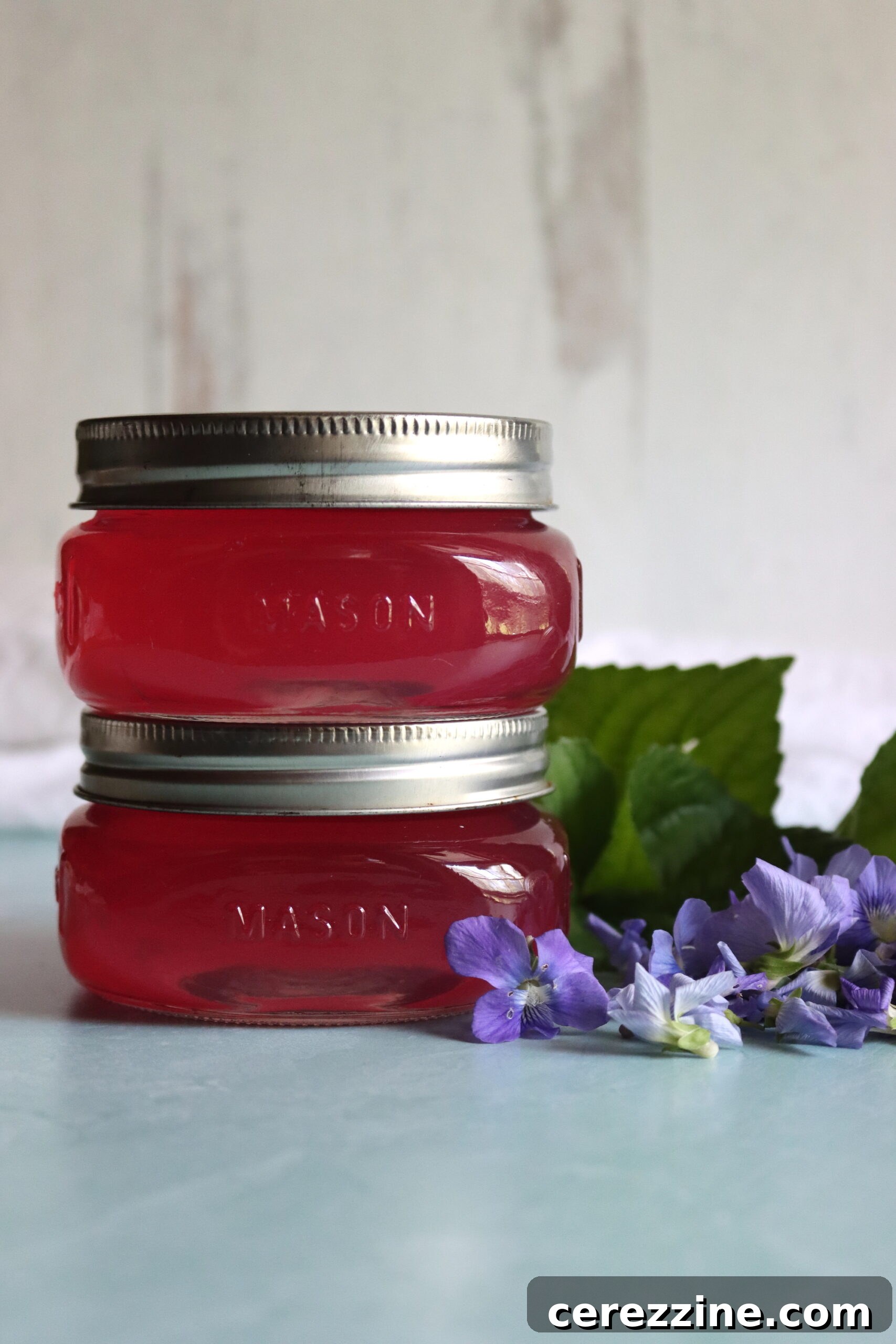
Preserving Your Violet Jelly Through Canning
Once your exquisite violet jelly has reached the desired consistency, you have two options for storage. If you anticipate consuming it within a few weeks, it can be safely stored in the refrigerator. However, for the enduring pleasure of enjoying this taste of spring throughout the entire year, water bath canning is the recommended method for preservation. This ensures shelf-stability and allows you to savor homemade violet jelly long after the wild violets have faded.
To embark on the canning process, you will need a reliable water bath canner. Begin by sterilizing your canning jars and their two-part lids (lids and bands). Carefully ladle the hot, prepared jelly into the sterilized jars, ensuring you leave precisely 1/4 inch of headspace at the top. This crucial headspace allows for proper sealing and vacuum formation. After filling, meticulously wipe the rims of the jars clean to remove any jelly residue that could interfere with the seal. Securely fasten the two-part canning lids onto the jars.
Place the filled and sealed jars into your water bath canner, ensuring they are fully submerged in boiling water. Process the jars for approximately 10 minutes. If you reside at an elevation above 6,000 feet, extend the processing time to 15 minutes to account for lower boiling points. For those new to the world of home canning, rest assured that water bath canning is a relatively straightforward and safe preservation technique when proper guidelines are followed. The boiling water bath creates a vacuum seal, making the jelly shelf-stable for many months.
Upon completion of the processing time, carefully remove the hot jars from the canner using a jar lifter and place them on a clean, towel-lined counter to cool undisturbed. As the jars cool, you’ll typically begin to hear satisfying “pop” sounds, which signify that the lids have successfully sealed, indicating your violet jelly is perfectly preserved and ready to enjoy at your leisure. Store your sealed jars in a cool, dark place for optimal flavor and longevity, typically up to a year.
If you tried this Violet Jelly Recipe, or any other recipe on Creative Canning, leave a ⭐ star rating and let me know what you think in the 📝 comments below!
And make sure you stay in touch with me by following on social media!
More Enchanting Floral Jelly Recipes
Your Guide to Making Flower Jelly (with 20+ Recipes!)
Delicious Redbud Jelly & Syrup
Fragrant Rose Petal Jelly
Violet Jelly Recipe
Rate This Recipe
Print Recipe
Equipment You’ll Need
-
Water Bath Canner
-
Canning Funnel
-
Jar Lifter
-
Half Pint Jars
-
Regular Mouth Canning Lids
Ingredients
- 2 cups wild violet flowers, loosely packed and pesticide-free
- 4 cups water
- 1/4 cup bottled lemon juice, or 1/2 teaspoon citric acid powder
- 1 Box powdered pectin, (1.75 oz, such as Sure-Jell or similar brand)
- 4 cups granulated sugar, (can be less with low-sugar pectin, see notes)
Step-by-Step Instructions
-
Harvest 2 cups of clean wild violet flowers, ensuring they are free from pesticides. If using a quart-sized mason jar for collection, fill it approximately halfway.
-
Pour 4 cups of boiling water over the harvested violet flowers in a heatproof container. Allow the mixture to steep for 15-20 minutes. Observe as the tea initially turns a greenish or turquoise color.
-
Stir in 1/4 cup of bottled lemon juice (or 1/2 teaspoon citric acid) into the steeped violet tea. Witness the magical transformation as the color vividly changes from blue-green to a beautiful pink.
-
Strain out all the flower petals from the tea, then pour the infused liquid into a large saucepan. Add the powdered pectin and bring the mixture to a hard, rolling boil. Boil for 1 full minute, stirring constantly.
-
Carefully stir in 4 cups of granulated sugar. Bring the mixture back to a hard boil and continue to boil for 1 more minute, stirring until the jelly begins to thicken to your desired consistency.
-
To test the jelly’s set, place a small spoonful on a chilled plate. If the surface wrinkles when gently pushed with your finger, the jelly is ready to be jarred.
-
Ladle the hot jelly into clean, sterilized jars, ensuring a 1/4 inch headspace remains. Use a clean cloth to wipe the rims of the jars thoroughly.
-
Seal the jars with two-part canning lids (flats and bands). Process the jars in a boiling water bath canner for 10 minutes (adjust to 15 minutes if you are at an elevation above 6,000 feet). If not canning for shelf-stability, store the jelly in the refrigerator for up to 3 weeks.
-
After processing, remove the jars from the canner and allow them to cool completely on a towel-lined counter without disturbing them. You will hear the lids “pop” as they seal. Once cooled and sealed, store the jars in a cool, dark place for up to one year.
Helpful Notes for Perfect Jelly
Pomona’s Pectin is another fantastic low-sugar option, though it operates a bit differently. With Pomona’s, you can use anywhere from 1/4 cup to 3 cups of sugar, and it also allows for the substitution of honey or various sugar alternatives if desired. If you choose to use Pomona’s pectin, always adhere to the specific instructions provided on its packaging, often drawing parallels with their mint jelly recipe.
While generally not recommended due to the high sugar requirement, if you prefer to use liquid pectin, you will need a substantial 7 cups of sugar for every 4 cups of violet tea. After boiling the tea and sugar together to dissolve, you then add the liquid pectin and bring the mixture back to a boil to ensure the jelly sets. Be aware that liquid pectin is typically not ideal for crafting low-sugar recipes, as it relies on a higher sugar concentration to achieve the correct texture.
Nutritional Information
Nutrition information is automatically calculated and should only be used as an approximation.
Enjoyed this recipe? Share your thoughts below!Your feedback helps fellow home canners!
Explore More Delightful Flower Jelly Recipes
Expand your repertoire of homemade preserves and stock your pantry with these equally delicious floral jellies, perfect for adding a touch of elegance to any meal!
- Fragrant Rose Petal Jelly
- Sweet Elderflower Jelly
- Spicy Nasturtium Jelly
- Charming Pansy Jelly
Discover Unique Herbal Jellies
Beyond beautiful blossoms, many herbs from the garden also lend themselves to making wonderfully flavorful and aromatic jellies!
- Versatile Savory Herbal Jelly
- Soothing Lemon Balm Jelly
- Calming Chamomile Jelly
- Bright Calendula Jelly (Marigold Jelly)
- Sweet Clover Jelly